Britain's hokey cokey economic cluster
I spoke about the risks to the Oxford Cambridge corridor at the Transport Select Committee in June
As a project of national significance, the Oxford–Cambridge corridor has been in, out, in and out of fashion as successive governments have changed.
George Osborne's National Infrastructure Commission championed it as the "Arc" in 2017. Theresa May's government backed a million new homes along it. Then it drifted: the spatial framework was quietly shelved in 2022, and for a while the whole idea seemed to have been filed under "things the last lot believed in."
Today it is firmly back in fashion, sponsored by Lord Vallance, the science minister better known to most of us from the Covid briefings.
The idea is to create a new global economic cluster.
It's a thoroughly good idea.
And it's probably about to fail.
What's a cluster?
The purpose of a city is to connect lots of people to lots of opportunities. The ideal city has lots of skilled jobs and lots of people who can do those jobs. By having plenty of both, a giant sorting process can take place. People with the aptitude to become scientists can work in a lab, those who are good at legal work can become lawyers and those who can code can join a startup.
Preferably, there are plenty of each kind of job, so that people can have the confidence that they can switch between employers.
This is why big cities generally do better than small ones, unless, as in Switzerland, the Netherlands or western Germany, the small cities are well enough connected to develop the characteristics of a larger one.
It is this dynamic the Oxford–Cambridge corridor seeks to replicate.
The potential
The potential is so great because Oxford, Cambridge and Milton Keynes are all fast-growing places with rapidly developing science and start-up sectors.
What they don't have is enough people, or enough houses.
If places could be found to build lots of new homes, you could start to see some of the economic effects more typically associated with bigger cities: high productivity, fast growth and dynamism.
But for this to be possible, people need to be able to travel easily around the corridor. Otherwise they won’t be able to reach the jobs.
The railway
During a previous period of the corridor's favour, it was decided to rebuild the Oxford–Cambridge railway as East West Rail. That creates a spine of connectivity for the corridor.
But the railway isn't enough.
And the reason creates a catch-22.
Let me explain using two different scenarios for how the railway stations are built.
Scenario 1 is the Car Park scenario.
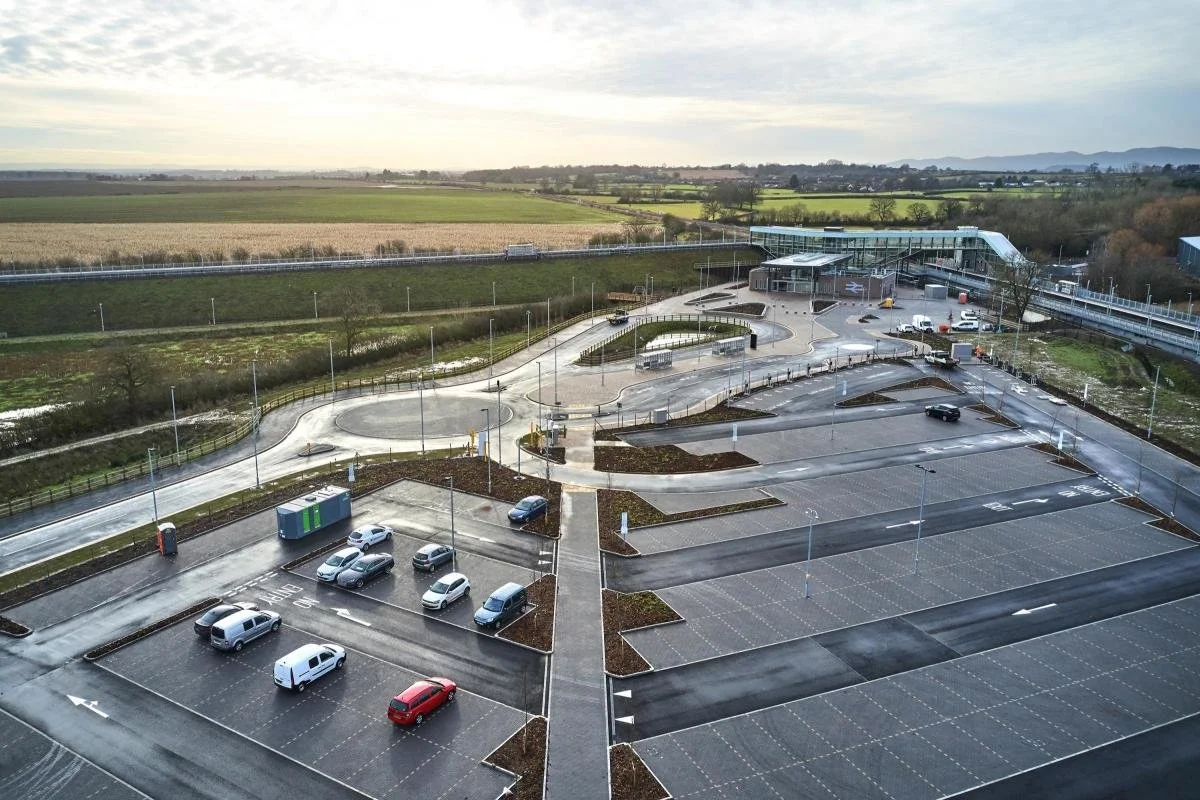
Worcestershire Parkway is a good example of a Car Park station
In this scenario, each station is surrounded by a giant car park. That means virtually no one lives close to the station, because the places close to the station are a giant car park, so everyone needs to drive to the station. That in turn means each home needs three or so parking spaces, because both adults will probably be driving, as might a teenage child. Each new community along the railway therefore gets built to a density of perhaps 20 homes per hectare. The largest settlement along the railway, the 1,200-hectare new town at Tempsford, would then end up with a bit over 20,000 new homes.
Replicated along the whole railway, you end up with a total number of new homes far below the maximum potential, significantly undermining the ability of the new cluster to develop.
So let's look at Scenario 2.
This is the High Street scenario.
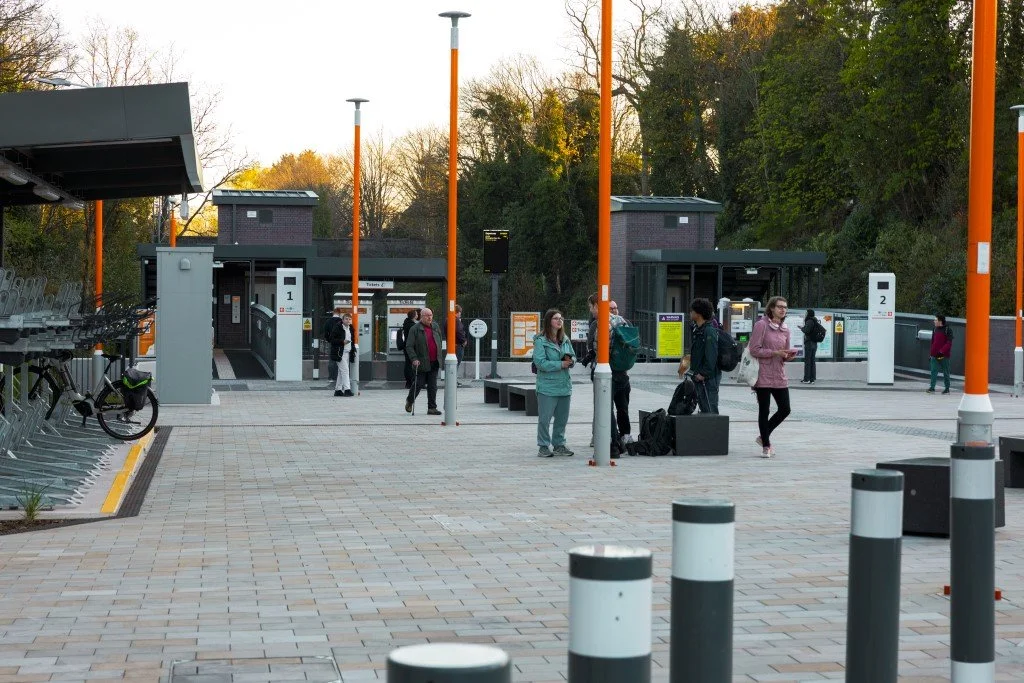
Moseley Village is a good example of a “High Street” style station.
In this scenario the stations are built rather like the way suburban tube stations once were: on a new parade of shops, served by buses. The space around the station is used for housing rather than parking. Because there is nowhere to park at the station, people either walk from the nearby homes or arrive by frequent, high-quality bus from the more distant ones. With just one parking space per home for the family car, you can achieve more like 60 homes per hectare. That is the absolute lowest of the range of densities used for new housing in London, which typically runs from 60 homes per hectare up to 400.
The High Street scenario therefore enables around three times as many homes as the Car Park scenario, significantly boosting the economic vibrancy of the corridor.
But here is the rub.
It will only work if the frequent, high-quality bus services I mentioned are not just provided but guaranteed to be provided, because the housing developer needs the confidence to build homes with less parking. They will need that public transport provision written in blood before they do it.
And they’re not going to get it.
Another Select Committee clip: why integrated transport is hard. These issues won’t get fixed here without someone fixing them.
It's the governance, stupid
The problem is that our Shire county governance model is not built to provide a guaranteed bus.
You might think this is a question of powers, and that the powers are now sorted. Since December 2025 every local transport authority in England has been able to franchise its buses, specifying the routes, frequencies and fares it wants and contracting operators to deliver them. On paper, a shire county could now do exactly what a developer needs: commit to a service and hold it in place.
But a power is not the same as a guarantee, and this is where the problem stops being about legislation and starts being genuinely hard.
A franchised network on the scale the corridor needs has to be paid for, and the revenue funding for rural bus services is precarious in a way that capital funding for a railway is not. It has to be specified, procured and managed by people with skills most Shire counties have never had to build, because for forty years the private market did that job for them. It has to be held stable across a planning horizon measured in decades, while the authorities responsible are reorganised, merged and re-bounded, and while their revenue budgets are fought over line by line every single year. It has to survive the awkward geography of the corridor itself, which crosses several authorities, none of which has an incentive to underwrite a service that mostly benefits the others. And it has to find a local authority (or series of local authorities) willing to take on the financial risk of the regional bus network at a time when local authorities can’t fund adequate social care.
So when a developer decides today whether to build at 60 homes per hectare or 20, they are being asked to bet that a bus will be running reliably in fifteen years and still running in fifty, guaranteed by a body that may not exist in its current form by then and which can’t afford it.
Faced with that, the rational developer builds the car park, because the car park is something nobody can take away.
That is the challenge.
The dense, productive corridor depends on a guaranteed bus. The guaranteed bus depends on an authority willing and able to underwrite it for the long term, across boundaries and across budget cycles. And the authorities along the route are, as currently constituted, the ones least able to do so.
There are several ways through, and none of them is simple:
As discussed, the counties could use their new franchising powers. The powers already sit with the body that also controls planning and roads, which is an advantage. But that does nothing about the money, the missing capability, or the instability that makes the long-term promise hard to believe, so on its own it is unlikely to give a developer the confidence required.
The corridor could be given its own transport body, an Arc-wide authority built to think in the timescales the railway and the new towns actually run on. That could deliver permanence and focus. But it means primary legislation, a fresh argument about boundaries and accountability and a new institution that the existing authorities will have reason to resist, none of which is quick.
A new Development Corporation could be set up for the Arc, which can take on franchising powers. There are advantages to this beyond transport but it’s neither simple nor cheap. The costs are swamped by the benefits of making this corridor actually fulfil its potential, but the country doesn’t seem to be in a short-term-pain-for-long-term-gain kind of place right now.
Or central government could tie its money to the outcome, releasing funding only where a guaranteed bus is part of the deal and underwriting the revenue so the guarantee does not evaporate when a council's budget tightens. That works with the structures we already have. But it asks the Treasury to commit to decades of revenue spending, which is precisely the commitment the Treasury is built to avoid.
In practice the answer is likely to be some combination of all three, assembled deliberately rather than arrived at by accident, and that combination will not fall into place by itself. It needs someone with the authority and the will to hold these moving parts together long enough to give developers a promise they can actually believe. That is a leadership problem as much as a governance one, and it is the part nobody has yet taken on. Lord Vallance isn’t really talking about transport beyond the railway - as always, integrated transport risks falling through the gap.
I say no-one: one person really is thinking about this; the person who highlighted the problem to me. Naomi Green leads the local sub-national transport body, England’s Economic Heartland. You can hear her explaining the scale of the problem to me on this episode of the podcast. She has also set up an Integrated Transport Taskforce for the Oxford-Cambridge corridor, which I’m part of.
The problem is that this needs central Government leadership to cut through the governance challenge.
let’s not miss this
The Oxford–Cambridge corridor is a genuinely global-scale opportunity; the kind that comes round perhaps once in a generation. We already have the three cities, the science, the start-ups and now the railway to connect them. We will not get another spine like East West Rail built through this kind of landscape of opportunity in our lifetimes, or our childrens’. The choice between a corridor of 20,000-home + car parks and a corridor of dense, productive, well-connected towns is being made right now, in the planning decisions being taken this year. The opportunity will not stay open for long.
What stands between us and the prize is not a single missing decision. It is a genuinely difficult knot of funding, capability, institutional design and competing geography, and untangling it will take sustained political leadership of a kind this corridor has not yet had.
This is a huge potential opportunity for Andy Burnham to demonstrate Manchesterism on a national scale. There is a worry that Manchesterism means that Burnham is going to be the Prime Minister of Manchester; basically using the rest of the United Kingdom as a kind of colony to attempt to enrich the North.
I don’t think that’s likely, not least because colonial projects tend not to work out so well if you let the natives vote. Instead, I think Manchesterism means the approach he adopted in Manchester of using public investment and leadership to turbocharge private sector investment. One of the most important building blocks of Manchesterism was not playing one part of the region off against each other. Far more investment went into Salford than Rochdale, but that’s OK because you have to go where the opportunities are.
The Oxford Cambridge corridor isn’t in the North. It’s in the South. It’ll either be a success in the South or a failure in the South. If it’s a failure in the South, the only impact on the North will be lower tax revenues to the Exchequer. So best for everyone that we make it a success.
So this is a plea to the people who can still shape it. Lord Vallance, the corridor's sponsoring minister, the leaders of the authorities along the route, Andy Burnham: the railway is being done. The work that actually determines whether this becomes a cluster is the slow, unglamorous business of constructing a bus guarantee that a developer can believe in, out of institutions that were not designed to give one.
Do that work, in whatever combination of the routes above you choose, and the corridor becomes what it could be. Leave it undone, and Britain's great new economic opportunity will end up as three cities, a railway and a very large amount of tarmac.