Why Revenue is the right Target for the railway
Last week, I wrote about how punctuality is not a great proxy for customer experience - at least based on my own family’s experiences of the school holidays.
As a reminder, this graph shows the correlation between punctuality and the stressfulness of the journey. There is a relationship, but it’s not a perfect one.
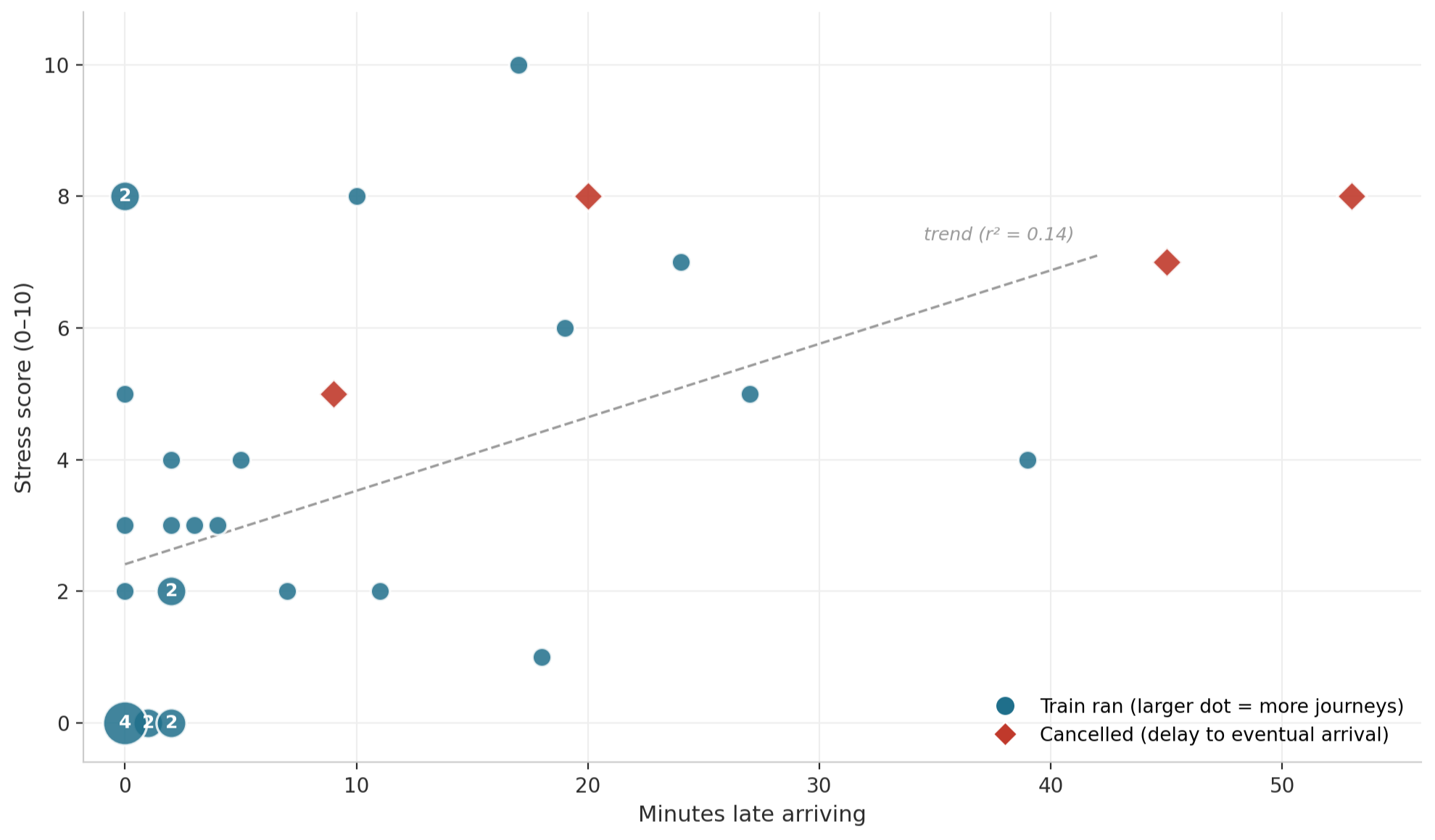
This matters because the rail sector is hard wired to focus on punctuality above all else. If punctuality only explains a quarter of the stress experienced by customers (which, based on my family’s summer, it does) then what explains the rest?
And what do you need to focus on to fix it?
Well, I’ll start by saying that the focus on punctuality is actually right and should continue. Anyone who’s travelled in Germany recently, as I have, can experience a railway that seems to have just given up on running trains on time. My former colleague Marc Bichtemann, who runs a railway there, told me how much Germany would benefit from the UK’s performance culture.
So the focus on punctuality should remain, but it needs to be in the service of a wider target - something that captures the other three quarters of the causes of stress.
That one thing is… revenue.
So many of the things that caused my family’s stress (and made many journeys actively miserable this summer) are invisible to someone managing using a punctuality target alone. Or, to be completely accurate, most of them would be eliminated if every single train was perfectly punctual but given that there are always going to be delays, there’s got to be a way of incentivising the industry that doesn’t just capture the movement of trains but also captures the false cancellation emails, the silence at Euston, the crowds abandoned at Ramsgate, etc etc (reminder of the full story here).
The reason why a revenue target achieves this is because a stressed customer doesn’t come back. Unless they’re me, of course. But the number of times I’ve had to persuade my wife to stick with the railway, despite it being her strong preference! Most normal people have options. They can go by car or coach or plane or - above all - simply not make the journey. A railway that feels itself accountable for revenue is automatically accountable for every cause of stress, because customers react to each one.
Alex Hynes has been doing a great job in the last year pointing out that a nationalised railway will be an unusual public service as it will have the potential of generating its own revenue, and not being dependent on the taxpayer. He’s spot-on. But there’s a wider benefit. The act of trying to generate revenue is also a way of focusing on customer needs.
What about C-Sat?
Now, you may be asking, if we want better customer experience, why not gear the entire industry around customer satisfaction?
There are a number of reasons, but the most basic is that we don’t measure it frequently or widely enough.
If every interaction was star-rated, this can be fantastically motivational. I know because I’ve run a business that worked on this basis. I’ve written about it here. If GBR could work like that, then it would be great. And maybe it can in a decade or two, but it’s not going to be in place anytime soon. By contrast, revenue is collected every second and there are systems in place to measure and apportion it. So it can actually be used to drive both incentives and behaviours.
Revenue also has the advantage that it creates its own business case. Customer satisfaction can easily be seen as a cost, whereas focusing on revenue creates the potential for a virtuous circle.
To be clear, the case for revenue isn't that it's a better metric than customer satisfaction. It's that it's a better mission: a question everyone in the organisation is answering, all the time, and being measured on. Let me show you what that looks like in practice.
How can it work?
How would a train company that was genuinely focused on revenue work? Well, I’m lucky enough not only to have worked for one but also been part of a team that thought properly about how it worked in practice.
The company was Chiltern Railways. We had some of the highest punctuality and highest customer satisfaction in the rail sector, but the driving force of the company was delighting customers and generating revenue.
And, helpfully, we actually wrote down how we did it.
Do you remember how, just over ten years ago, there was a spasm of getting European Foundation for Quality Management (EFQM) accreditation in the rail industry? It was believed that DfT took it into account when awarding franchise agreements, so suddenly everyone needed to get accredited - and to get five stars.
It was actually a very useful exercise.
EFQM isn’t like ISO accreditations: it doesnn’t give you a template to work to. It’s simply a question of documenting how your organisation works.
What is it you’re trying to achieve?
What do you do to achieve it?
But within that apparent simplicity is a lot of hard work in actually figuring out the answers. Even in an organisation that’s succesfully doing the doing, it can sometimes be hard to step back and understand precisely how.
EFQM forced us to do it, and it was a very useful exercise.
At the heart of our “processes” section was this diagram on how Chiltern Railways worked:
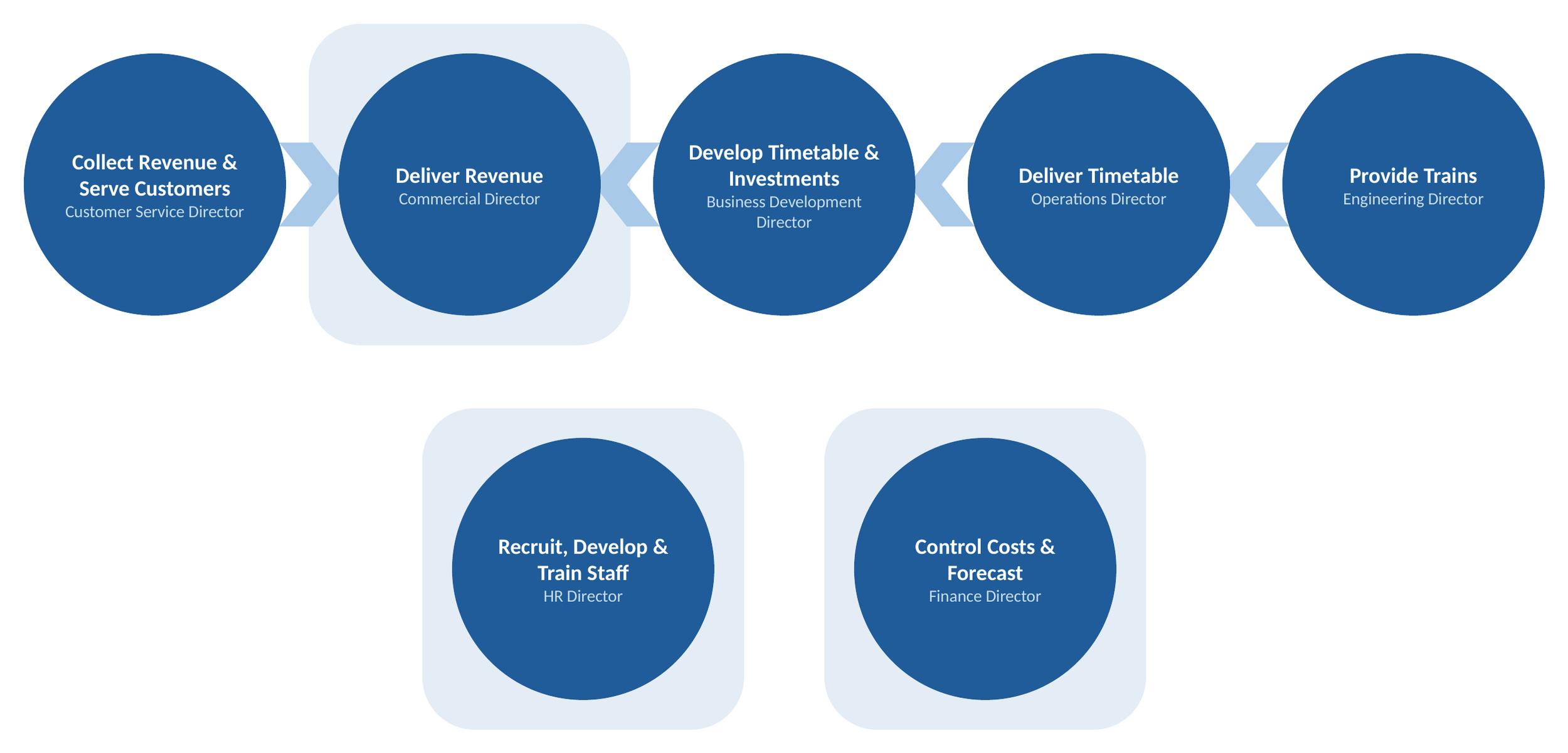
As you can see, the Commercial Director was at the very centre. That was me.
But - and this is key - that didn’t mean I was in charge; this diagram was about the flow of responsibility.
I was responsible for the revenue line. But so was everyone else.
The Customer Service Director was responsible for delighting customers and collecting revenue, in service of that revenue goal.
The Business Development Director was responsible for making investments and setting a timetable, in service of that revenue goal.
These two people were, therefore, my key colleagues: as I would “define” the timetable, sales channel and customer service propositions that I believed we needed to deliver the target, and then we’d have a thoroughly enjoyable debate about what was actually possible in reality - given they had the human resource and cost targets that I didn’t. In one sense, the creative tensions in our professional relationships were key drivers of our success.
But even that doesn’t quite explain it right, as the tension was only between the fact that they had responsibilities I did not. But it wasn’t like we were trying to achieve different things: they felt as responsible for revenue as I did.
Then, on the right-hand side of this diagram, the chain of creative tensions continued.
The BD director’s timetable (which he set in creative tension with me) he also set in creative tension with the Ops Director, who actually had to deliver the thing. I’d want more trains, faster trains and the correct allocation of the right types of carriages onto the right service specs. The Ops Director knew his job was to do what I wanted but only as far as it was deliverable. The BD Director had to satisfy himself that the timetable was satisfying me as much as was possible, while still being deliverable.
The Ops Director, meanwhile, was having a similar relationship with the Engineering Director (who is shown on this diagram) and with Network Rail (who is not - but would be, if this diagram was being drawn in a GBR context).
So it’s not that we didn’t care about punctuality - we did. Hugely. The Ops Director’s responsibility was to deliver the timetable, and that meant the trains must run on time. It’s just that punctuality wasn’t at the core; revenue was.
HR and Finance were there to support all of us.
The reason why the arrows point inwards towards me / revenue is because everyone was working together to achieve that goal. And that’s genuinely how it felt.
One of the joys of revenue as a central organising mission is that it incentivises everyone to look under every stone for the things that might be getting in the way. If we’re losing customers because of poor information, it’s not a standalone goody-two-shoes effort to improve customer information - it’s core to the mission of the organisation. Same with so many of the customer experience features that can otherwise be seen as standalone projects.
The Chiltern Railways service was good for the same reason the Pret service is good: because our organising mission was to get customers to buy from us.
In the seven years I was there, we increased revenue from £100 million to £200 million. In the process, we retained industry-leading punctuality and customer satisfaction. Focusing on revenue didn’t distract us from punctuality and customer satisfaction - it created the incentive to focus on them.
Checks and balances
I’m not suggesting this diagram could necessarily be lifted and shifted into the world of GBR.
But I am suggesting that revenue could be made a core goal of GBR.
But for this to work, there need to be some checks and balances.
Fares
The first is around pricing. We inhabited a world of fares regulation, so I couldn’t simply achieve my revenue goals by putting the prices up. We really need a new fares regime for GBR. I am very worried that we are throwing the baby out with the bathwater in moving away from the privatised system of fares regulation. I wrote about that here.
The people who should most want clear rules are the future managers of GBR. Otherwise, they’re going to find themselves forced to hold down fares by politicians, which will starve their service of investment (which is what’s happened in London - TfL’s not even got close to its asset renewals targets for a single year Sadiq Kahn has been Mayor. It’s going to have devastating consequences for the next generation of commuters, but not for Sadiq - I’ve written about this issue in more detail previously here)
A sensible set of rules can then liberate those managers to chase revenue, secure in the knowledge that social goals are protected.
Devolution
Revenue is a great goal for a railway as the cost base is largely fixed. Therefore, every additional ticket sold is additional revenue. Nevertheless, it’s also obviously true that a ticket from Newcastle Central to London is worth more than a ticket from Newcastle Central to the Metro Centre.
That’s why it’s absolutely critical that GBR is both a commercial entity seeking to maximise revenue, and a supplier of services to Combined Authorities and Strategic Authorities. The obvious way to maintain the revenue incentive but without losing focus on the smaller flows is to recreate something very like the Section 20 mechanism that existed pre-privatisation, which allowed Passenger Transport Executives to take revenue risk for local services. This excellent paper describes how it worked.
What needs to change?
This requires a very different culture from the one we’re used to. Being focused on revenue means the whole organisation focused on revenue. There’s a reason, in the diagram above, that the MD of Chiltern Railways wasn’t shown. That’s because his focus was on setting the culture that made this all possible.
These will be some signs that this culture is starting to work:
1) We’ll see (far!) fewer ‘do not travel’ advisories.
It’s become alarmingly common for train companies to react to a severe operational crisis by asking customers to go away. In the seven years I was at Chiltern Railways we never once did that.
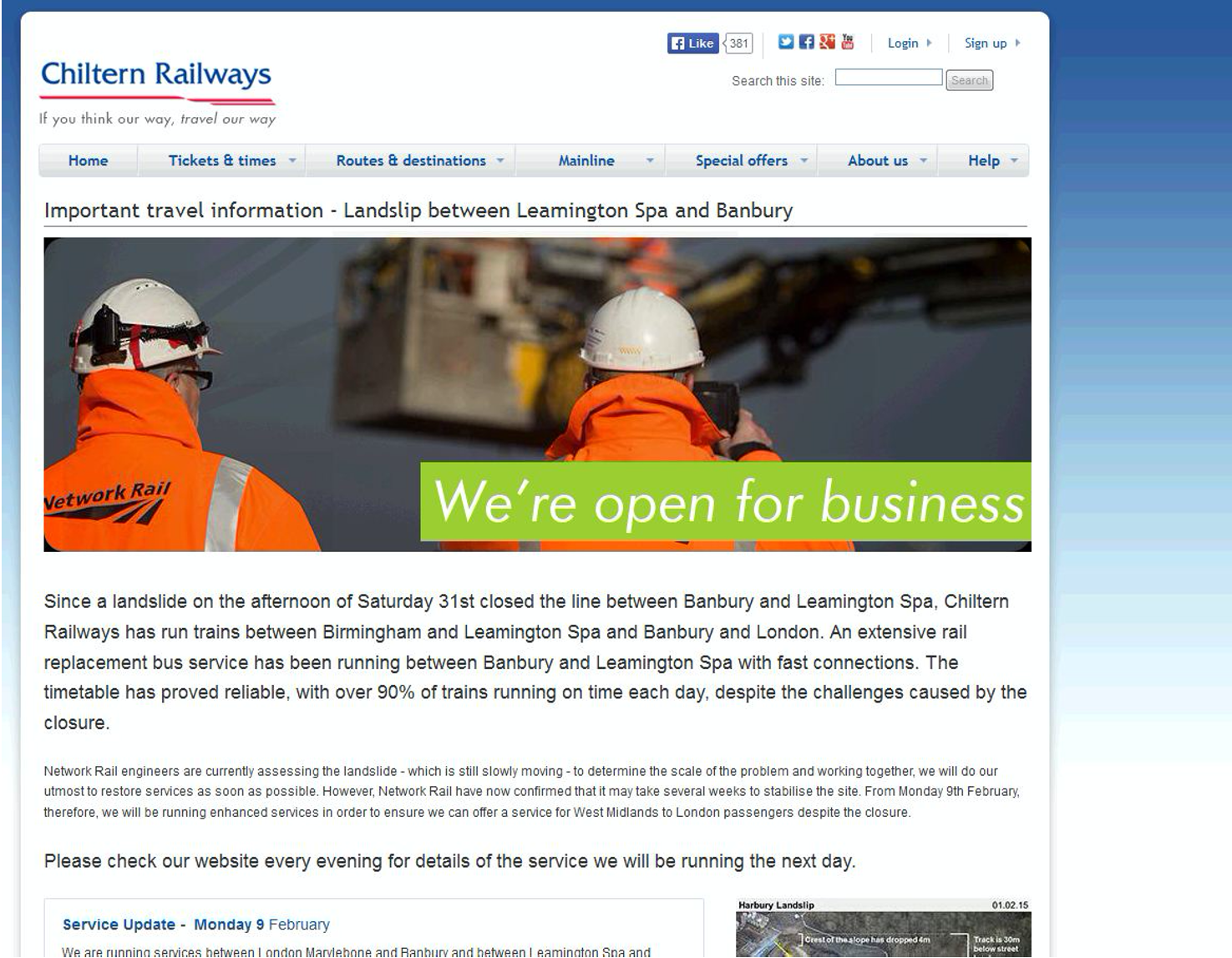
Even when a landslide completely blocked the mainline at Harbury, near Leamington Spa, (one of the places on the route where there is no diversionary option), not only did we not send customers away but we did our absolute best to encourage them. We marketed the rail replacement service as a “step straight on” service, making sure there was always a coach waiting at the door at all times. We had staff checking each coach, and sending scuzzy ones back to teh operators. We gave each customer a goody bag as they boarded the coach as an apology. The goody bag included a chocolate brownie. Not a shitty corporate chocolate brownie; an artisnal nice one from an actual bakery.
Was it my idea, as commercial director, to buy artisinal brownies? Of course not. That’s what happens when everyone in the company knows that it’s their job to make sure we maximise revenue.
You can read more on our response to the Harbury landslide here. And if this is a topic that interests you, I recommend you do.
2) We’ll see much faster decisions.
Customers don’t move at our pace, they move at theirs. So if we’re doing things to attract customers, we need to be working at their pace and in their way.
In my post last week, I highlighted that we seem to have developed a habit of emailing customers to tell them their train is cancelled when it’s simply not serving the stop they booked (but, very possibly, is serving another stop in the same town).
I don’t know how long we’ve been doing that for, but my guess is that fixing it is delayed in a tangle of contracts - if anyone’s fixing it at all.
In a railway focused on revenue, you can’t hang around like that. We’re literally emailing customers and telling them not to travel on trains that are running!
3) Customer-facing problems will just get fixed
Most of us who travel by train know the constant run of petty frustrations experienced by users, because the systems train operators, managers and staff operate to have been designed around contracts and compliance, not around customers.
Once the whole industry is recalibrated to a goal that we need to sell as much as possible, everyone will understand that it’s their job to fix the things that make this harder. In the diagram above, everyone in the organisation is responsible for revenue.
This series of two posts started by asking the question how to achieve the Secretary of State’s goal for GBR to offer a better service to customers.
Perversely, the best way to achieve this public service goal is for it to act - in places - more like a private business.