
Punctuality is not a good proxy for rail passenger experience
When trying to offer a better passenger experience, the rail industry is programmed to focus on punctuality.
But my family’s experiences over the summer show a poor correlation between trains on time and stress-free journeys.
“A better passenger experience”.
These are the words that the Secretary of State has repeatedly used to describe what she wants from nationalisation, so it’s also an instruction to the rail industry to make it so.
Given the culture of the rail industry, for a lot of railway managers, that will translate to “Make the trains run on time.”
But is punctuality actually the right measure for a better passenger experience? And, if not, what is?
In this week’s post, I’ll illustrate why it’s not. Next week, I’ll say what is. And, despite the excellent work done by Transport Focus, I don’t mean Customer Satisfaction.
To illustrate why punctuality is not the perfect proxy for a better passenger experience, allow me to talk you through every journey taken by a family over the summer holidays.
That family is mine, and we made a mixture of business and leisure trips across the UK. For each journey, I’ll tell you how punctual it was, and give you a ‘stress score’ out of 10. The stress score is subjective, but I’ll explain my logic as we go. For punctuality, I’ll give the number of minutes late the train we were booked on arrived at our destination station. For trains that were cancelled, I’ll list how many minutes late we arrived in brackets.
For clarity, this shows every train journey made by members of my immediate family or me during the school holiday. If it looks like I’ve only chosen the bad ones, it’s because there were very few good ones.
I realise we travel more than most families, but it’s representative of what life looks like for a family trying to live car-free and make the most of seeing family and getting away. Which is, I think, what we want more people to feel able to do.
Helen’s Leisure Trips with the Girls.
The first weekend of the school holidays started with Helen taking the girls to Manchester to see family.
On Friday 24 July they went from London Euston to Manchester Piccadilly. The 1233 train left on time, very crowded because the previous one had been cancelled. They were told they would be diverted via Birmingham, but not told what that meant for arrival time. Then they were later told that they wouldn't be diverted, but were 39 minutes late arriving anyway. The fact it boarded and left on time and the fact they had seat reservations meant it wasn’t too stressful. It was probably more stressful for my sister in law attempting to work out when to collect them at Piccadilly. Delay: 39. Stress Score: 4
On Saturday 25 July they attempted to go from Walkden to Salford Central, a short local journey in Greater Manchester. The 1042 train was cancelled at last minute and despite being a suburban line, these trains only run every thirty mins. Last minute scrambling for a lift. Thankfully Helen’s brother answered his phone and was able to drive them into town, otherwise they would have missed the event they were going to. Delay: Cancelled (20). Stress Score: 8
On Tuesday 28 July They returned from Liverpool South Parkway to London Euston (having been given a lift from Manchester to Liverpool). Helen checked on the Trainline app that afternoon and it showed the train 1454 from Liverpool South Parkway to London was on time. Except that later she got an email that it was cancelled. She decided to get the earlier train, and went to Lime Street so she could be on that start, given that she no longer had reservations. The ticket inspector questioned why they were on the wrong train and Helen explained. He didn't believe her until she showed him the email from Trainline as he said to his knowledge, Avanti trains were all running.
On investigation for this blog post, I discovered that the ticket inspector was right. The email saying that the train was cancelled was bollocks. Avanti had simply put a Pendolino onto the train which doesn’t fit the platforms at South Parkway. But the email didn’t say that: it said cancelled. So Helen and my girls had a stressful journey for nothing, when they could have simply got on at Runcorn (which is almost as easy to reach from her parents’ house).Delay: 24. Stress Score: 7
The next day, Wednesday 29 July, they went camping in Sussex. The 1059 journey from London Victoria to Haywards Heath was smooth and stress-free. Delay: 1. Stress Score: 0.
On Friday 31 July, they came back from Haywards Heath to London Victoria. They got on the train at Haywards Heath at 1347 and waited in the station for a while. Then they left but shortly afterwards, there was an announcement that due to trespassers on line at Clapham Junction, the train would be terminating at Gatwick. So they got off at Gatwick already 26 minutes late. All trains to Victoria were cancelled. After half an hour or so got on a train going to St Pancras. Delay: 26, then cancelled (45). Stress Score: 7
Then, towards the end of the holidays, Helen took just Sophia back up to Liverpool to see her parents again.
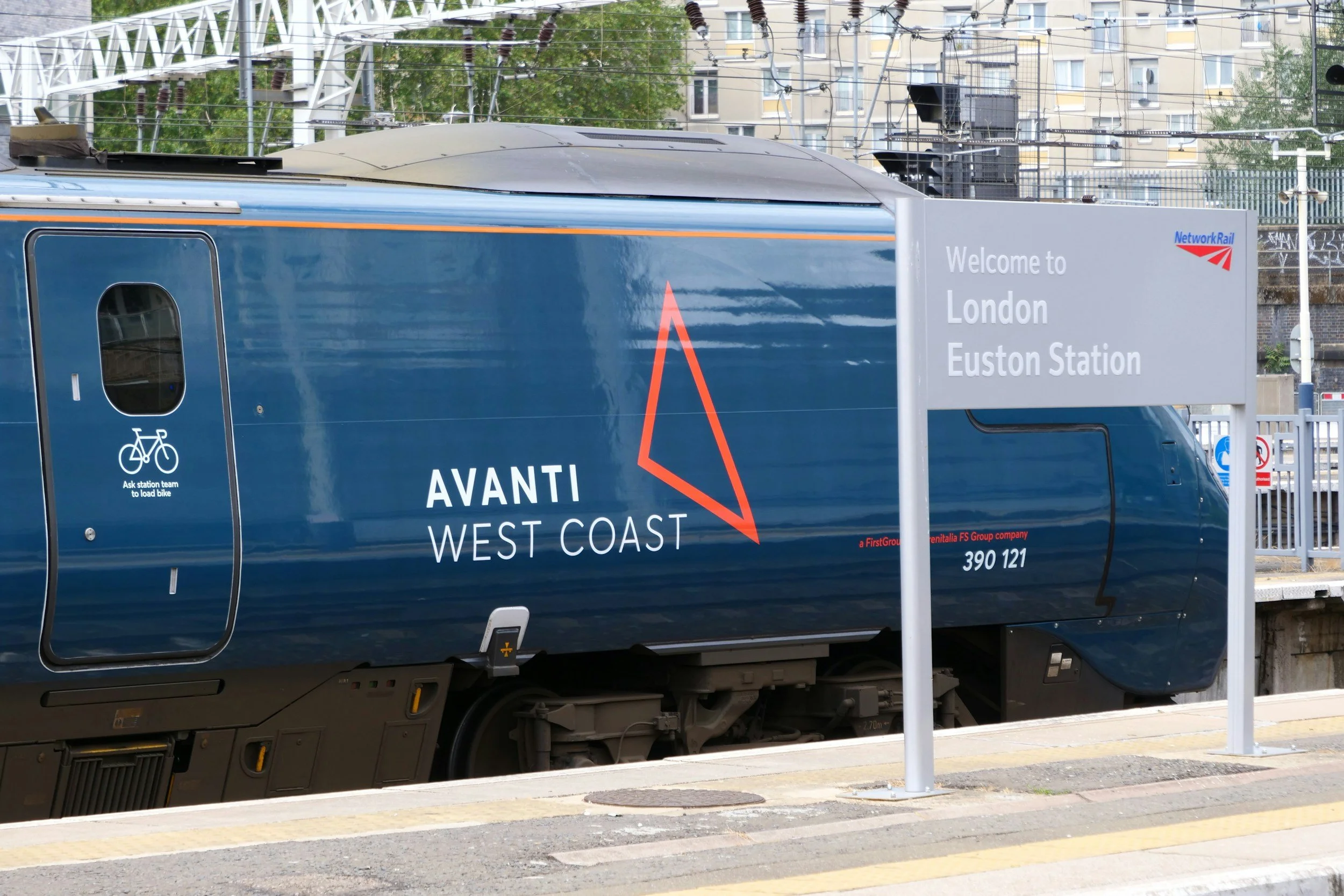
They were booked on 1243 on Tuesday 25 August on the 1243 from London Euston to Liverpool South Parkway. That morning, Helen got an email saying the train was cancelled. It’s pretty clear that it’s cancelled. Except that, thanks to my research for this article, I now know that this is nonsense. It means Avanti have put a Pendolino onto the train and can’t stop at South Parkway. So they ignored the cancellation email and got picked up at Runcorn. But that’s not what most passengers would do and it’s still very stressful being told your train is cancelled, having frenetic WhatsApp conversations with your transport expert husband and being convinced that you can just turn up for a train you’ve been officially told isn’t running. The system can’t work on the basis of customers needing to ignore what they’re officially told in order for journeys to work. Delay: Train: 0, though no stop at South Parkway. Stress score: 5.
I’m glad to report, however, that the journey back from Liverpool South Parkway to London Euston on Thursday 27 August actually worked (first of the three attempted this summer that did!). The 1155 ran fine. Delay: 0. Stress score: 0.
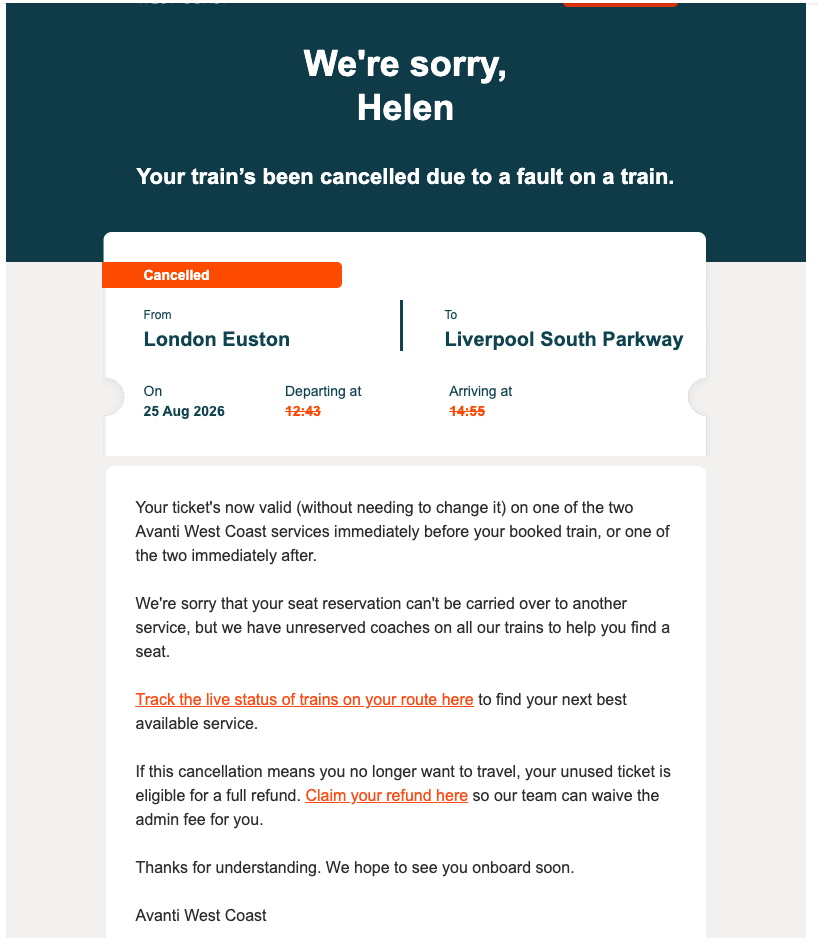
One of three phantom cancellations we encountered this summer. This train did run, albeit without a stop at South Parkway. But it’s much easier to be picked up at Runcorn than get a different train.
Thomas’s Week One Business Trips
The first week of the school holidays was dominated by business trips by me.
On Monday 27 July, I got the 1933 London Euston to Manchester Piccadilly. The train left Euston late and there was absolutely no information at all, so we didn’t dare leave the concourse. That was a shame, as the concourse was horrifically hot. Standing drenched in sweat watching a “Delayed” notice with no announcements is utterly miserable. Not for the first time, I felt myself regretting just how often I choose to travel to visit my clients in person. Also felt bad for the UK economy, because if I think that, so will others. The train was actually only moderately late but the terrible experience at Euston made the journey utterly miserable. Delay: 27. Stress Score: 5.
The next day, Tuesday 28 July, I got the train from Manchester Piccadilly to Sheffield. Boarding at platform 13 at Piccadilly was as stressful as it always is, but no worse. There were plenty of seats on the Transpennine Express train, though it was somewhat stressful waiting as it’s not a route I know well, so I didn’t know if there would be. Enjoyed travelling through the Hope Valley. Delay: 0.Stress score: 3
On Wednesday 29 July, it was Sheffield to Birmingham New Street. The 1724 train left on time, though got progressively later as the journey went on. However, I was onboard by then, so it didn’t really matter. I’d booked a cheap first class ticket, which was good as the standard class catering wasn’t available. Delay: 11. Stress score: 2.
My final trip of the week on Thursday 30 July was Birmingham New Street to London Euston. I was booked on the 1717 train. It left on time, and arrived 18 minutes late. Delay: 18. Stress score: 1.
To and from Folkestone
We spent the core of August in Folkestone where our family has a flat. We had a Spanish family staying in our home in Walthamstow. So we did a bit of shuttling between London and Folkestone.
On Monday 3 August, Helen and Anna went from London St Pancras to Folkestone Central on the 1204. It ran four to six minutes late throughout. That could be worse, but the late arrival into St Pancras makes the boarding process a bit stressful. Delay: 4. Stress score: 3.
On Thursday 6 August, Helen brought Anna to London for the Penzance trip described below. She went from Folkestone Central to London St Pancras on the 1056 (Delay: 2, Stress score: 0) and back on the 1807 (Delay: 0, Stress score: 0).
On Monday 10 August, Helen needed to attend a hospital appointment in East London so got the 0956 from Folkestone Central to Stratford International. This is where the interaction between the NHS and the fares system wasn’t helpful. The only appointment time was the one they’d given her but to get the first off-peak train meant that it had to be precisely on time for it to work. It wasn’t - it was five minutes late, so she needed to get a black cab from Stratford to make her appointment. Still worked out cheaper than getting the preceding peak time train but the just-in-time nature made it more stressful than it would otherwise have been. Delay: 5. Stress score: 4
She returned on the 1714. Going from Stratford International to Folkestone Central in the peak is never stress-free because the train can arrive full, with commuters from London standing. But that’s less of a worry in August. Delay: 2. Stress score: 2
The same day, I brought Sophia down for us to join them from St Pancras International to Folkestone Central. We had been on holiday together and were coming back on a delayed Eurostar, so missed our planned connection. We ended up getting the 2207, which left eight minutes late and arrived seven minutes late. Given how late it was, keeping a tired child awake on the platform added to the stress levels a bit, but it wasn’t too bad. Delay: 7. Stress score: 2.
Helen and Anna returned to from Folkestone on Sunday 23 August at 1756. The train journey was fine, though Sunday nights on that line are always stressful because so many people travel back from the seaside that you can never be sure of a seat. That’s always more stressful when travelling with Anna because, being disabled, she really needs one. Delay: 2. Stress score: 4.
Sophia and I came back a few days later on Tuesday 25 August at 0956. Again, fine. Again, slightly stressful as it’s the first off-peak train, so is always somewhat stressful. Delay: 3. Stress score: 3
To and from Penzance
On Thursday 6 August, Anna went on her annual trip to see her Granny from London Paddington to Penzance. Anna is seventeen but she’s visually impaired and autistic, and finds travelling by train independently extremely difficult. Helen put her on the train at Paddington and my mum met her on the platform at Penzance, but we prayed nothing went wrong.
We’d got seat reservations lined up and Helen got to Paddington on time for the 1503 train. The train was shown on the board terminating at Plymouth. Helen went and asked a member of staff who said casually, “Yeah, it’s terminating at Plymouth. You can change there.”
That might be easy for some people: for a disabled girl travelling alone, it’s literally impossible. Anna had a panic attack.
Thank God, a member of staff (Niki) was absolutely brilliant and took charge of the situation. He stamped her Advance ticket for the next train at 1603. Anna calmed down and Helen got on with her to make sure she got a seat.
In researching for this post, I discovered that this was all unnecessary, as the 1503 train did, in fact, run through to Penzance. Delay: 17. Stress score: 10.
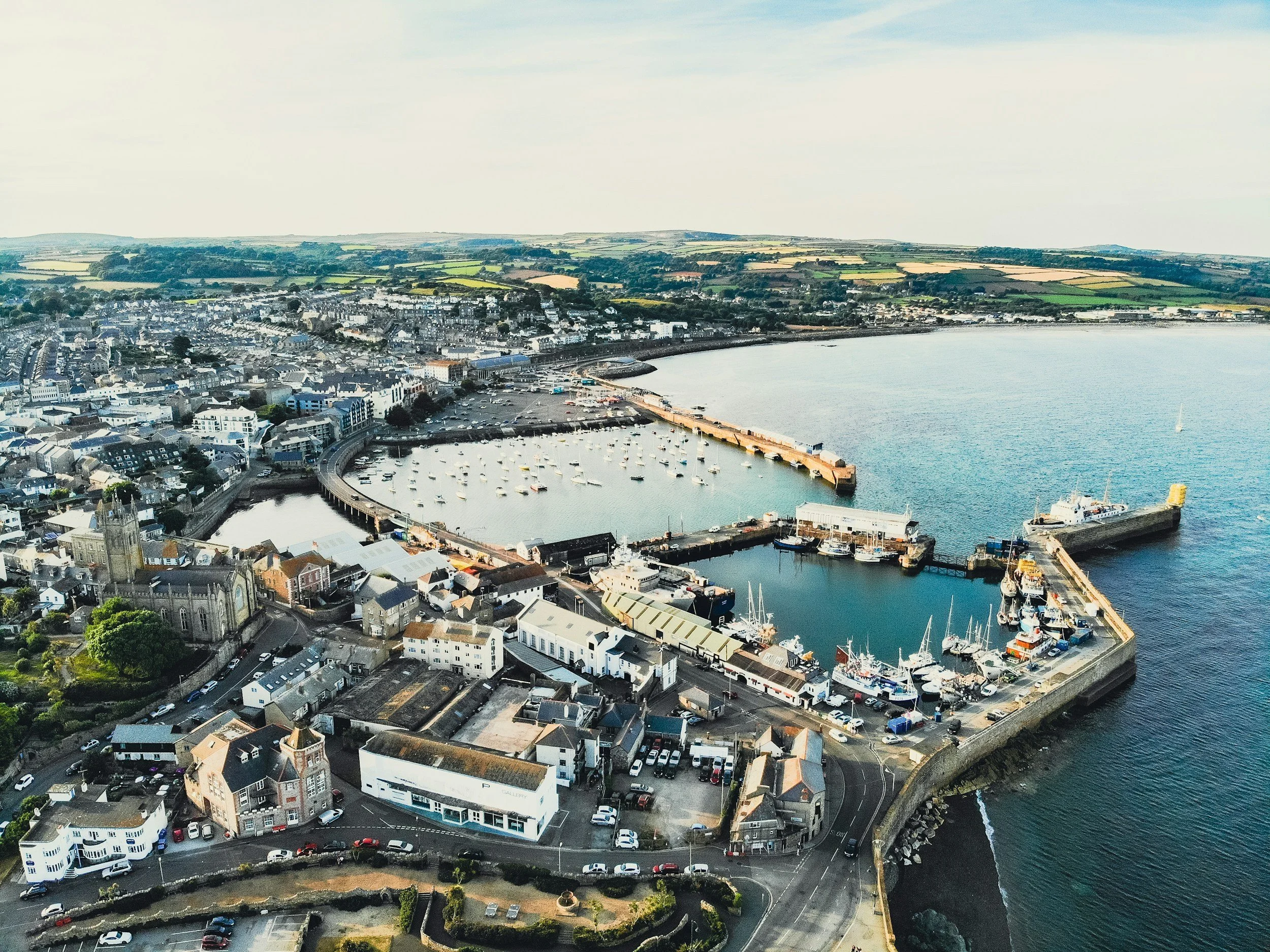
Penzance: the 1503 train was going here, even though my family were told it was not
The return journey on Monday 10 August from Penzance to London Paddington at 1020 ran 19 minutes late. But that wasn’t why it was stressful. It was stressful because it was massively crowded. It was too crowded for Anna to be able to reach the loo, which isn’t much fun on a five-hour journey. The guard kept announcing (in a slightly accusatory tone) that there’s another train behind and you can get off and travel on that if you don’t want to be on such a crowded train. But she never explained whether Advance tickets would be valid on that train (which it’s reasonable to assume most passengers, including Anna, will have on a long-distance leisure train); no one did. Delay: 19. Stress score: 6
The Kent Day Trips
On Tuesday 4 August, Helen took the girls from Folkestone to Broadstairs. This is a very easy hour-long journey with a simple cross-platform connection at Ramsgate. Except when it isn’t…
The 1105 Folkestone Central to Ramsgate left five minutes late and arrived 10 minutes late. This meant it arrived just as the connecting train left. There was no information, despite lots of people clearly all making the same connection. (Delay: 10. Stress score: 8)They figured out that there would be another train to Broadstairs 20 mins later, the 1221. It arrived late. As they were about to board, platform staff announced that the train would NOT be stopping as scheduled at Broadstairs, Margate or Herne Bay but would go fast to Faversham. This left most of the passengers on the platform as everyone wanted to go to the seaside on a hot sunny day in the school holidays! Again, no info was given about alternatives. Delay: Train: 0, though no stop at Broadstairs. Stress score: 8
Eventually, they got to go from Ramsgate to Broadstairs on the 1302. This ran on time but, of course, for Helen and the girls was part of the same extremely stressful and difficult journey. Delay: 0. Stress score: 8
I find this journey particularly interesting as, if you look at the numbers, you have one train that ran ten minutes late and another that ran on time. Hardly even worth noticing. But on the ground, crowds of holiday-makers felt stressed and abandoned.
Their return journeys on the 1633 Broadstairs to Ramsgate (Delay: 0. Stress score: 2) and 1646 Ramsgate to Folkestone Central (Delay: 2, Stress Score: 2) all went like clockwork, though their stress levels were elevated as a result of the morning’s experience.
Even though three of the four trains they actually travelled on that day were on time, their experience of the railway that day was extremely poor.
On Monday 17 August, we had another go. This time we went out to Margate. First we got the 1002 from Folkestone Central to Ramsgate (Delay: 1. Stress score: 0) and then experienced the cross-platform interchange that’s meant to happen onto the 1100 Ramsgate to Margate (Delay: 0. Stress score: 0).
The journey back was interesting, though. We came back from Ramsgate which has a station a good mile from the town centre. The station at the Harbour was closed pre-war and the tunnel to reach it turned into an air-raid shelter. Three consecutive buses were either delayed or cancelled, which caused us to miss two consecutive trains. So it’s no fault of the railway that our stress levels were elevated but, equally, it’s a fact that customers’ journeys don’t start and end with the train journey. We eventually made it onto the 1907 Ramsgate to Folkestone Central (Delay: 2. Stress score: 3).
Return To Oxford
The other day trip of the summer holidays was me alone, and it was for work. I needed to go to a meeting in Oxford on Wednesday 12 August.
I got the 0728 from Folkestone Central to London St Pancras, which was very simple and smooth. Delay: 2, Stress score: 0.
Then I was planning on getting the 0923 London Paddington to Oxford but when I checked, it was cancelled. Thankfully I checked early enough to divert to Marylebone for the 0906. This ran on time but, based on Chiltern Railways new policy of randomly assigning the trains with tables and plug points (sorry - a bit of personal legacy from me here: we put a lot of effort to making sure that the Oxford and Birmingham trains always had tables and plugs, and I’m sorry that this has been lost), my train had neither tables or plugs and I’d been planning on working. I still had to work, so I had a rather hunched journey. Delay: Cancelled (9). Stress score: 5.
For the return journey from Oxford to London Paddington, I was planning on getting the 1501 but, yes, it was cancelled. So I got the 1519 to Marylebone instead. This train was only 5 minutes late but was one of the most stressful journeys of the summer. As the train continued, it got hotter and hotter and hotter until it genuinely started to become hard to breathe. I’ve never felt like I was somewhere where heat could be a safety risk before, but this was one such moment. Delay: Cancelled (53). Stress score: 8.
Finally, I got the 2207 from London St Pancras to Folkestone Central. This train was on time and smooth. Delay: 0. Stress score: 0.
How was Our Summer?
As a family, we attempted to get 33 trains.
Of these, 29 ran and 4 were cancelled.
Of the 29 that ran, nine were on time and 11 ran within a minute late. 20 were within five minutes. Just eight journeys were 10+ minutes late. The average lateness of the trains that ran was just 6.8 minutes and the median just two minutes.
Looked at through a punctuality lens, we had a pretty good summer.
Yet I’m sure you’ll agree with me, having read the experiences, that it didn’t feel like that.
Just eight of the journeys were stress-free; fewer than one in four.
Only four were both punctual and stress-free.
12 journeys were highly stressful (a stress score of five or above).
The average stress was 3.6 across all journeys, though 7.0 for those that were cancelled. (Cancelling trains is really stressful!).
This graph shows the relationship between punctuality and stress for my family’s journey. If punctuality was a good way of measuring “a better passenger experience” (as requested by the Secretary of State) then these dots would form a neat line from bottom left to top right. Do they?
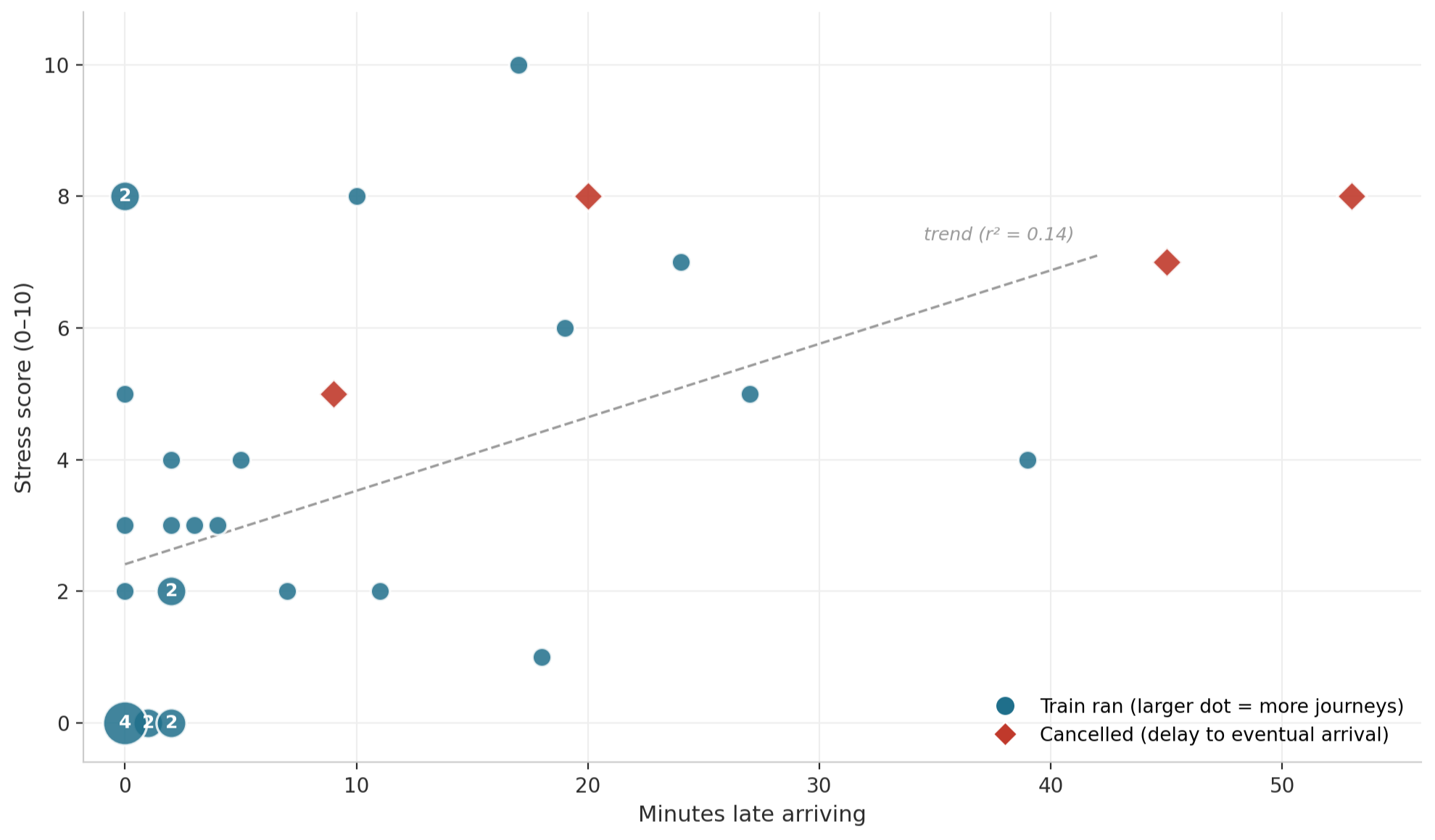
Well, there’s a correlation - but it’s not a strong one.
Delay explains only about a quarter of the variation in my family’s stress level when travelling by train, and much of even that comes from the four trains that were cancelled outright.
Among the trains that actually ran, minutes of lateness explained barely a seventh of how stressful the journey was.
The biggest delay of the summer (39 minutes) scored just 4 for stress; the highest stress of the summer (10) was a train that ran well. At the extremes, they barely correlate at all.
Lessons to learn
Well, you might - reasonably - say there are no lessons to learn as my family is one family, and probably atypical. That’s not an unreasonable point: I doubt most families travelled on 33 trains over the summer holidays. But even if we travelled more than most (and largely to places our family live), I suspect our experiences aren’t totally atypical.
One thing that I’d love to know is whether my family’s experience with phantom cancellations is typical of a wider issue. Over the summer, my family was told by the railway seven times that our train was cancelled. Of these, three were trains that actually ran - two missing a single stop, one running its full route exactly as booked. The missed stop at Liverpool South Parkway may be interpreted by railway systems as a ‘cancellation’, but it’s not what a passenger means - as they could simply get on at a different stop in Liverpool. How often is this happening?
The second thing is hardly a new discovery - the biggest issues were all caused by a consistent theme: inadequate or wrong information. It wasn’t the delays that caused the stress, it was no announcements at Euston, no connection information at Ramsgate, false cancellation emails and announcements that turned out to be wrong.
But the most important lesson is that if we attempt to deliver a better passenger experience by focusing solely on punctuality, we’re going to fail.
I’ll come back to that next week.