How to make a Mini Switzerland: your cut out ’n’ keep guide
Last month’s news that DfT and East Midlands County Combined Authority (EMCCA) have jointly committed funds and resources to make Mini Switzerland in the Hope Valley happen is fantastic. I’m beyond thrilled. Last month was alsothe one-year anniversary of my LinkedIn post that kick-started the whole thing.
But we don’t want Mini Switzerland in the Peak District to be a one-off curiosity; we want it to be the first of many, each giving us new lessons and expanding the footprint of genuine public transport access.
So how do you go about making a Mini Switzerland?
(For a reminder of what Mini Switzerland is, click here)
The British Problem
Well, first we need to understand the problem that we’re solving.
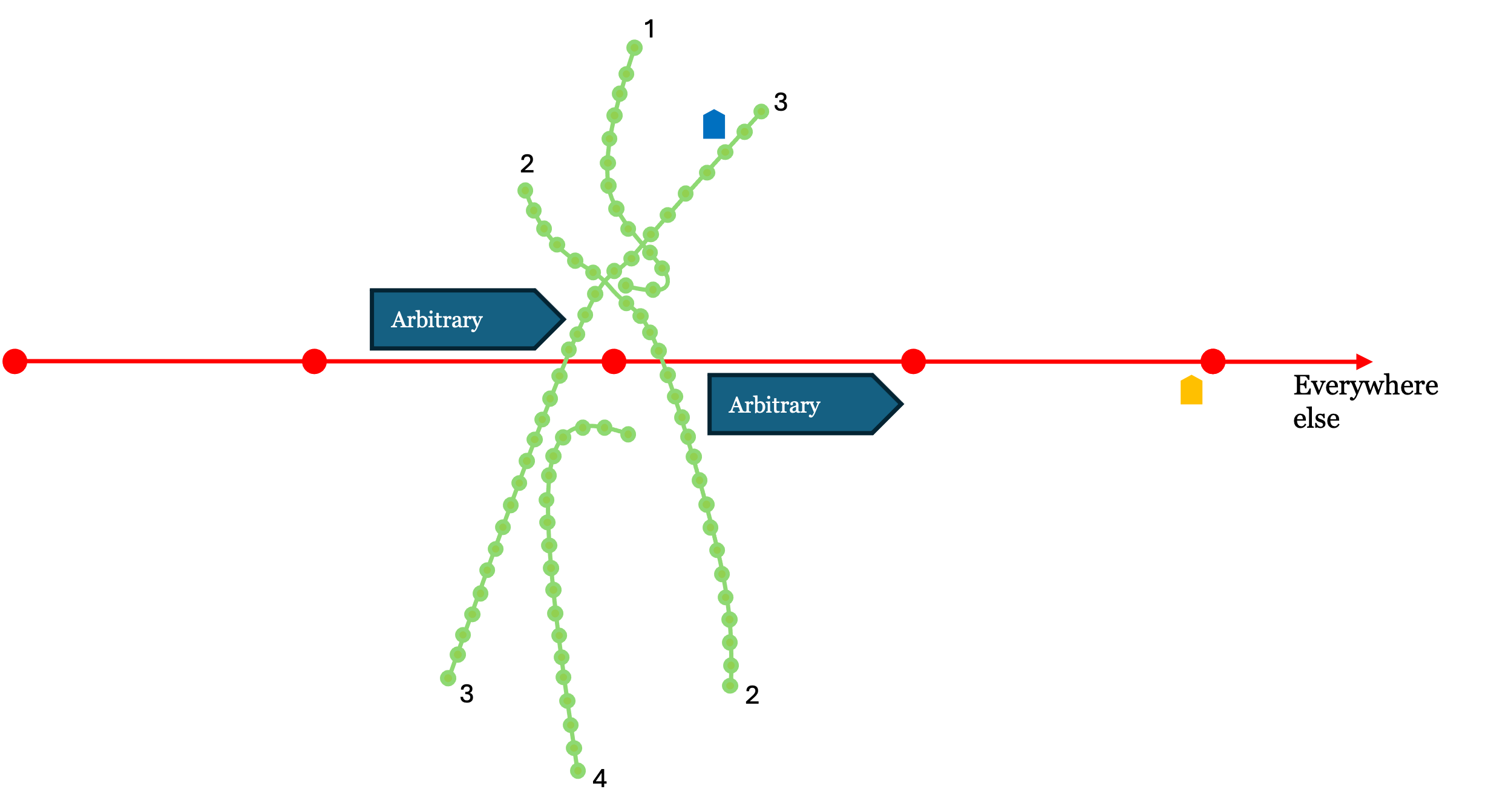
The map below shows how transport works in a typical British rural town. There are some bus services but they often don’t serve the stations and certainly don’t meet the trains. As a result, if you live in the house marked in blue (top right-hand corner), the only places you can access are those served by route 3, which passes your home. This is inadequate.
This map shows the same town but as a Mini Switzerland.
All the bus routes now serve the station.
All of the buses (and the train) arrive at the station at roughly the same time, and leave at roughly the same time.
This repeats every hour.
As a result, the person in the blue house can - with one simple interchange at the station - reach any of the bus stops in their local area, and any of the stations served by the train.
And they can do this every hour. This is an excellent level of public transport access.
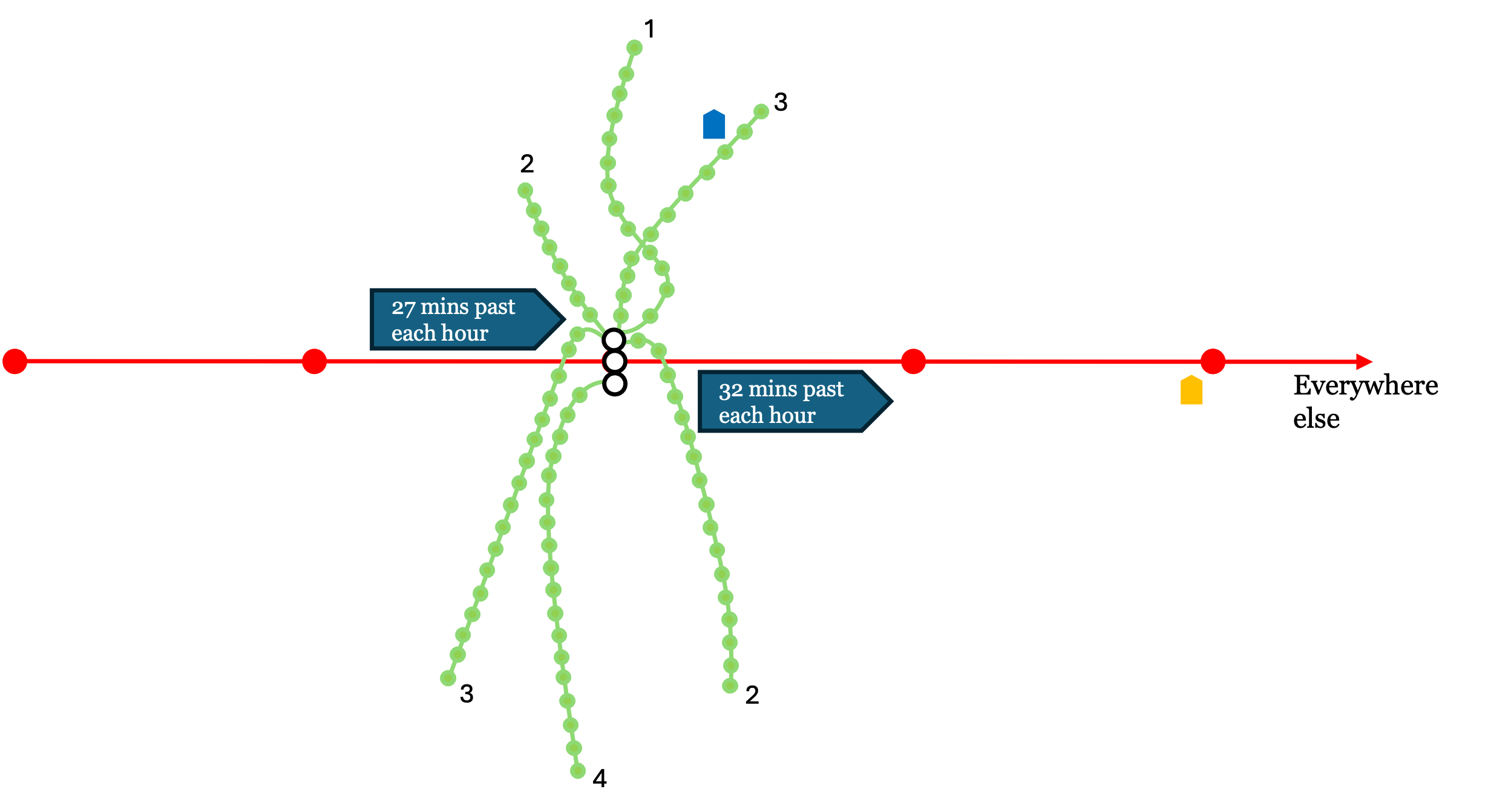
The role of a Mini Switzerland is to get us from the top map to the bottom.
How did we get here?
The root cause of our problem is that we plan our bus and rail networks in isolation and design them for optimal efficiency.
The top diagram below shows a typical bus route. Each diagonal line represents a bus. As you can see, each bus starts at A and travels to F. At F it turns around and returns to A. The route is designed to keep each bus moving for as much of the day as possible. If you’re the bus firm manager, this makes total sense.
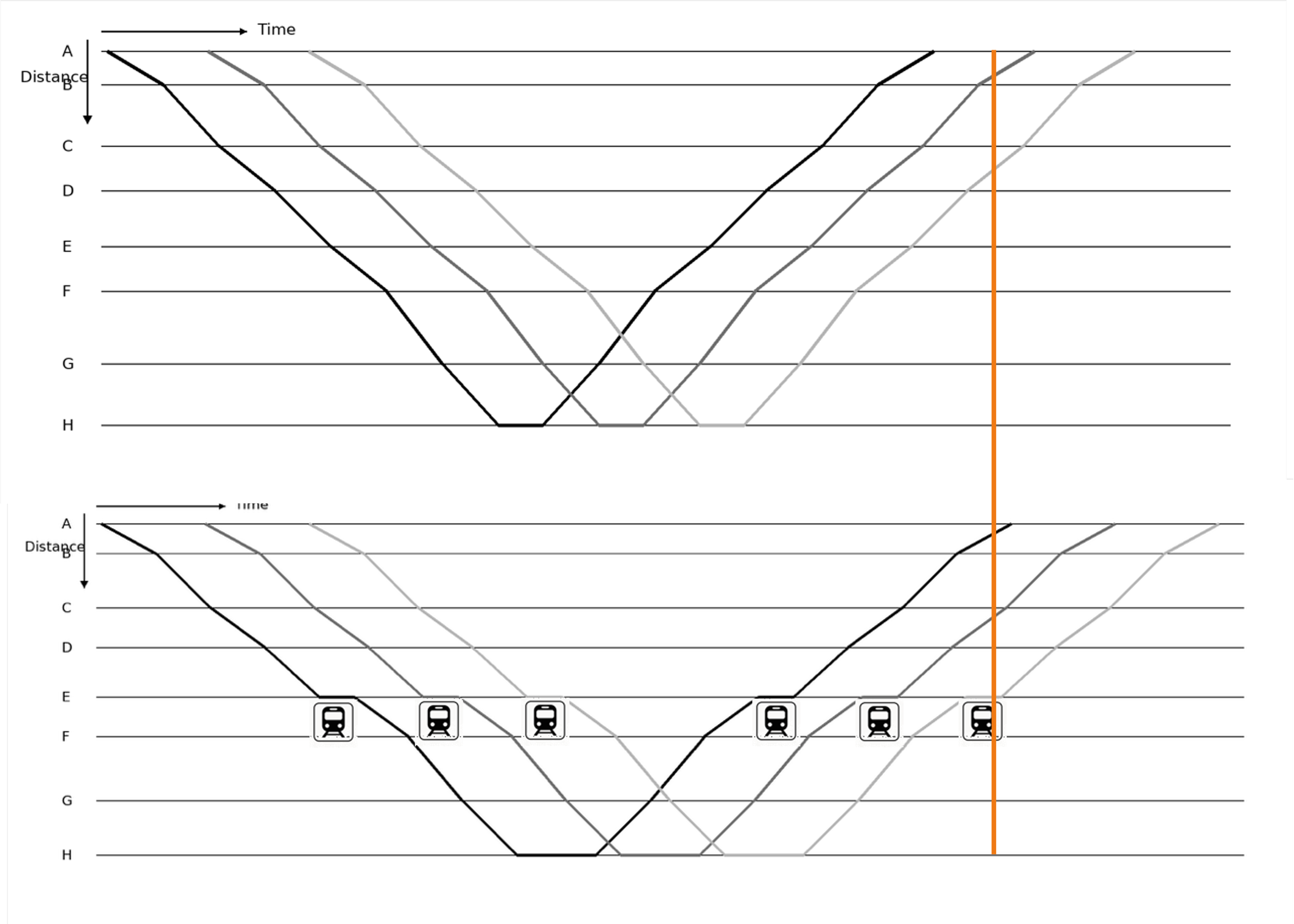
Now let’s imagine we do a Mini Switzerland and seek for the bus to arrive shortly before the train does, and to leave shortly after the train leaves. The bus now needs to pause at the station. You can see this version in the second of the two diagrams.
Stopping at the station takes time. If you look at the vertical line on the right, you’ll see that the consequence of this is that - in the second diagram - the bus is not back to where it started by the time it’s time to leave again. So we need to add an extra bus into the cycle. This costs money. If you’re only thinking of the bus itself, that is to be avoided.
But - of course - as we’ve seen from the first map, thinking solely of the bus route means that the person in the blue house has inadequate transport access. They need to be able to reach many more places than served by this route. They need to connect. If we now flip the perspective from looking at the bus vehicle to looking at the passenger journey, let’s see how a typical journey might look for a passenger in a typical British rural scenario:
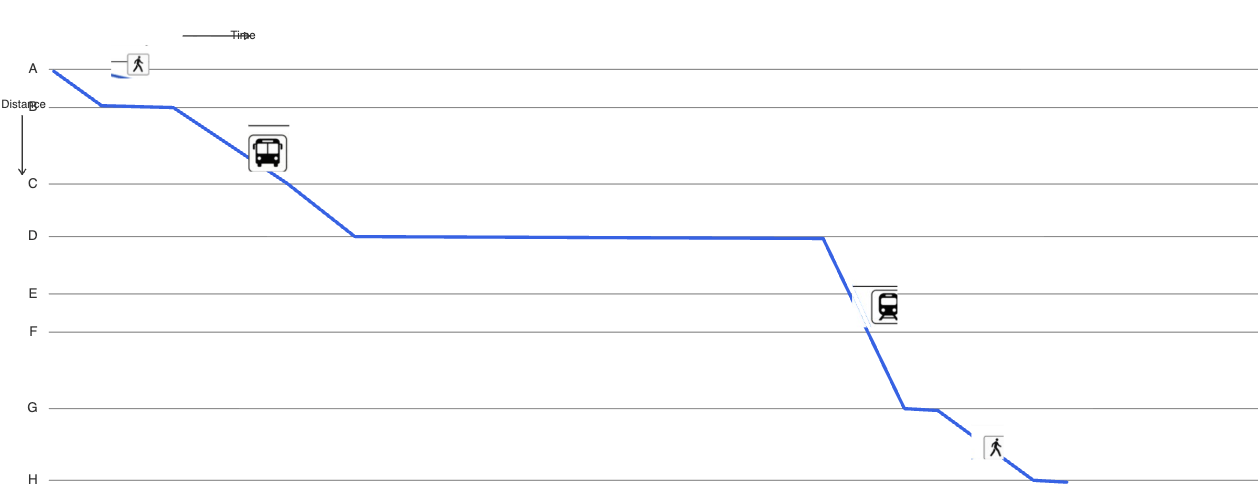
It involves so much waiting around that no sane person would do it. That’s why rural buses are typically empty and require high subsidy. And why rural social isolation persists and rural economies underperform.
Now let’s look at the same customer journey in a Mini Switzerland scenario:
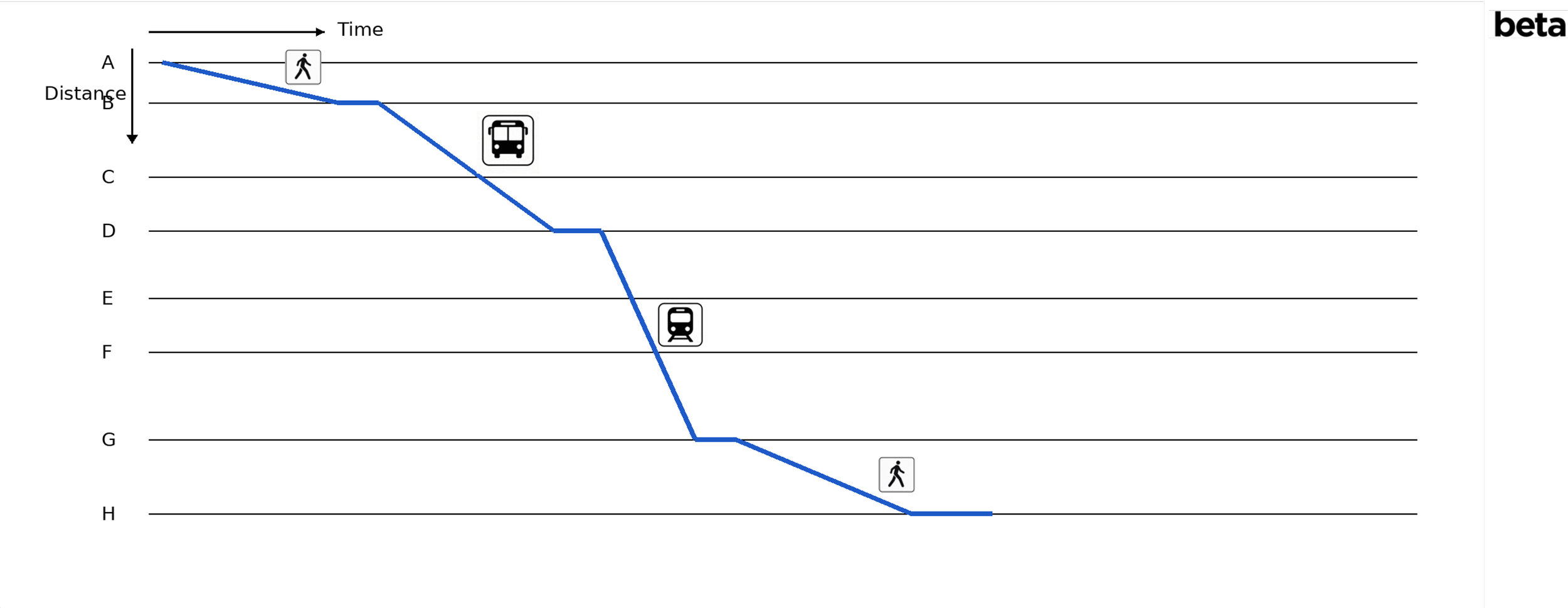
Because the bus and train are designed to meet each other, the customer’s journey is seamless. The lack of horizontal lines shows that the customer spends much more time travelling.
What we’ve done is moved the inefficiency from the customer journey to the vehicle journey.
This makes accountants very uncomfortable and is why it’s never happened. But Switzerland (and Austria and Germany and the Nordics) have proved not only does it generate much higher demand but those countries believe it’s a big part of the reason why their rural economies are much stronger than ours, and their GDP per capita higher than ours.
So what do we do?
There are roughly four things to think about when creating your own Mini Switzerland:
Interchange locations
Times
Price
Ease
Let’s start with the most important: the interchange locations.
Interchange
If you’re creating a Mini Switzerland, we’re assuming you already have a railway line. We’re also going to assume it runs hourly. Eventually, we’re going to have to get into the problem of rural train lines that don’t run hourly but that’s not today’s problem.
Your railway line will have stations. These are your potential interchange locations.
They serve both as interchange points between the bus and train but also between buses. So you want to serve as many villages as possible from the smallest number of stations. That way, more buses connect at each one. If you have 10 villages in the area and 5 stations, it’s better for 5 villages to connect to two stations than two villages each to five. That’s partly because of the connectivity and partly to avoid having too many stations to manage as hubs.
This is tricky as many British rural stations don’t have sufficient bus stop capacity (or, often, any bus stop capacity). This was also true in Switzerland. Over the last forty years, they’ve progressively rebuilt virtually every rural station to improve bus-rail interchange.
For now, though, you’re going to be pragmatic. Nigel and Anne (from the Mini Switzerland project team) spent hours out looking at each station, figuring out which ones could serve as interchange hubs. You need to identify the necessary capital investment to make it work. There may need to be more bus stop capacity or an expanded car park (to free up space for buses) or a new turning circle or improved signal access. That’s fine - figure out what needs to be done.
From this you end up with your interchange hubs identified and the capital investment needed at each.
Times
Now the core of the Mini Switzerland proposition: the timetable.
The Swiss promise is very simple: every village of 300 people or more has a bus connecting to the station every hour. So start on this basis. (For info, every Swiss village of more than 100 people must have a bus service of eight buses a day. Let’s leave that for now…)
Obviously, it’s only a guideline so you can be pragmatic.
Start with the existing route network and flex from there. Regular customers already have lives that depend on the existing routes so it’s never a good idea to change them more than necessary.
Your goal is to get to the position where every village has a bus every hour that arrives at its designated interchange hub a few minutes before the train. When I say ‘the train’, I mean the train in the main travel direction. If your train line is a branch line with a small town at one end and a big city at the other, you want the bus to meet the train travelling towards the big city (unless there’s some local exception).
The bus should also meet the returning train. In some places, this will be easy. In others, it will be difficult. It is this that creates the inefficiency we described earlier. This inefficiency is deeply counter-cultural to the UK bus industry, which is used to optimising to the minute. But it’s absolutely key to what we’re trying to do here.
By the end, you’ll have a bus network for the station catchment that:
Gives every village of roughly 300 people or more a bus every hour
Ensures those buses meet the trains in the main direction of travel
Ensures as many of these buses meet each other at the same interchanges
Price
The British public transport pricing structure could have been designed to prevent multi-modal interchange. Typically, two completely separate fares are required with totally different conditions. It makes multi-modal journeys disproportionately expensive. Given that cars are generally single-mode journeys, this makes it much less likely that people will take them.
Mini Switzerland isn’t just about timetable integration; it’s also about pricing integration. In Switzerland, there’s a common pricing structure and ticketing system covering every transport service across the entire country. Britain’s not quite there yet, so the template for what you should do will depend on what you already have locally.
Depending on where you are, it might be that you’re best expanding the integrated ticketing scheme of your nearest Mayoral system (e.g. Bee Network, Weaver Network… ) into your rural hinterland, or working with your local rail operator to adapt the existing multi-operator bus pass or to start with something completely new.
I have a particular fondness for Fairtiq (the Swiss company that created the Swiss Easyride product on which you can press a button on your phone at the start of the day and it will track your GPS, match you to whatever transport you took and automatically charge you the cheapest fare). But there are other options available.
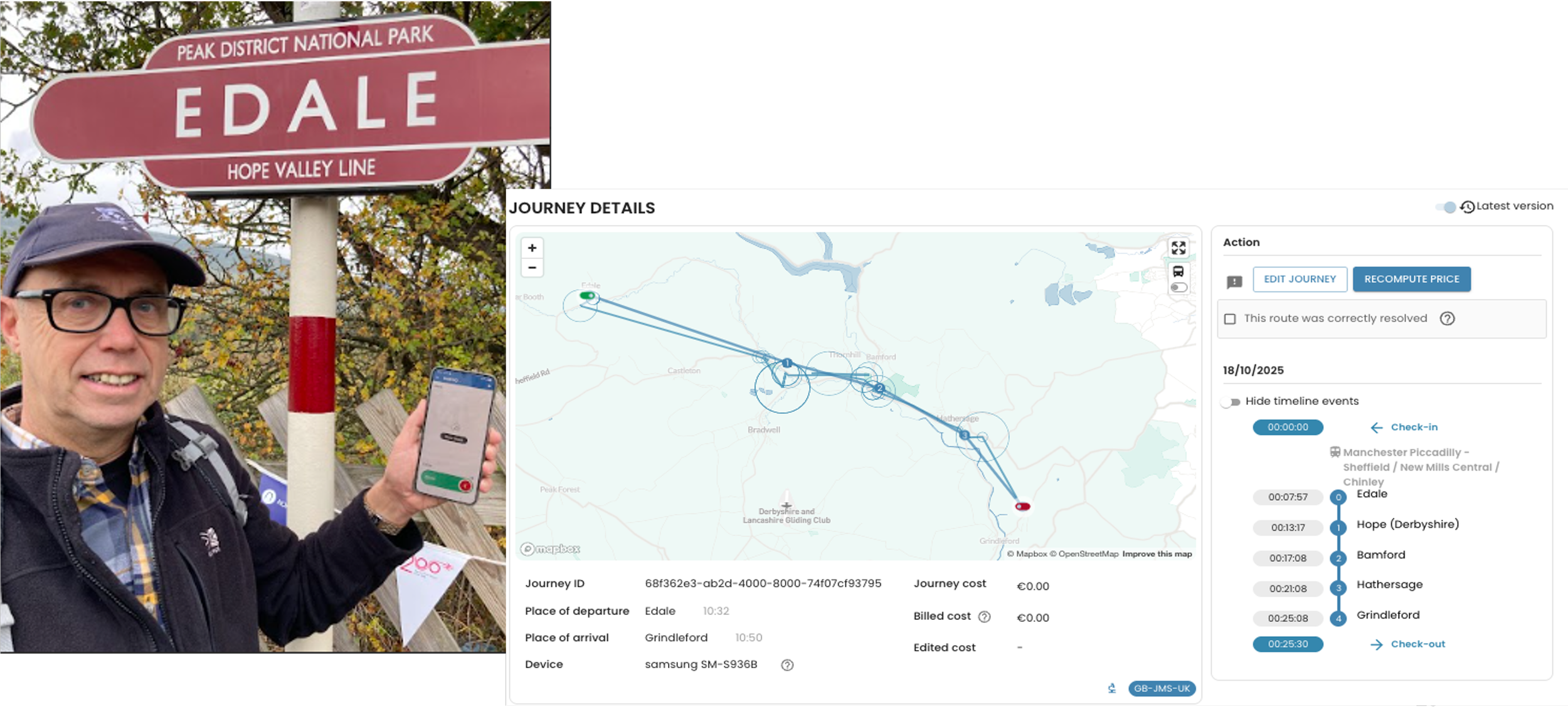
Steve Broadley from Fairtiq out surveying the Mini Switzerland stations
The key point is that a passenger needs to be able to use one reasonably-priced, comprehensible ticket for their entire journey.
Ease
Public transport needs to be easy or people won’t use it.
A substantial part of the Mini Switzerland budget that we have prepared (obviously it’s now EMCCA’s project) is about making sure it’s easy. That means clear signage between bus stops and station, signalised crossings so that bus passengers can get across the main road, paving at rural bus stops so that decent shoes don’t get muddy, bus stop shelters that aren’t etched, integrated information screens showing both bus and train information, etc.
Don’t scrimp on this bit - it’s absolutely crucial to the Mini Switzerland experience.
What next?
One of the reasons Mini Switzerland got from idea to a funded scheme in less than a year was the way we worked. I wrote more about this a few weeks ago. Do take a read.
My hope is that this way of working won’t change as it moves into the public sector for delivery, though it’s EMCCA’s decision.
But, in the meantime, where’s next?…

👋 I'm 𝗧𝗵𝗼𝗺𝗮𝘀. I help transport organisations with 𝗶𝗻𝘁𝗲𝗴𝗿𝗮𝘁𝗶𝗼𝗻, organisational 𝗰𝗵𝗮𝗻𝗴𝗲, and 𝗳𝗮𝘀𝘁𝗲𝗿 results.
🚀 I do this through 𝘀𝗽𝗲𝗮𝗸𝗶𝗻𝗴, 𝗺𝗲𝗻𝘁𝗼𝗿𝗶𝗻𝗴, and 𝗰𝗼𝗻𝘀𝘂𝗹𝘁𝗶𝗻𝗴. Let’s talk!