How A.I. Can Benefit Transport
A blog post that attempts to predict the future
Do you know one of the stupidest things you can do right now?
Attempt to predict what AI will do.
The range of outcomes runs from “annihilate all humans, possibly quite soon” to “nothing: it’s all a bubble”.
Entertainingly, both these could be true - as could every option in between.
So I find it slightly baffling that I’m attempting this game.
But, hey, it’s worth a try…
After all, after the robot apocalypse, no one will be around to see if I got it right.
The Chiltern counter-factual
Part of the reason I find it fascinating to consider the impact of AI is that I imagine what we’d have been doing with it at Chiltern Railways, had we been at this moment in 2012.
Adrian Shooter wouldn’t have understood it but he’d have expected us to figure out what to do - and be doing it fast.
So we’d be trying things.
What would we be trying?
Well, in the short term, it seems to me that there are three big opportunities for AI in transport.
The first is around decision support when things go wrong.
Disruption and information
AI agents are very good at making ‘intelligent’ decisions. They’re not always right and how they make them is a black box: but they can absorb large amounts of information quickly and make intelligent decisions rapidly. In that respect, they’re rather like a controller in a control centre.
The problem that control centres face is that, when everything’s going well, they don’t need to decide anything, as the whole system is running based on pre-planned decisions made months ago.
But as soon as anything goes wrong, 18 months’ planning work (where trains go, where drivers go, where guards go, maintenance cycles, connection patterns, ticketing validities, crowding responses) all need to be taken afresh and instantly. Given that it took entire teams of people months to do that work the first time, it’s unsurprising that doing it all again instantly is beyond any human being.
That’s why the number one source of customer dissatisfaction is always information during disruption. Customers think they’re not being informed. The reality is that no one knows the answers. When the overhead wires collapse at Bletchley, a customer immediately wants to know whether their train from Euston to Leighton Buzzard, leaving in 45 minutes, will be affected. But answering that question involves absorbing an almost inconceivable amount of information, utilising it and making dozens of decisions - all of which are entirely interdependent and which have second- and third-order effects.
It’s an impossible task, which is why the only solution is to do your best, make decisions as they come up and tell the customers what is known once it materialises. Customers find this approach frustrating. “You must know”, they shout, “so why aren’t you telling us.”
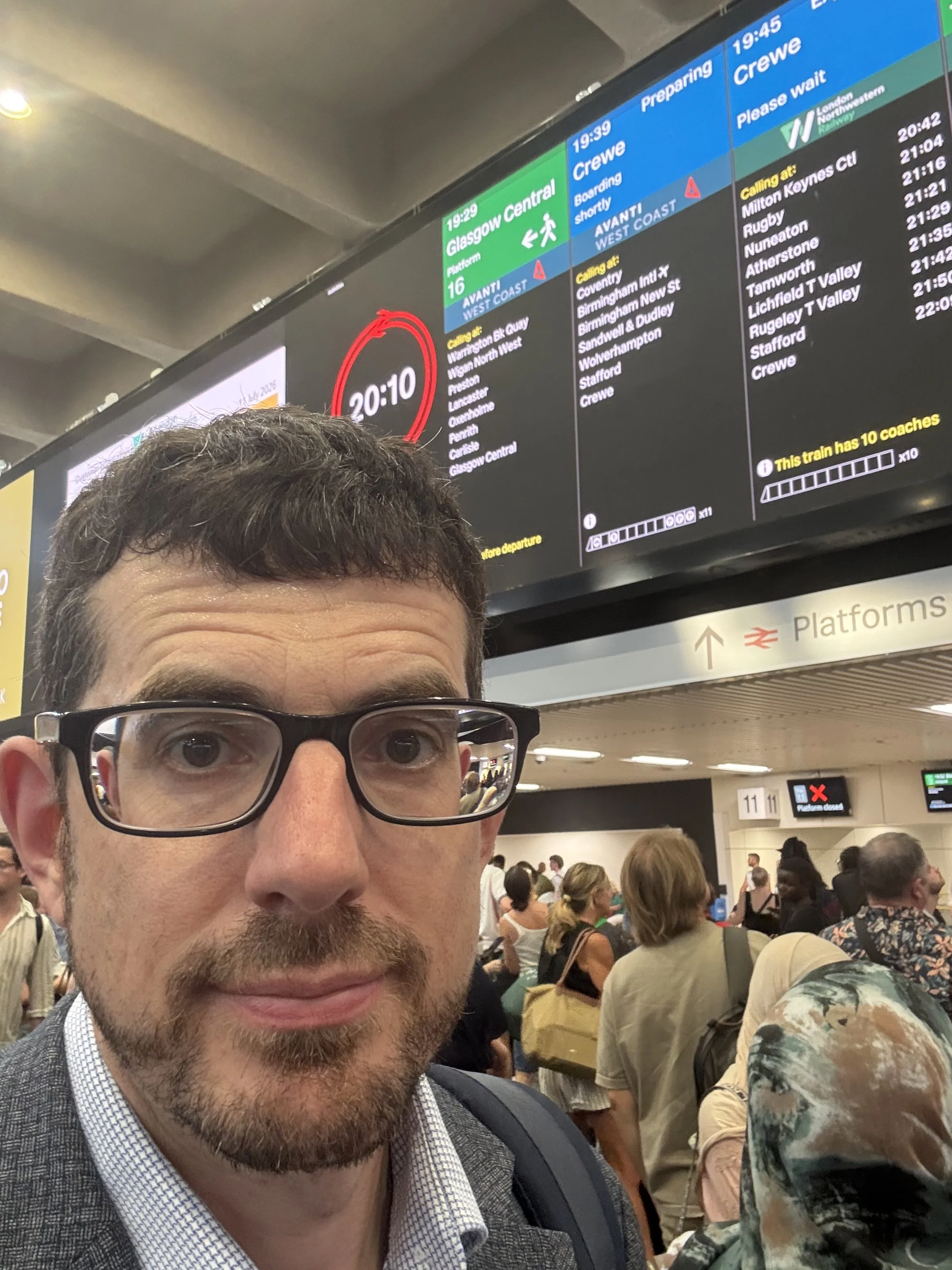
A frustrated me at Euston Station when it’s all gone wrong and no-one is telling us anything. The sweat on my brow is because this was taken this summer and it was HOT!
AI agents could have been designed to solve this problem. Each of the dozens of decisions can be delegated to individual AI agents programmed to optimise that decision, in collaboration with other AI agents working on adjacent tasks. They can quickly make a prediction of the most likely outcome of this incident, as they have visibility of every previous occasion when wires collapsed and every previous incident at Bletchley (and every previous incident of everything, everywhere, for good measure) and can use all that to come up with a new base plan almost instantly. Then AI agents can get to work optimising and optimising, based on the interdependencies and second-order effects. In a relatively short period of time, an entirely new train, driver, crew, maintenance and information plan will exist.
At this point, the controller gets to work. The plan won’t be perfect as there’ll always be information that the controller has that the AI does not have. “Ah”, the controller can think, “You’ve assumed that Driver Jones will work a short PNB (Personal Needs Break) on his turnaround in Liverpool. He’s a surly bastard; ain’t gonna happen” and go in and fiddle with the plan to resolve this issue.
In many respects, the controller’s job will change little from today. The crucial difference is that they’ll be working from a plan designed for this situation (one where there is no railway through Bletchley) and not one designed for a totally different and alien world (i.e. one in which there is a railway through Bletchley). They then manage all the perturbations and issues that arise from this new plan. But while they’re doing so, the customers are already working off a plan vastly more accurate than the entirely invalidated timetable.
Getting to this point won’t be easy. Rail industry data is siloed in legacy systems all over the place. AI itself can solve some of this problem: AI agents can go and find different data sources, as opposed to everything needing to be in one place. But if the data’s simply inaccessible, then it can’t be accessed. And AI will not solve the problem of a driver taking advantage of the disruption for a sneaky fag break when the new schedule assumed they’d be ready to take a different train.
But if I was at 2012 Chiltern Railways, I’d be assuming that AI had the potential to solve our customers’ single biggest problem: disruption management.
And, by the way, I said earlier that assembling the original train plan took 18 months’ of work. Well, of course, the technology that enables us to create a dynamic new train plan will also enable us to vastly simplify the process of creating the scheduled one.
Journey planning and pricing
It will not only be us using this technology; our customers will be using it too. While our AI agents are dealing with the disruption, customers’ AI agents will be doing the same thing.
At the moment, journey planning is done using pretty simple “from” and “to” interfaces in systems like Trainline, Google and Citymapper.
In future, it will be fundamentally different.
First, customers will describe their needs in full text: “I’m starting in Lane End and I need to be in the City by midday. I’d rather use the Elizabeth line if there’s still going to be parking at Maidenhead, but otherwise give me the simplest option that lets me leave the car at home.”
AI agents will generate multiple queries from that single request, process them all simultaneously, identify the interdependencies and return a single answer. It’s hard to overstate how different this is from the simple question and answer we are used to with Google Maps.
Moreover, the customer will have delegated the ability to act on the plan.
So if there isn’t going to be parking at Maidenhead, the system, knowing that this customer doesn’t like buses (I’m sorry! I know! But the reality is, some people don’t…), will already have ordered an Uber for the right time and paid for it (within parameters). It will already have bought the train ticket, or authorised the customer’s digital pay-as-you-go to go live.
It will optimise for price, too. The customer in Lane End is focused on journey time, but others are focused on price. If it’s cheaper to hire an e-scooter for a three-mile ride to a station with a cheaper Advance ticket, it will buy the ticket and pre-book the e-scooter. The entire transport network will become a single system.
And all of this will be the result of that single initial query; probably spoken.
But why did I say this would be happening at the same time as we are dealing with disruption? Because the service will keep running throughout the journey. If something goes wrong, it will plan a new one.
So, in this scenario, the customer goes to High Wycombe by Uber because the agent had spotted that the Elizabeth line was down. But then there’s a signal failure at Wembley Stadium, Chiltern Railways is suspended and the customer is abandoned at West Ruislip. Today, they’d end up trundling all the way on the Central line but in this scenario, because the system knows this customer values speed ahead of cost, it will have an Uber waiting at West Ruislip to take them to the Metropolitan line for the journey into the City.
Who is going to build this service? I would love to say that it will be the transport sector, but I can’t quite visualise it.
I also don’t think it will be Google or Citymapper, because they are both owned by Americans, who don’t really get public transport.
So I suspect it will be a British or European startup.
But, transport industry: prove me wrong!
Safety
The final way AI will transform transport is in how we run our own organisations. It will gradually become all-pervasive.
As it does, we will need to fundamentally re-evaluate our relationship with work and, especially in transport, with our concept of safety.
One of the most discomforting things about AI systems is that they make decisions that cannot be audited. Various people have attempted to get the AI to describe the decisions it is taking and how it takes them, but there is significant evidence that it doesn’t tell the truth: it reports a plausible series of explanations that are not necessarily the real rationale.
Does that mean we should not use AI in safety-critical environments? What if the AI is better at safety-critical decisions than we are, even though we will never be able to audit that it will always get it right?
Think about train dispatch at Liverpool Street.
At the moment, a human dispatcher gives the driver the signal to depart, having visually checked the platform. If he or she gets it wrong, they can be asked why. But a customer has been trapped in the doors in the meantime.
An AI system can have perfect visibility from computer vision cameras along the entire platform and can decide based on every previous train on every previous platform: far more experience than any dispatcher. Far fewer passengers will get trapped in doors. But when it happens, we will never be able to ask the system why. Is the lack of transparency acceptable for the better outcomes? I suspect we will decide, rightly, that it is.
A similar use case is in the prevention of assaults on vehicles. I spoke with Jocelyn Elleby on the podcast last month about how AI can reduce violence against women and girls. I won’t put in a spoiler, but I highly recommend listening to the episode.
Will all this happen?
Obviously, I don’t know.
One of the most notable characteristics of the future is that it’s unpredictable.
Doing the work I do, I sometimes get commissioned by organisations to help them predict the future. I’m not complaining, but Philip Tetlock’s research reveals that experts in their area are barely better than chance at predicting the future, and most of the rest of us are no better at all.
The simple truth is that we have no idea what is about to happen (that’s why I’m such a critic of business case processes, which depend entirely on a base case that is almost certainly bollocks).
No one predicted the fall of the Berlin Wall, and, 10 years ago, no one predicted ChatGPT, including the people who created it.
But there is one important thing to say: Amara’s Law is generally right. We tend to overestimate the effect of a technology in the short run and underestimate it in the long run.
So, probably, what I’m describing won’t happen in transport anytime soon. This time in five years, controllers will probably be making decisions just as they always have, and so will customers.
But I also suspect that, should we all survive the AI apocalypse, something not too far from what I’ve described will happen eventually, simply because the technology is too good at this stuff for it not to.
What would we have done at Chiltern Railways? Well, fairly obviously, not much: I don’t want to overstate things: we were a small team. But I can be confident that we’d have been trying to find ways of using this technology to benefit our customers and, probably, partnering with a couple of agile, nimble startups to try to achieve some of the outcomes I’ve described in this post. Some would have happened, some would have failed, some would never have got going.
There is no Chiltern Railways with the innovation culture that we had back then, but this industry is full of ambitious, positive people trying to improve outcomes for customers. I really hope that, right now, there are teams out there figuring out how to use the great tech breakthrough of the 21st century to improve customers’ journeys by public transport. Because, let’s be clear, there certainly are folk doing that for cars.
—
Next week, I’ll look at more ways in which AI can benefit our organisations - if we let it.
I often link to my past blogs, but there are three in particular I’d like to draw your attention to.
Two are from 2025 and one is from 2024 which, in AI terms, means they’re virtually pre-historic. So some of my comments and predictions have been overtaken by events.
But they still make points that are worth making.
This one describes how the increasing automation of tasks by AI will, in my opinion, cause us to value the human even more. In that context, transport is currently getting a lot wrong. We keep humans doing things that could be done by machines while pulling humans away from places where humans would value human contact. We need to change.
This one attempts to learn lessons from the history of the gargantuan tech revolutions of trains and cars and apply them to AI. Things have changed a bit in the 18 months since I wrote it. Then the tech companies were fiercely resisting regulation; now they’re demanding it. But I still think the lessons are worth learning.
And this one, from two whole years ago (!), was my first attempt to look at what AI will do to. I certainly don’t stand by all of the detail as the tech’s moved on a lot, and I’ve learned a lot. But I stand by the principles.