Last year, I had a rather startling experience.
I wrote a LinkedIn post highlighting my favourite example of a commercial bus route. A role model for others to follow, I said.
A bunch of people replied to say that the operator had scrapped it.
“What!”, I replied. I was genuinely astonished.
But it was true.
It turns out that the route is not a role model to follow but a role model for everything wrong with public transport in Britain.
Scrapped
The route in question was the Lands End Coaster; a circular open-top bus that ran round the Lands End peninsula in West Cornwall.
We’ve been visiting the area every year for the last forty years, so I know it well.
Go back 20 years, and the bus route was the 1/1A. It was the kind of struggling, infrequent rural bus route that exists all over the country.
Then the local operator, First Kernow, started experimenting.
They added some open-top buses at high season. They started playing with the route - changing the times, tweaking the destinations, fiddling with fares. Over the decades, they evolved this struggling backwater bus into a popular, packed, seven-day-a-week anchor of the local visitor economy.
I can’t begin to describe to you how busy these buses were.
Throughout high season, they were invariably full and standing. Even at shoulder season, they were packed.
There are very few bus routes that combine high fares and high demand. Just the most basic back-of-envelope calculation says that this single bus route must have been making a six-figure profit every year.
This was one - which is why I said it was a role model.

Porthcurno and the Minack Theatre - just two of the destinations previously served by the Lands End Coaster
Why’s it gone?
The reason First Kernow said they had to scrap it was as follows:
"Unfortunately, a significant reduction in Cornish tourism last year, added to falling passenger demand and rising cost, has made running these open-top buses commercially unviable.
If that is true, then First is saying that they’ll abandon two decades of incremental growth and investment as a result of one bad year.
Really?
First operates open access train services. Local stakeholders will want confidence that services will survive a bad year or two.
Not that 2024 was that bad. I was in Cornwall that year (as every year). If tourist numbers were down, they weren’t that much down. Quite frankly, given that these buses frequently had to leave people by the side of the road, a small reduction would have got them to the position where they were just full. If you can’t make money on a route with full buses and a high fare (even with a slight downturn), it’s not the route’s fault.
And even if it’s true, it’s still an appalling response.
If we take at face value that the route was unviable in its current form, then do something. Play with times, play with fares. If that doesn’t work, do a deal with the council. These services were much-loved with entire businesses depending on them. The scrapping had been trailed by local papers with dismay for months. If you can’t find a way to save it, this either reflects a worrying lack of urgency to maximise revenue or suggests they’ve given up trying.
Moreover, this is how it was announced on their website:
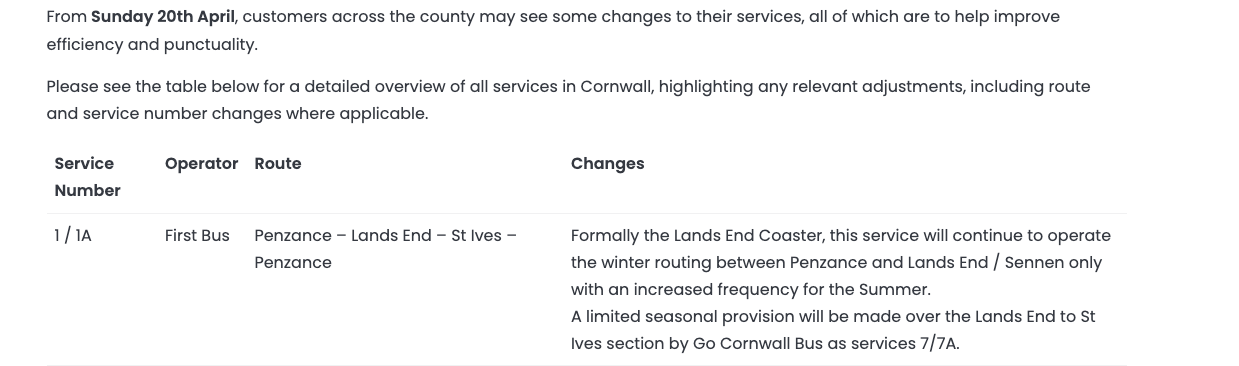
i.e. they not only scrapped the open-top buses but scrapped the name, and went back to the old “1 / 1A” number it had twenty years ago. Back when no-one used it.
Now, the open-top buses may have been commercially unviable, but the name can’t have been.
Yet, they’ve made a deliberate decision to scrap something with equity.
Google “Lands End Coaster” and you’ll find five pages of positive reviews of that bus route. How many bus routes in Britain have five pages of positive Google content? And yet, they just chucked the lot away.
I’ve spoken to quite a few First people about this decision in the last year, and they all assure me that the service was so heavily loss-making as to be unrescuable.
I’ve spoken to Giles Fearnley, former MD of First, and the sense I’ve had from him was that it was pretty profitable in his day.
How can a profitable route suddenly be so loss-making that it’s worth throwing away so much brand equity?
Well, I think I found a clue.
The First Kernow website was replaced with a new one, with a new journey planner.
Here’s the result of a search for the most popular journey on that route: Penzance (the largest town and rail hub) to Land’s End (the biggest destination)

Eh? WHAT?
Walk for 14 minutes from Penzance to… Lidl?…
I know that Lidl - it’s on the very edge of town.
But the bus starts at the bus station (which is conveniently next to the rail station) and then goes through the town centre.
The journey planner is, in effect, telling me to walk along the bus route for 14 minutes in order to get on at an out-of-town budget supermarket.
I think we might be starting to understand the falling passenger numbers!

Sennen Cove, as seen from the top of the Lands End Coaster
Lost Customer Connectedness
This is very basic stuff being done very badly indeed.
Penzance is the hub of the West Cornwall network and Lands End the key destination. This is the equivalent of the national rail journey planner telling Londoners headed to Manchester that they’d need to board the train at Watford Junction not Euston and no-one noticing.
We are clearly looking at a business that lost all focus on its customers.
It doesn’t massively surprise me that First subsequently pulled out of their entire Cornish operation and closed the business.
The services have been rescued by Go Ahead and are now being run as Go Cornwall. I really hope they take the decision to reinstate the Lands End Coaster. The pages of Google results are still there!
I find this frustrating because I work with teams in our sector trying to innovate, to make things better, to drive growth. The casualness with which First threw away the results of twenty years of their own effort was frustrating.
I’ll be honest, though, I took it particularly hard because I know this route so well. My mum lives in Penzance and used that route at least every month. She can’t drive so the existence of this open-top bus route became a huge joy to her. As you can tell, I was frustrated that it was taken away based on a rationale I struggle to reconcile with observable reality.
But it’s also because it feels to me that it’s going in precisely the opposite direction from the direction our sector needs to go in. I’ve been doing a lot of thinking about the coming world of AI. Here’s a quote from my blog post on the future AI economy:
As more tasks are handled by machines, people will actively seek out positive, enjoyable human experiences.
You can see this happening on the high street. In posh areas, the supermarkets are still there, but they’re joined by butchers, bakers and greengrocers. The kind of shops that vanished when we embraced efficiency… but are now making a comeback. Why? Because people like them. They enjoy the interaction. They’re willing to pay for it.
Transport needs to master this zeitgeist.
Right now, much of public transport still feels utilitarian. Efficient. Functional. And often… joyless.
If we want people to choose public transport - not just use it when they must - we need to make it experiential. Warm. Personal. Human.
First already had the ultimate experiential route, and they chucked it away after one year’s marginally reduced trading.
It Doesn’t have to be this way.
The good news is that I know there is an alternative path because I work with teams who are, in the context of a sector where driving change is always hard, trying to develop services that customers want to use. Trying to find growth. Trying to improve. Building a future for our sector. So I know there are people out there doing this hard graft.
Because public transport can be joyful. It can be branded, beloved and financially sound. I used to use the Lands End Coaster as my proof.
But it only works if we stay connected with our customers, treat them as people, notice when our own journey planner gives stupid advice and value progress as something worth protecting.