The Home of Transport Innovation
Let me sell you the idea that Walthamstow, my home for the last 18 years, is Britain’s centre of transport innovation.
Come for a walk with me….
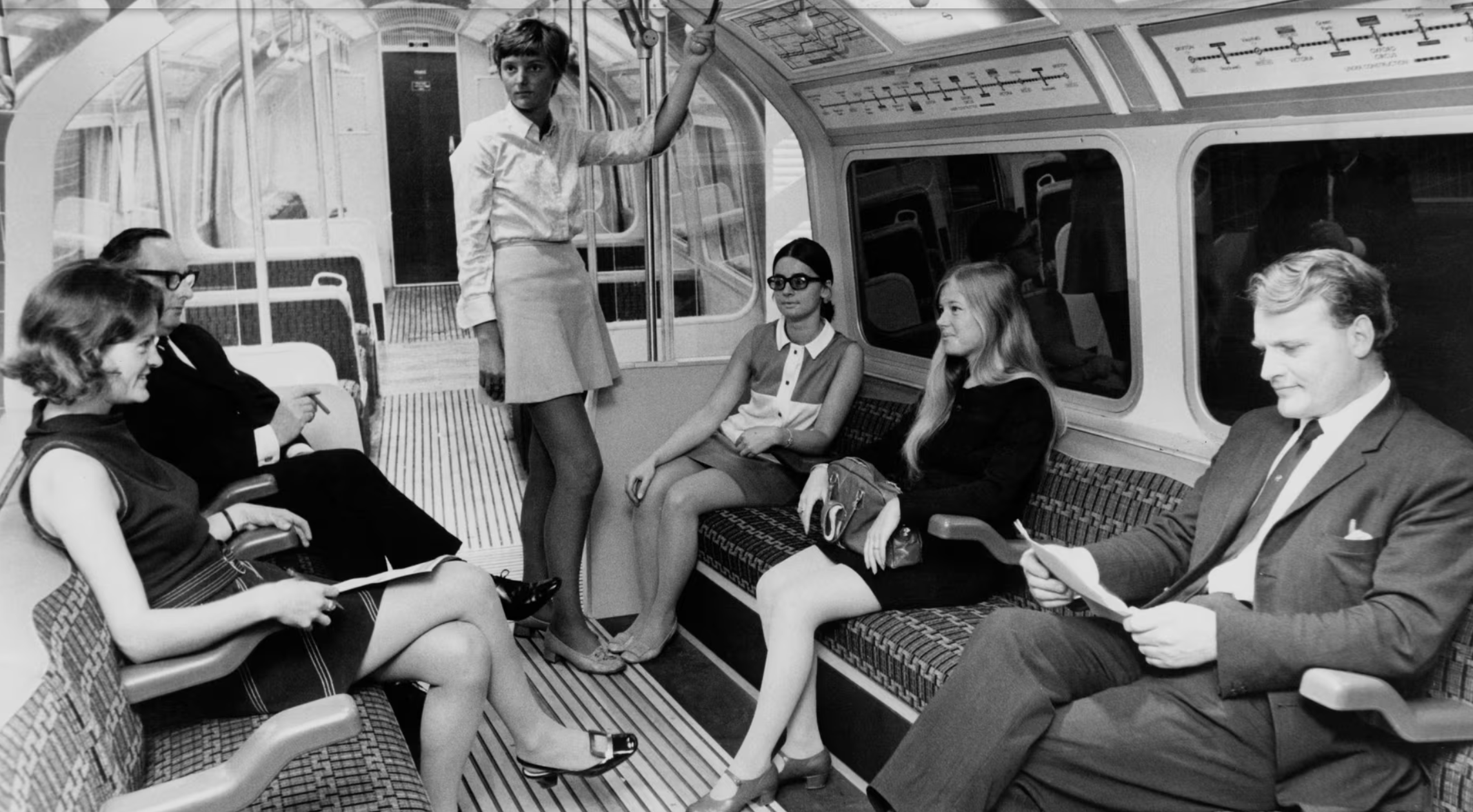
A mock-up of the Victoria line trains to be used at opening
The First Automated Metro
First stop, Walthamstow Central station.
This is the end of the Victoria line which, when it opened on the 1st September 1968, was the very first fully-automated metro anywhere in the world.
Since then, we’ve had the DLR and subsequently the Central, Jubilee, Northern and parts of four other lines have also had the trains drive themselves. Dozens of global cities have followed suit. But Walthamstow’s where it started, way back when Hey Jude was at Number 1.
And I literally mean Walthamstow is where it started: the very first train left Walthamstow Central for Highbury & Islington at 7:32 a.m.
the Inventor of the Modern Bicycle
Leave the station via the High Street exit and turn right. At the traffic lights, it becomes Church Hill.
This is where John Kemp Starley lived.
There were bicycles before John Kemp Starley, but they were penny farthings and - for most people - unusable.
Starley figured out how to use gears and chains to make both wheels the same size (and thus enable a normal human being to be able to both board and balance).
His company was called the Rover Cycle Company. After a bit, they removed the word “Cycle” and it just became Rover.
The names lives on as the last letter of JLR, Britain’s most successful car company, and in the Land Rovers and Range Rovers that scatter the streets of Walthamstow.
But - I’m glad to say - far more common than cars from his company are bikes to his design.
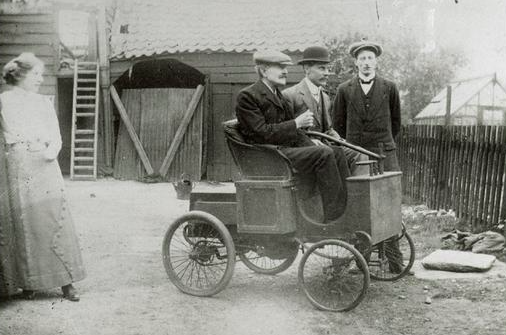
Frederick Bremer with his car
The first Petrol Car
Turn right at the church and walk through the churchyard. You’ve now reached the Vestry House Museum. Go inside (though not right now: it’s closed for refurbishment) and take a look at the Bremer car.
This was the very first petrol-driven car in the country.
At the time, it was assumed that new cars would be electric but Frederick Bremer thought that the internal combustion engine had more promise. So, in 1892, he built a car.
Having created the technology that would go on to revolutionise every aspect of life in the twentieth century, what did he do with it? Umm - he used it to potter round the streets of Walthamstow.
You know how the Brits have a reputation for being great at inventing stuff but terrible at commercialising it? Well, Frederick Bremer proves this is not a new phenomenon.
The same year as Frederick Bremer built his car in Walthamstow, a fella called Henry Ford did something similar in America. I wonder what happened to him?
The first powered flight
Now return to Church Hill and retrace your steps to the High Street. Carry on until it becomes Coppermill Lane and then follow it to where it ends on Walthamstow Marshes.
Here, on the River Lea floodplains, a freelance inventor called Sir Edwin Alliott Verdon Roe rented two of the arches in 1909 under what is now the Weaver line of the Overground.
There he built a plane. On the 23rd July, he flew 900 feet across the marshes, in Britain’s first-ever powered flight.
His company Avro went on to design the Avro Lancaster.
Honourable mentions
The invention of modern cars, modern bikes, modern metros and modern planes are the key reasons why I argue that Walthamstow is the home of transport innovation.
But there are some smaller things too:
Low Traffic Neighbourhoods - the modern craze for culture wars about closing streets to cars but leaving them open for bikes started in Walthamstow. While the rest of the country tore itself apart over Brexit in 2016, we argued about “Mini-Holland” as it was then known. Campaigners against the scheme took a coffin through the area to be traffic filtered, to symbolise the area’s death. Nine years on, it’s thriving. If you want to see a successful scheme for turning car-filled suburban streets into beautiful places for humans, come to Walthamstow.
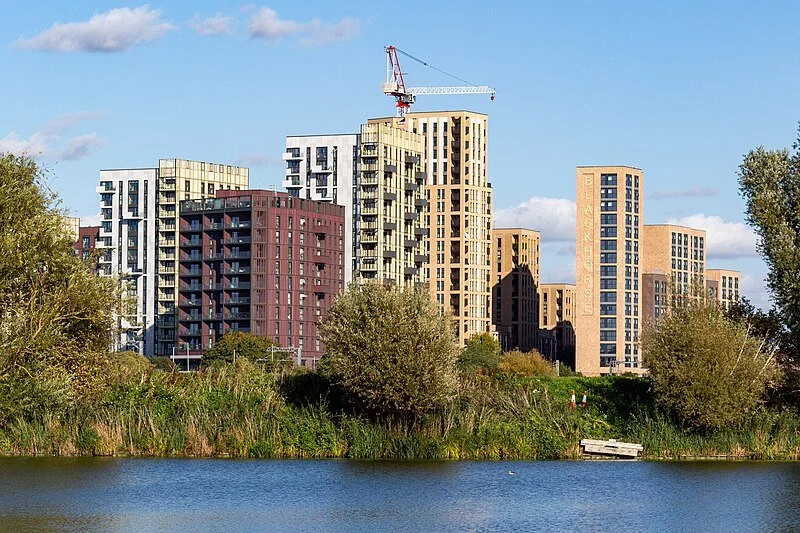
Blackhorse View from Walthamstow Wetlands
Transit Oriented Development - TfL has grand ambitions to make money from property, with a new property company Places for London having recently been established. The poster boy for this approach is Walthamstow’s Blackhorse View. Where once there was a station car park, now there’s a thriving, dense development with outstanding access to public transport. As they literally live in a station car park…
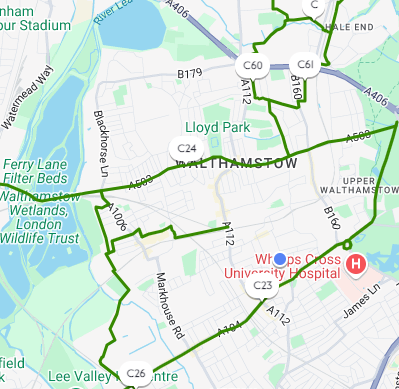
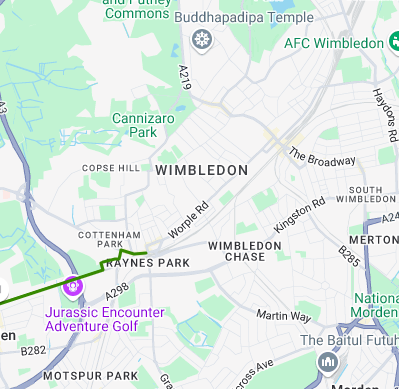
Cycleways - cities all round the world have been busily installing segregated cycle lanes since 2020. Paris is famous for it but even New York has got in on the act: there’s a shiny, bright green cycle lane down Broadway, no less. Not everywhere in Britain has joined in the party, but Walthamstow has been building cycle lanes with gusto since long before the pandemic. Here’s TfL’s cycle map for Walthamstow and the equivalent area of Wimbledon (exactly the same distance from central London in the opposite direction).
Night Tube - we’re now used to the Underground running all night at weekends, but it never used to happen. It opened in stages starting on the 19th August 2016. But where was the very first train? Well, it was the 00:10 from Walthamstow Central, of course.
Innovation
I hope you’re convinced that Walthamstow is, indeed, the home of transport innovation.
Therefore it only remains for me to mention that if you’re thinking of hiring a transport innovation advisor, speaker or facilitator: you want one from Walthamstow.
It’s in our blood…

How Can I Help You?
Click Here For Services
👋 I'm 𝗧𝗵𝗼𝗺𝗮𝘀. I help organisations like yours drive 𝗶𝗻𝗻𝗼𝘃𝗮𝘁𝗶𝗼𝗻, deliver 𝗰𝗵𝗮𝗻𝗴𝗲, and achieve 𝗳𝗮𝘀𝘁𝗲𝗿 results, drawing on 20 years of leadership across public and private sectors.
🚀 I offer 𝘀𝗽𝗲𝗮𝗸𝗶𝗻𝗴, 𝗺𝗲𝗻𝘁𝗼𝗿𝗶𝗻𝗴, and 𝗰𝗼𝗻𝘀𝘂𝗹𝘁𝗶𝗻𝗴 that energise teams, shape strategies and remove barriers to change. Whether you aim to accelerate innovation, drive change, or inspire your people, I’m here to help. Let’s talk!