Percy Weasley’s In-Tray
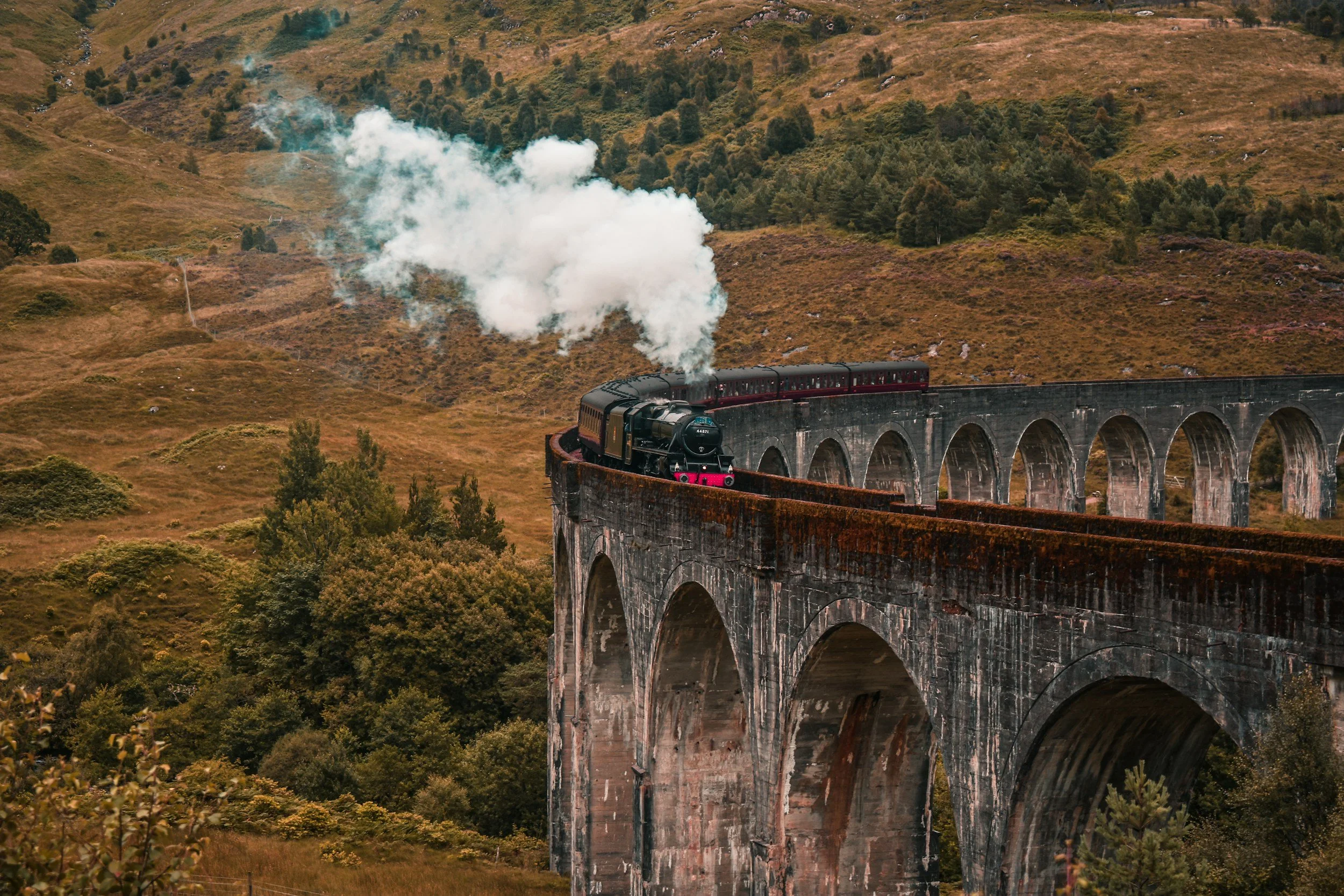
The railway service in the Wizarding World is rubbish.
Today, being 1st September, will see the Hogwarts Express leave King’s Cross Platform 9 ¾ at precisely 1100.
Then, as far as a reading of all seven books can tell you, there won’t be another train departure until the end of term.
Six trains per year on a single line - it’s worse than America!
In fact, when you look at it, the Wizarding World has many transport issues to solve. Luckily, there’s a man there to deal with it.
Did you know that, after the series ended, Percy Weasley went on to become Head of the Department for Magical Transportation? JK Rowling revealed that in a short story published in 2014.
So what are the issues in Percy Weasley’s in-tray?
I am assisted in answering this question by a magnificent piece of work from my daughter, Anna.
She has individually categorised and tabulated every single journey made in the entire Harry Potter series. I can therefore tell you that the characters make 1,950 journeys across 2,824 legs across all seven books.
I should also mention that while I’ve used AI to make some of the graphs below, my daughter did not use AI to tabulate the journeys: she did this by reading all 1,084,170 words of the series and noting down every single journey made, and the full details of the modal split.
Finally, I should make it very clear that this was entirely her idea!
Sustainability Age Disparities
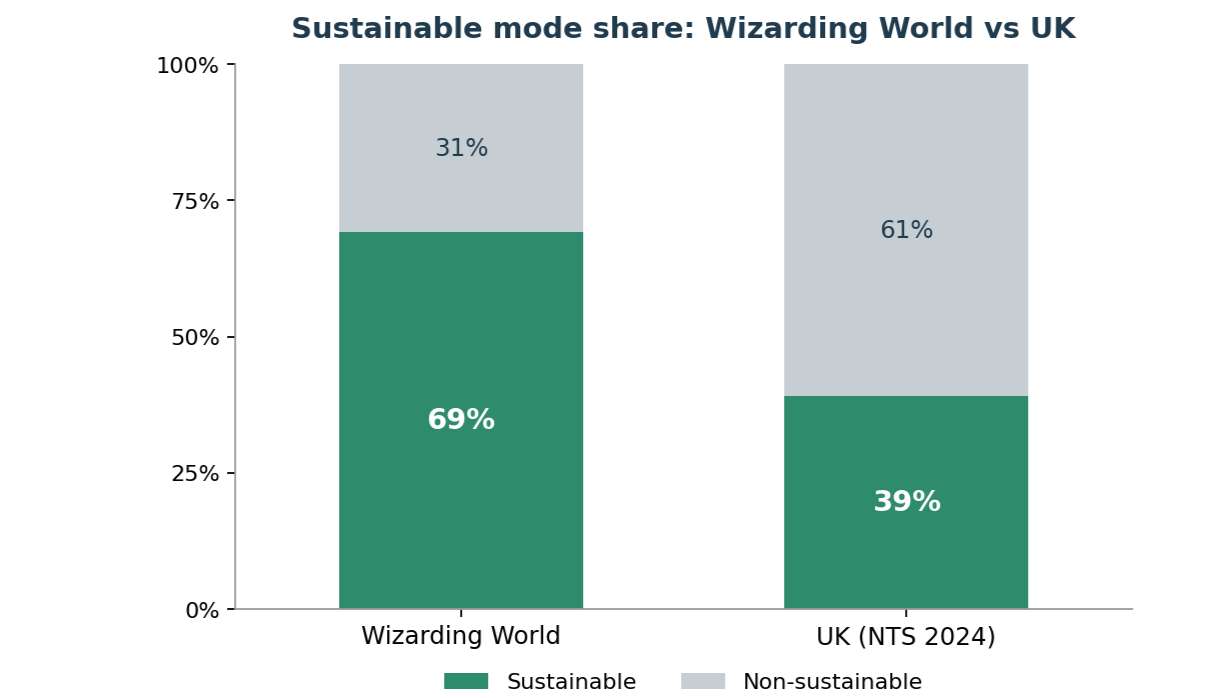
Firstly, the Wizarding World should be congratulated on its performance when it comes to sustainable travel. 69% of journeys in the Wizarding World are made by sustainable modes; a full 30 percentage points higher than in the Muggle UK.
That doesn’t mean that there’s nothing for Percy Weasley to get his teeth into, though. They have a rather different challenge to us when it comes to sustainable modes.
Their only train is coal-fired, so we must count it as unsustainable. Floo powder also requires a live fire in the grate, so must count as unsustainable. Whereas apparation seems to be entirely free of carbon emissions.
It therefore looks like the more collective travel is in the Wizarding World, the less sustainable it is, while individual travel is highly sustainable.
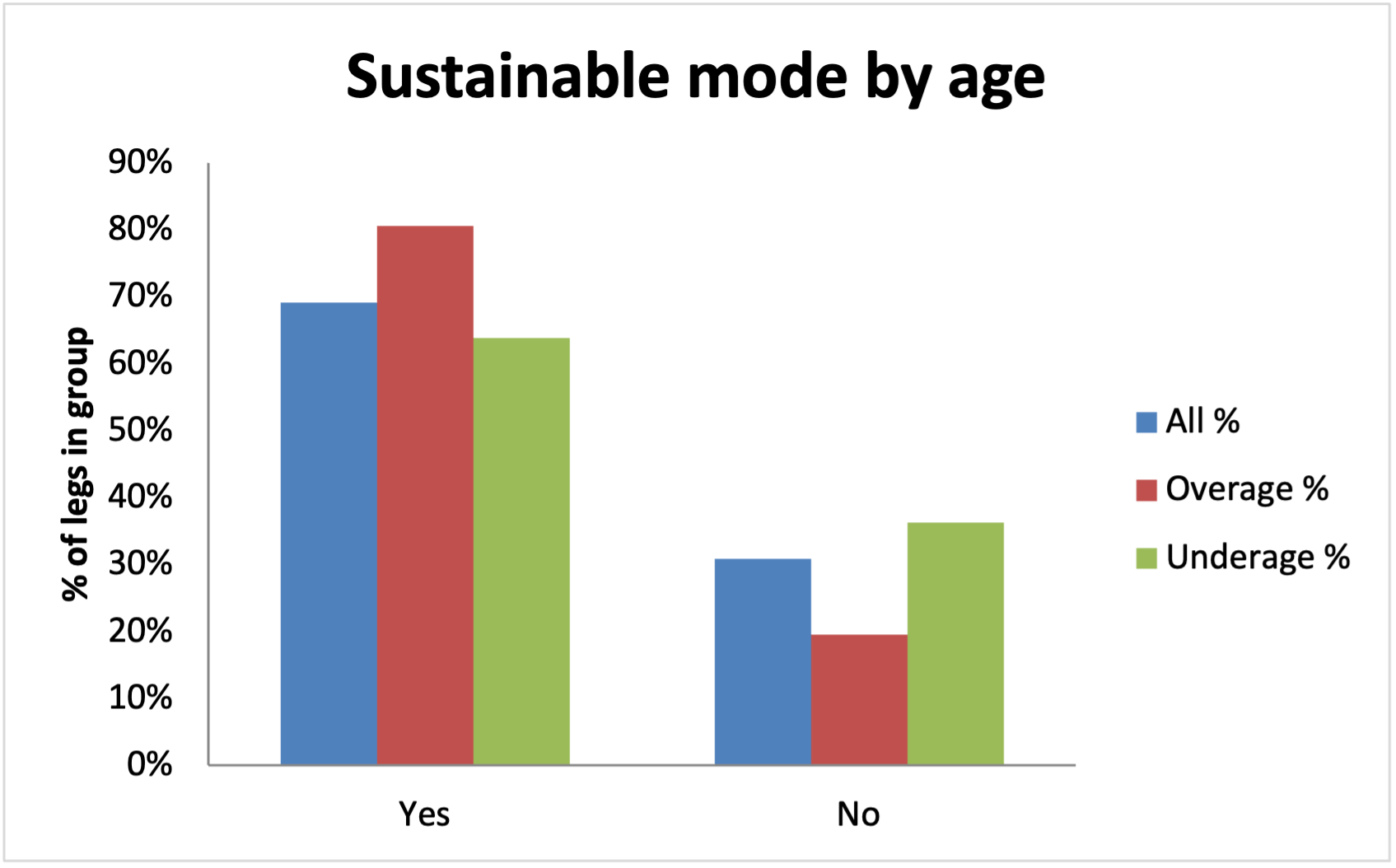
The result is that use of sustainable modes rises as witches and wizards get older.
As you can here, 80% of adults use sustainable modes, but just 63% of kids.
The reason for this becomes immediately apparent when you look at the detail: it’s children replacing journeys by Hogwarts Express (unsustainable) with apparition (sustainable) as they come of age.
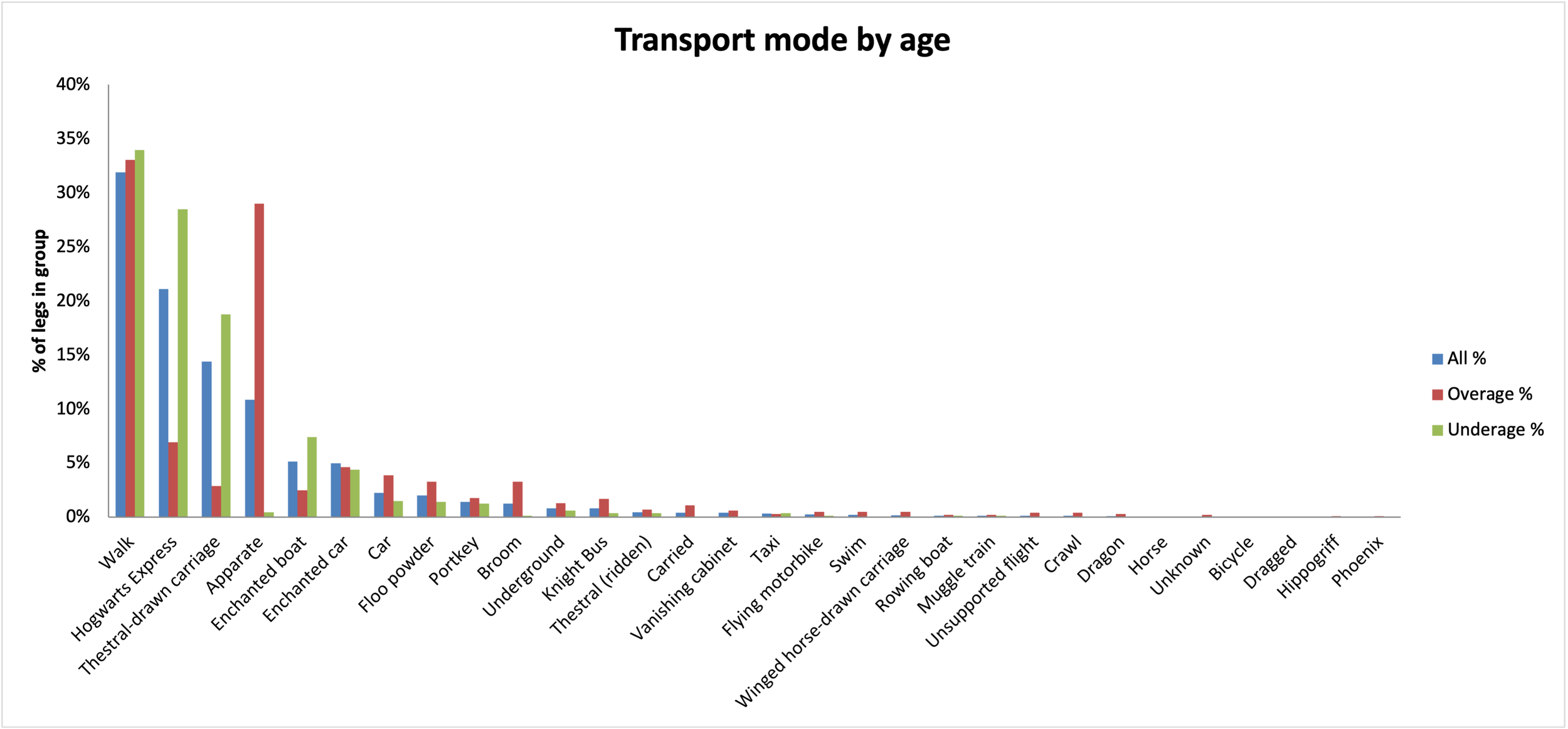
Now, apparition is a highly dangerous form of personalised transportation that requires a test at 17. So highly analogous to car travel. But it’s clear that a form of sustainable transport is required for children.
ACTION FOR PERCY WEASLEY: Replace Hogwarts Express with a sustainable mode for children.
Insufficient Active Travel Modes
Interestingly, while active travel modes in the Wizarding World are very different from the Muggle World, the split is more or less identical. In the UK Muggle world, 30% of trips are made using active modes.
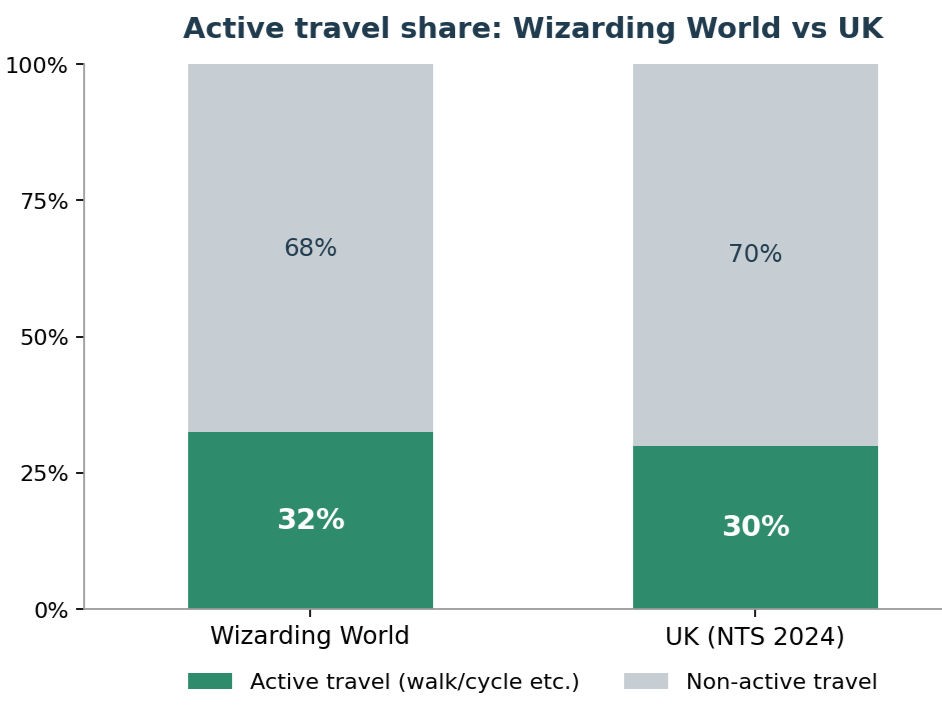
Moreover, almost all the Active Travel journeys made in the Harry Potter series are made by walking. There are also six journeys that involve swimming, four by row boat, four crawling and one on a bike. None are magical.
The Wizarding World has many modes that we don’t have (portkey, floo powder, apparation, Thestral-drawn carriage, Knight Bus, vanishing cabinet, flying motorbike, Hippogriff, etc) but none of them are obviously active.
However, some face the same challenge that we face with public transport modes: they probably involve active travel elements.
Just as a journey categorised as a bus journey may involve more walking (to and from the bus stop) than a journey categorised as a walking journey, so a journey by Portkey involves walking to Portkey site. This doesn’t actually apply to the Knight Bus, as it comes to you wherever you are - including through buildings. So very little activity required.
Now, this is - of course - dealt with in the way my daughter has recorded the data, but I would advise Percy Weasley to check that Ministry of Magic statisticians have adopted the same approach.
Either way, even though the Wizarding World is doing brilliantly in overall use of active travel, it’s a clear failure that there are no magical active modes. Definitely something for Percy’s in-tray.
ACTION FOR PERCY WEASLEY: Development of magical Active Travel modes.
Limited Integrated Transport
66% of journeys in the Wizarding World are single-leg. These are overwhelmingly apparation (which is a private door-to-door mode, very much occupying the role of the car in the Muggle world) or walking.
Of the remainder, the Hogwarts Express is overwhelmingly likely to be the mode used for integrated journeys. This is a result of the integrated transport hub at Hogsmeade in which passengers transfer between train and either Thestral-drawn carriage or walk to catch an enchanted boat over the lake.
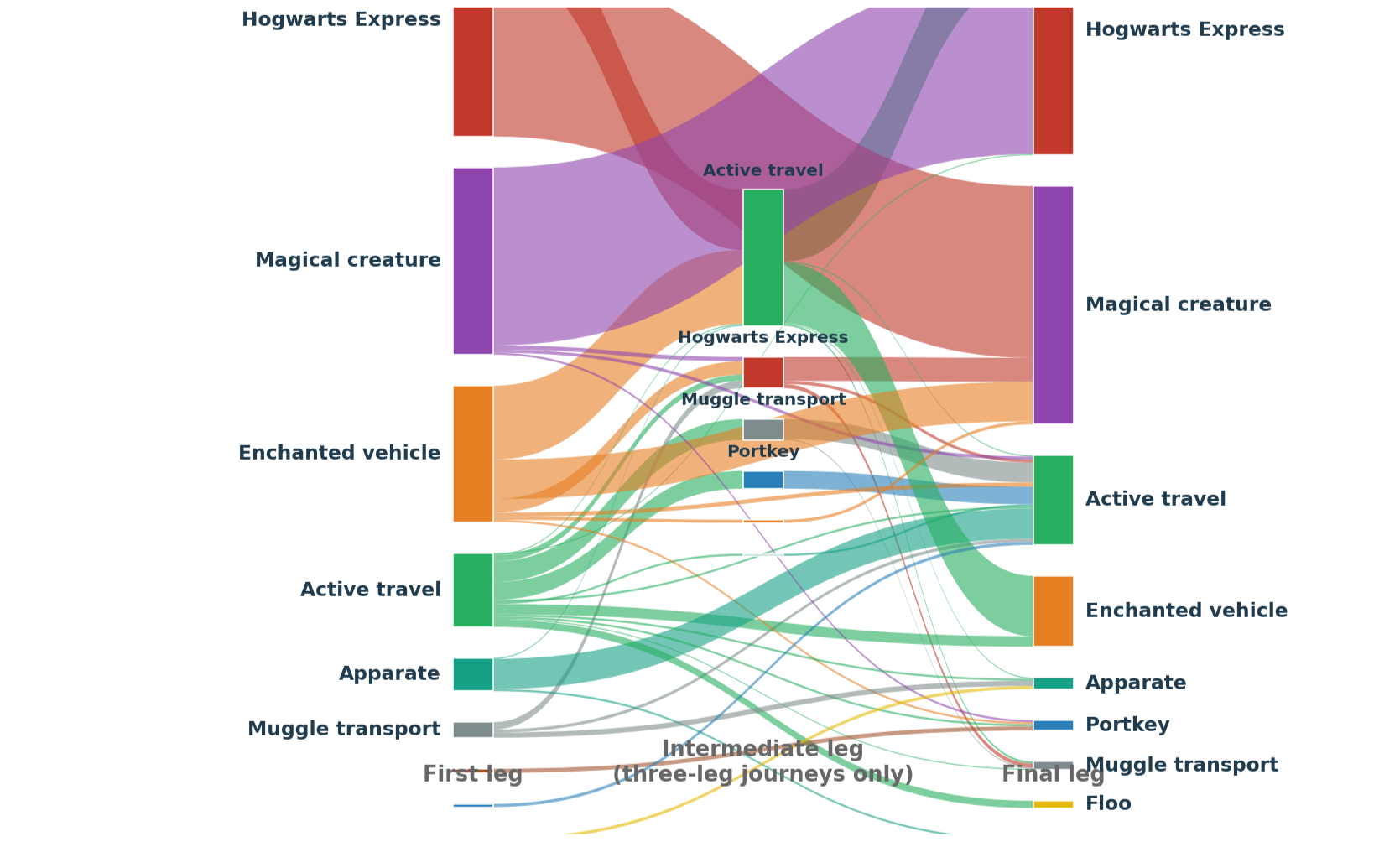
In fact, 74.6% of integrated journeys in the Wizarding World involve the Hogwarts Express at some point. This suggests a serious lack of investment in widwer integrated transport infrastructure.
ACTION FOR PERCY WEASLEY: Development of new integrated transport opportunities
Social Exclusion Issues From Apparation
I’m not a fan of free public transport (I’ve written why here) but the Wizarding World is different as there seem to be serious social exclusion issues. Apparation requires lessons and a test, suggesting it’s not available to everyone. Floo Powder and the Knight Bus are the best options for those who don’t pass, but the Knight Bus has to be paid for and Floo Powder bought. This suggests a serious equity issue to resolve.
ACTION FOR PERCY WEASLEY: Consider Floo Powder subsidies and free Knight Bus service
The Boy Who Walked
For all the transport economists reading this and shouting at their screens that journeys recorded in the books is not a representative sample of journeys in the Wizarding World, you’re dead right. But it’s all we’ve got.
So let’s lean into that even further and look at Harry’s individual journeys, and how he differs from the other characters in the books.
Of the 2,824 journey legs made in the series, 276 are by Harry himself - so just under 10%. Of these, 148 are made on foot. In his early years, Harry does a lot of trips to Hogsmeade (often by secret passage), and in the final book, he does a lot of miserable trudging while on the run.
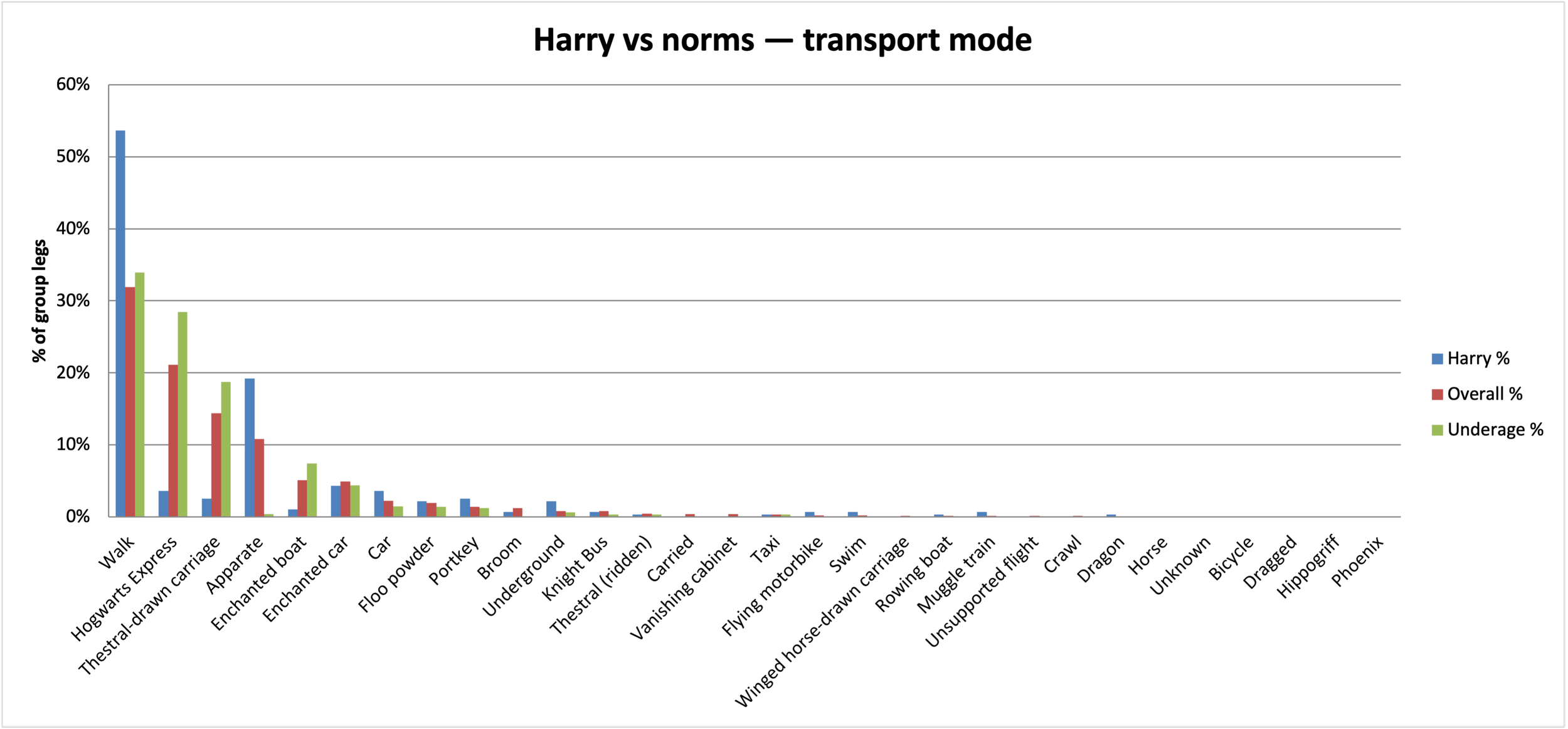
Harry is also surprisingly likely to apparate, given he only learned in the penultimate book. But, of course, so did all the other kids.
A few other facts for you:
Harry makes the most journey legs in the series (276), followed by Ron (191) and Hermione (179). Then there’s a steep fall to George Weasley (79), Fred Weasley (78) and Hagrid (75).
A long list of characters make just one journey each: Albus Potter, Alecto Carrow, Amycus Carrow, Bernie Pillsworth, Cecilia, Crabbe, Dolores Umbridge, Emmeline Vance, Garrick Ollivander, Gellert Grindelwald, Gibbon, Goyle, Grawp, Igor Karkaroff, James Potter Jr, John Dawlish, Lestrange, Madam Marsh, Mafalda Hopkirk, Mary Cattermole, Mary Macdonald, Mulciber, Muriel, Myrtle Warren, Nott, Perkins, Pius Thicknesse, Riddle's maid, Rodolphus Lestrange, Rose Granger-Weasley, Scorpius Malfoy, Sturgis Podmore, Teddy Lupin, Thorfinn Rowle, Tom Riddle Sr, Victoire Weasley, Wakanda, Walden Macnair, Winky and Xenophilius Lovegood.
It’s worth being clear that - obviously - these people will have made many, many journeys in the seven years covered by the Harry Potter series. But implied journeys are not counted: to be in our numbers, the journey has to be specifically recorded in the text.
Also, in case you’re reflecting that Dolores Umbridge makes multiple journeys around the Hogwarts grounds (including, memorably, being dragged into the Forbidden Forest by enraged centaurs), like most transport stats, our numbers do not include journeys made exclusively within private property.Cars are not a big part of the Wizarding World. The car we see most often is Arthur Weasley’s enchanted Ford Anglia. 140 journey legs are made in it, with Ron the most frequent traveller. Harry, though, memorably uses it to race the Hogwarts Express and crashes it into a Whomping Willow. Amazingly, wouldn’t count as a KSI.
The chapter with the most journeys is "At Flourish and Blotts" (Chamber of Secrets), with 75 journeys. It's the Diagon Alley shopping chapter, so many characters make lots of short shop-to-shop trips. The next busiest are "The Goblin's Revenge" (Deathly Hallows) with 71 and "The Whomping Willow" (Chamber of Secrets) with 64.
In case you were wondering, a journey made by an animagus counts, even while they’re an animal. So Peter Pettigrew’s journeys as a rat are counted but journeys made by animals are not.
Percy Weasley’s the right man for the job
Fascinatingly, JK Rowling made an excellent choice appointing Percy Weasley as Head of the Department for Magical Transportation. It’s important that transport leaders are familiar with all the modes in their responsibility (too many in the Muggle world do not: bus company CEOs who arrive by car, for example). Of all 222 characters who make a journey in the series, Percy Weasley is the statistically most representative of the books as a whole:
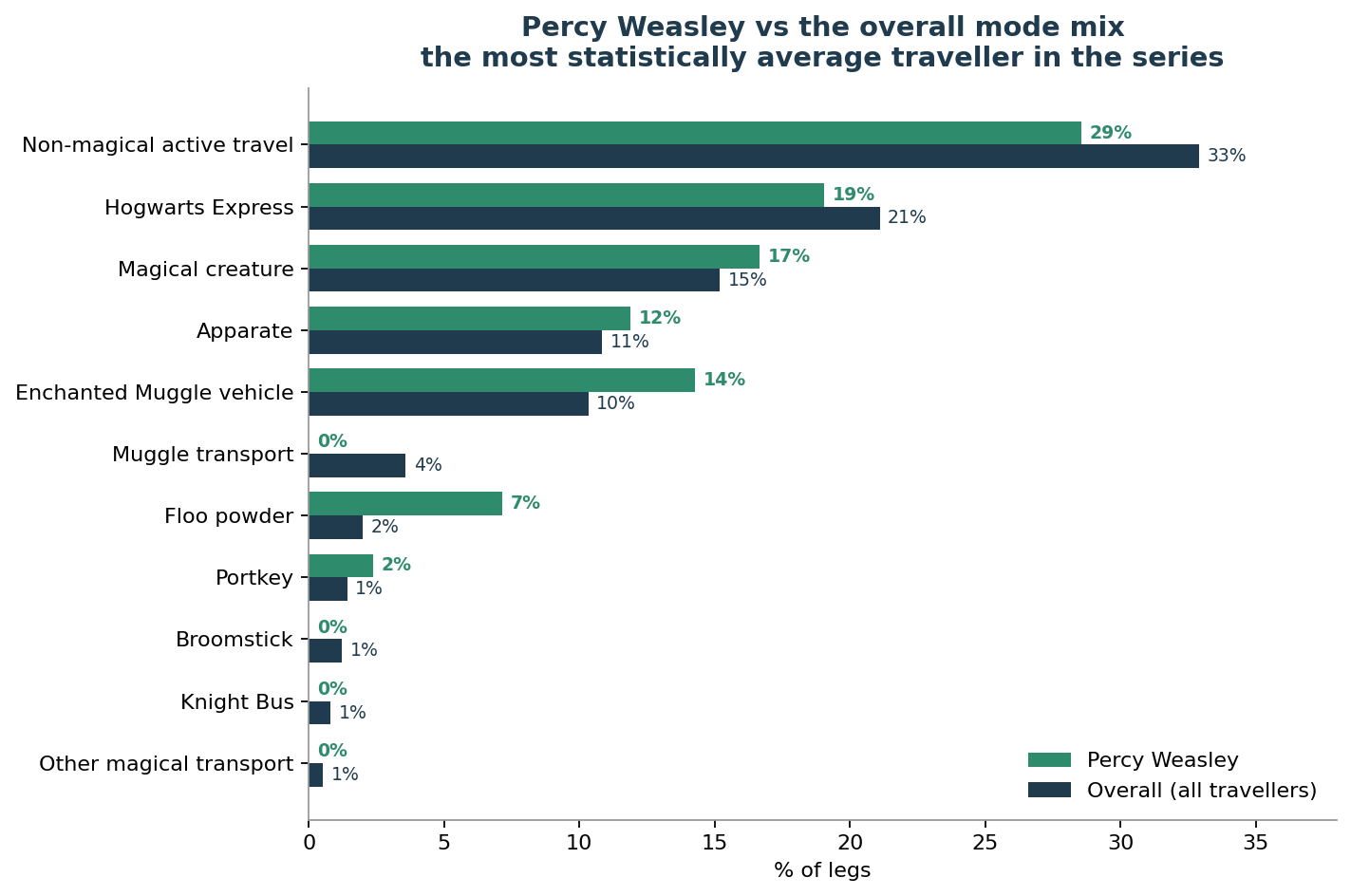
Excellent appointment, JK! I now have complete confidence in Percy Weasley to get to grips with the issues.
In the book, it’s revealed that the Prime Minister’s office includes a secret portrait allowing the Minister for Magic to visit Downing Street unobserved for private meetings with the Prime Minister.
Do you think Percy has a special portal into Great Minster House for tete-a-tetes with Heidi Alexander?