Why Free Public Transport is a Bad Idea
Yesterday, the Government announced that rail fares will be frozen next year.
This is may be a good thing.
The cumulative effect of policy over the years has been to increase the cost of public transport while reducing the cost of driving.
The graph below is a few years out of date, but the story won’t have changed significantly.
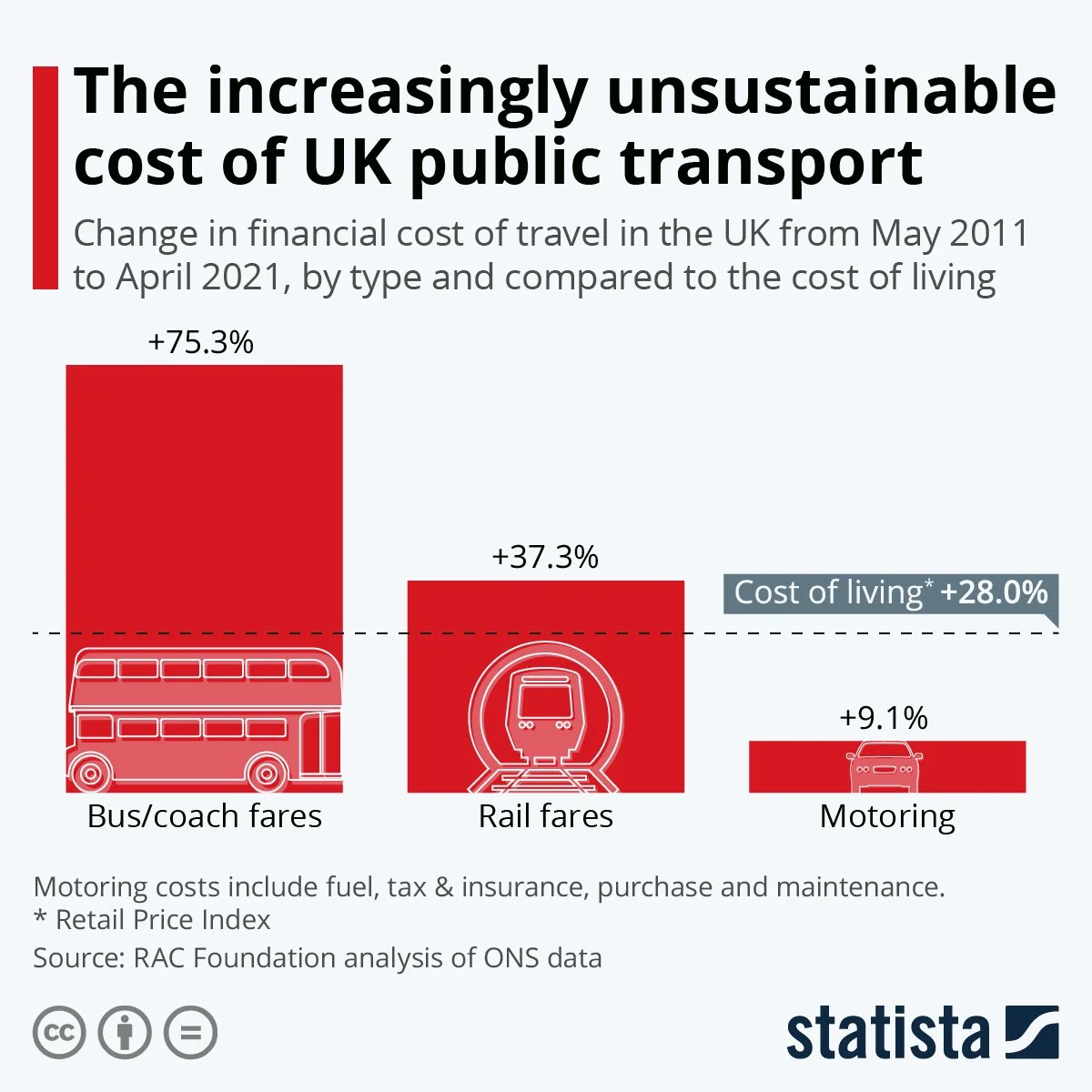
I would much prefer that fares could continue to rise but road costs could rise faster, but this is the second best alternative.
So if freezing fares is good, eliminating them altogether msut be great, right?
Actually, no.
It would be a thoroughly bad idea.
Why eliminate fares
Before explaining why free public transport is a bad idea, let’s just look at why it’s often considered a good idea.
There are two main reasons given: firstly, to increase public transport’s share of journeys and, secondly, especially for bus fares, to help reduce living costs for the poorest people in society.
Unfortunately, free public transport fares aren’t particularly effective at either of these objectives.
Let’s start by looking at whether it would get more people onto public transport.
Why Free Fares Won’t Work - ModE share
To explain why it won’t have nearly the impact its promoters believe, let’s imagine the Government decided to give everyone a free meal each day.
This meal, to be precise:
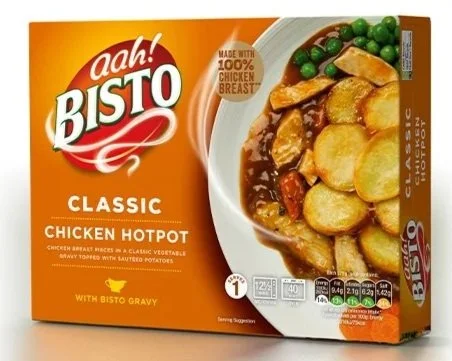
Two groups of people would be very pleased.
Firstly, people who already buy this type of meal. They’d get something they value for nothing.
Secondly (and I suspect this is a larger group), people who would prefer something a tad more premium, but eat what they can afford.
But how about you?
How would you react?
Being completely honest, looking at the demographic of my readership (according to LinkedIn analytics, the most common job title is “Managing Director”), I can guess.
You wouldn’t take them up on it.
Partly because it’s too inflexible.
You’re used to having a lot of freedom in what you eat and would not welcome the constraint.
Partly this just isn’t the kind of food that you want.
But also, and we have to be honest here, there’s a point about how you self-identify. You can call it snobbery if you like, but redeeming your meal voucher for this ready meal would involve going to the kind of shop you don’t normally go to. You don’t see yourself as that kind of person.
Not only that, but it’s probably not a shop you’ve been to before.
You wouldn’t know where to begin.
And, given you don’t even want the food, you’re not going to make the effort.
Well, my friends, this is how millions of people in this country feel about public transport: they don’t want it, they don’t know how to use it, they don’t identify as the kind of people who use it and - even if given it for free - they wouldn’t take up the offer.
Now this isn’t how I feel.
I’d love it.
I spend thousands of pounds on public transport every year.
I even went to Lithuania by public transport last month!
But I’m not normal.
And a big part of not being normal is knowing that you’re not normal.
But for most people, the reasons they don’t use public transport are the reasons above: self-identity, not even knowing how to, inflexibility and just not wanting to.
Car users don’t use cars because of the price of public transport.
You can tell this because public transport has a high mode share where it is the best option.
That’s why public transport mode share is very high in central London but much, much lower in outer London (despite outer London having lower fares than central London).
Giving a car driver free bus travel as a means of encouraging them to use the bus is like giving a turkey to a Hindu to help them celebrate Christmas: it’s a misunderstanding of why they were choosing not to in the first place.
There are, of course, some people who’d switch but most of the new trips generated would be people who already travel by by public transport, making more journeys.
And even that would be comparatively limited as people who already use public transport use it primarily for work, business, health, school and visiting family. i.e. things that are pretty fixed. Even if customers loudly complain about the fare, most people do commute if their job requires it and they do go to see family, including by train when it’s the best option.
They may resent the fare (often loudly) but if it were eliminated, their gratitude wouldn’t materialise in more train rides; they would spend the money saved elsewhere.
Why Free Fares Won’t Work - Cost of Living
But there’s a second reason why some people advocate free fares, especially for buses: social justice.
Buses are mainly used by people with less money, so making fares free is a subsidy of the poor by the rich.
This is, of course, true.
Most taxes are paid by the rich and buses are disproportionately used by the poor. So free bus tickets are a way of redistributing income.
But a very bad one.
I use buses a lot, and I’m in the top 5% of income earners.
Whereas lots of people on low incomes never travel by bus.
So while public transport fares are a way of redistributing income, they’re a very inefficient one.
Much better to use the tax and benefits system, which was explicitly set up for this purpose.
Don’t Tempt Rachel
And there are two more reasons why free public transport is a bad idea.
The first is that it makes public transport much more expensive to the Treasury.
At the moment, public transport at least covers some of its costs.
If it were all paid for through taxation, it would become like the NHS: entirely dependent on the public purse.
And, let’s be honest, when the Chancellor has to choose between cancer treatment and the number 17 bus, she won’t even hesitate.
Free public transport will shrink and shrink, because it will be inadequately funded.
You’re pretty bright, so you can immediately see the irony: if public transport shrinks, it means fewer people can use it, which means it can’t achieve the mode share and income redistribution objectives anyway, even ignoring the fact that they don’t work.
The Customer Bargain
The final reason why it’s a thoroughly bad idea is that customer service will collapse.
We all know that the NHS can be almost unbearable at times.
My wife (who has a chronic condition) was recently fined for getting a free prescription when she hadn’t realised her prescription prepayment certificate (PPC: basically a season ticket for prescriptions for those, like my wife, lucky enough to need lots of them) had expired a few days earlier.
It was an honest mistake by someone who has paid for a PPC year after year after year.
If you think train companies are hard to reason with, try attempting to have a human conversation with NHS bureaucracy.
Public transport isn’t perfect, but the fact there is still a transaction involved creates a consumer mindset in the buyer and a service mindset in the service provider.
Lose that, and public transport risks becoming more like the NHS: great, well-motivated people drowning in a system focused on Whitehall, not users.
Ineffective
In summary, free public transport is an idea by people who already like public transport and assume that the main reason people aren’t using it more is the price: make it cheaper, and they will come.
It’s been tested time and time again, and it never works for the simple reason that it’s not true. Make public transport better and they will come
For clarity, I’m not saying that it won’t increase mode share at all and it will obviously cut cost of living for those people who pay bus fares.
But public transport fares total circa £20 billion. Is free public transport the best way to spend £20 billion a year? That’s the equivalent of an Elizabeth line every year, forever more.
No, it’s not - your job as a public transport changemaker is to make public transport better so that people choose it - and are happy paying a fare to do so.
But, in the meantime, let’s applaud the Government for a welcome step in equalising the cost inflation between road and rail.
How I can help
I support people like you who are trying to make public transport better.
I do this through advice, projects on customer experience and transport integration or workshops.
I’ve also worked on the commercial strategy for an operator recently, focused on customer experience and revenue growth.
If any of this sounds useful, please contact me.