13 Ideas for getting Government moving again
We’re about to have a new Prime Minister. That now seems highly likely.
And the reason couldn’t be clearer: there’s a consensus, across the board, that Keir Starmer has moved too slowly on too many things.
So what needs to change under his successor?
Well, a big part of it is the way Government works.
As I described last year, the Civil Service is stuck in a culture of pushing paper up to Ministers, allowing the paper to fester on Ministers’ Desks for months on end, and then be passed back down again to where it can be executed.
Often the world has changed by the time it finally gets back to the official who needs it, so the whole process has to start again.
In my post last year, I discussed that a key reason for this is a catastrophic misunderstanding of the way decisions are taken in Whitehall that has resulted in the widespread notion that “Advisers advise and Ministers decide”.
I won’t repeat the argument again (though you can read it if you want to), but the summary is: that’s just not true.
The Civil Service does not need to feel dramatically different to a private company, in which decisions are made by the person with the relevant knowledge and expertise, in real time.
But the “advisers advise” culture is well-established, so what can we do to change it?
Here’s a Baker’s dozen of ideas to get you started:
1) Remember that “Advisers Advise and Minister Decide” is bollocks
This is actually hugely important.
If you do a ChatGPT query about “Advisers advise and ministers decide”, this is what you get:
As I explained, it’s just not true.
But it’s become so widespread in our thinking that the professional plagiarism machine that is ChatGPT regurgitates back to you the direct opposite of reality.
Officials who want more accountability for decisions need to be able to be clear with both their Ministers and their bosses (and, most importantly, themselves!) that the law is on their side.
2) Make decisions Through Experiment
A view has emerged in Whitehall that “a decision” is a procedural event, and that a decision can only be seen to have been taken correctly if it was taken by a Minister and recorded in a formal memo.
But the law doesn’t care how a decision was taken, only that it was lawful, rational and fair.
Let us imagine, for example, that an official decided that - instead of commissioning a big piece of analysis and putting the conclusions in front of the Minister - they were going to fund a dozen experiments in the real world, and then scale up those that best achieved the Minister’s objectives.
In this situation, the decision-making process would not have a single decision-making 'moment' but instead be a constant, iterative learning process.
Would a Judicial Review consider that the decision was made correctly?
Well, the official in question is competent to conduct these experiments and is doing so with the Minister's authority. The process shows a rational connection between evidence and action. The biggest issue is that “fair” has come to be synonymous with “following a previously defined process”. I talked last week about the issues with how we think of fairness.
So it would make sense for the official to publish a new version of this process before starting out.
Even better, the Department could publish that live experiments were now a decision-making method that the Department was going to use, thus enabling not just this official but every official.
3) Build a culture of delegation and accountability
Now that we all understand that Ministers don’t have to decide and that officials aren’t limited to merely advising, we can get on with the important work of getting decisions to the level where they make sense.
If there’s an official who understands the Minister’s goals and understands the subject at hand, they’re perfectly competent to decide.
Indeed, they should be deciding. Currently, officials and ministers are almost conspiring together to get bad outcomes, with officials (sometimes) reluctant to be held accountable for decisions and ministers demanding to make all the decisions.
Both need to be reversed.
For an illustration of just how much of a difference it can make, read this blog post about the building of our Chiltern Railways extension to Oxford.
While you’re unlikely to be involved in building a new railway, as you read it, you can immediately see how empowerment and accountability meant the job got done faster and cheaper - and better.
This is where Keir Starmer has been most culpable.
Political accountability is absolutely crucial - decisions made by Officials must always be in the service of the Minister’s vision and agenda. By determinately refusing to give any kind of hint as to what his vision or agenda might be, Starmer has forced the entire Whitehall machine to push decisions up the tree for individual decisions.
Ministers do have to be clear what they want if they’re going to get it.
4) Lose the “Daily Mail Test”
Have you heard about the Daily Mail test?
It’s widespread in the public sector.
It basically means “don’t do anything the Daily Mail might criticise”.
There’s a problem, however.
The Daily Mail criticises everything.
The day after the final of Celebrity Traitors, the Daily Mail published this:
It’s criticising Celebrity Traitors for an alleged ‘fix’.
When you read the article, however, it turns out that there is literally zero evidence it was a fix, or that Alan’s tears were fake.
All they’ve done is found some people who posted on X that they thought they were.
There is literally no way of avoiding being criticised by the Daily Mail, so it’s time to abandon the Daily Mail test.
5) Provide Innovation Budgets
Once we’ve lost (some!) of our fear of the Daily Mail, then allocate an amount of money to innovation experiments.
Be explicit on what the fund is for.
It’s there to enable local managers to try things - without requiring the level of certainty we normally expect.
We can justify this expenditure because, of all the multitudinous evidence types, trying stuff is the cheapest way to discover what good looks like.
But to do that, we need to be able to back people’s ideas and hunches and allow them to develop real-world evidence.
As you can hear in my interview with Jonny Mood, Director of the National Audit Office, he couldn’t be more explicit: running experiments to try things in the real world is fine, and some of those experiments will fail. As he put it to me,
“It's fine when you're swinging big to have a few misses in a controlled environment”.
And he’s literally the guy in charge of deciding if money’s been well spent.
Not the Daily Mail.
(do take a listen)
6) Empower through Strategy
A number of years ago, I wrote this blog post which chuckled at the fact that one of TfL’s strengths was that it is forced, by law, to write clear strategies.
Wouldn’t it be great, I pondered, if the central Government that had (rightly) made this a requirement for TfL also practised what it preached and actually wrote strategies for itself.
Well, now’s the chance.
As I spoke about last year, empowerment only works if there’s absolute clarity as to the destination in mind.
The problem is that “strategy” (as interpreted by Whitehall) tends to be a very long, detailed document that takes months (frequently years) to assemble and is invariably out-of-date by the time it is published.
I’m talking about something very different.
Here’s a reminder of what we meant by “Strategy” at Chiltern Railways:
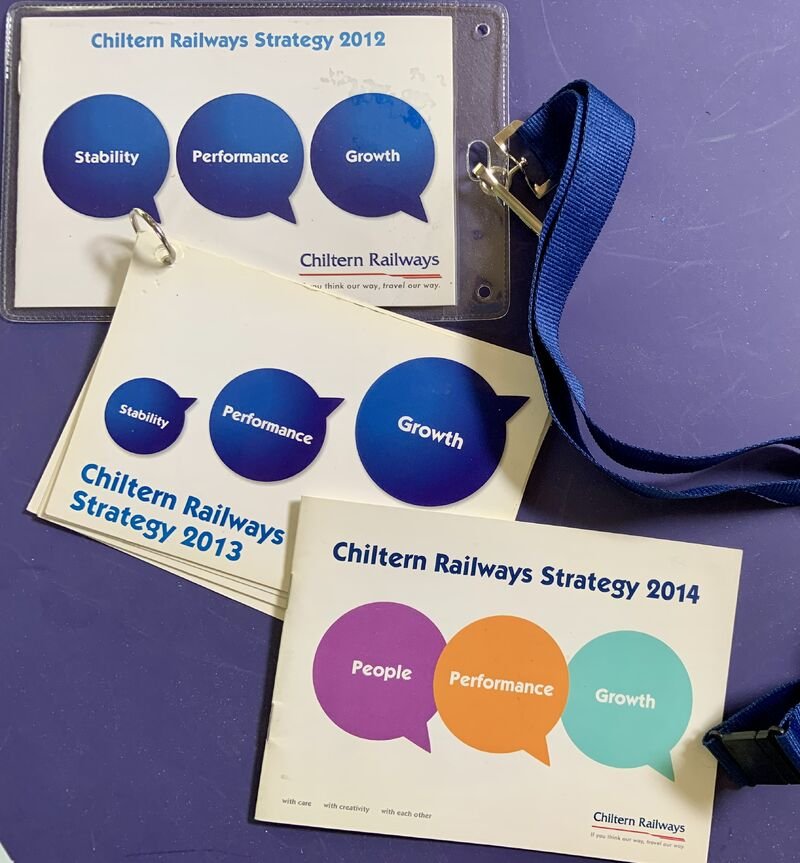
Dominic Cummings rather wrecked the reputation of three-word slogans (“Hands, face, space”, “Get Brexit Done”, “I’m a tosser” etc) but I’m something of a fan (of the slogans. Not of Cummings).
Ministers need to be super-clear on what they want and super-brief in saying it.
As at Chiltern Railways, make it fit on a lanyard.
Well, I hope that’s enough to get you started.
Do pass it onto Mr Burnham or Mr Streeting if you run into them.
This post continues next week with another seven ideas. Here they are.