Leadership is about direction, people and money - and escalations
I think I’m better able to judge whether Keir Starmer should go than you are.
No, I’m not being arrogant (not really) - it’s simply a result of a specific experience I’ve had that you probably haven’t.
In March 2020, I was running a digital transport startup.
Suddenly, the business was annihilated overnight. Covid restrictions effectively outlawed our product. As a digital business, we neither benefited from the standard Covid support grants (premises-based - we had no premises) or the transport-specific grants (vehicle-based - we had no vehicles).
And my team of software developers were all on three times the furlough rate and there was a digital business boom inspired by the new demand for online businesses.
So I had to make the team redundant.
It’s an experience almost none of us get to have.
Most of us go at 100mph from one job to the next; normally already mentally in the next one by the time we quit today’s.
If we do have a career break, it’s normally planned and therefore you’re in demob mode by the time it comes round.
The experience of going from 100mph leadership to nothing is eye-opening.
With a lot of free time, I reflected back on my own leadership.
I concluded (unsurprisingly) that I’d done some things well and some things badly.
What’s important
I also realised that there are only actually three things that matter for a top leader:
Setting direction
Appointing great people
Knowing where the money’s coming from
Subsequently, I added a fourth:
Making decisions in response to escalations
If you do all of those, everything else takes care of itself.
Setting Direction
This is so crucial. If your people don’t know where they’re meant to be going, they’re highly unlikely to get there. Organisations without clear direction can find lots of ways to be busy but that work is essentially unproductive. Teams in directionless organisations are especially good at making work for other teams, which means everyone feels productive but nothing is achieved.
Setting direction is more than just setting strategy; though this is absolutely crucial. It’s also about endlessly, constantly, repeatedly communicating it - using every opportunity.
Sir Keir is, I’m afraid, a great example of a directionless leader.
He’s neither set out a clear vision of the destination in words or in numbers. That’s how you end up with absurdities like the Department of Health putting vast time, effort and resources into abolishing the central organisation that sits above all the NHS Trusts (NHS England) while the Department for Transport is putting its time, effort and resources into creating exactly the same thing above the train operators (GBR).
If there was a clear central mission, teams wouldn’t focus in on themselves.
Appointing great people
This is also fundamental. So much of leaders’ lost time is in picking up the pieces of management disasters - or marking the homework - of their own people. Leaders need to be surrounded by a team they trust absolutely. Micromanagement feels essential if you don’t trust your people but it reduces the scope of what the organisation can achieve.
One of the things that’s become clear is that Sir Keir is terrible at choosing staff.
The fact that in just two years he has cycled through three Cabinet Secretaries, three Chiefs of Staff and four Directors of Communication tells us that he doesn’t make good selections first time.
From what I’ve heard, this is partly because he doesn’t put time into it. Certainly, we know now that he didn’t meet Peter Mandelson when he was appointing him as Ambassador to Washington.
We also know that he fired Sir Olly Robbins from his job at the Foreign Office without actually listening to Sir Olly’s reputation. Because I’m that kind of person, I watched Sir Olly’s entire appearance at the Select Committee and can tell you for definite that he shouldn’t have been fired.
Sir Keir is the classic overworked boss - he doesn’t appoint people he can trust, so is frantic himself, so he doesn’t have time to focus on the next appointment and has to make rushed decisions.
Knowing where the money’s coming from
Organisations run on money. When there’s lots, everything’s easy. When there’s not enough, everything’s hard.
Leaders should always understand where the money comes from. If your organisation’s money comes from customers, you should passionately care about customers. If it comes from investors, you should suck up to investors. If it comes from taxpayers, you should have a pretty clear story to tell on what you’re doing and why it’s good value. You also should never forget the “cash is king” rule: you actually need to know you can afford your own plans.
John Healey’s resignation last week was the ultimate nail in the coffin of the idea that Sir Keir understands the money of his organisation. This kind of resignation really should not happen. The Government should never end up in the position where it’s massively talked up a particular agenda as a national priority and then discovered it hasn’t got a way of paying for it.
This isn’t - by the way - a comment on whether John Healey’s right that we need to spend more on defence. But Keir has repeatedly said that we do, but then the money wasn’t there to fund it. That shouldn’t happen.
Escalations

Organisations are complex and it’s very easy for objectives to get out of alignment. I love this photo of four bendy buses in Oslo stuck on a roundabout last year. Each one can’t move because the one in front is in its way.
That’s how our organisations often end up: each department can’t move because it’s dependent on resource from another department, which is working on a different priority. But that department is also stranded because it needs resource from another department, which is also working on a different priority.
When someone says this to the leader, they need to instantly prioritise.
I’m not close enough to Downing Street to know firsthand, but Stephen Bush (FT associate editor and Freewheeling podcast guest) has repeatedly written that Sir Keir refuses to make decisions or adjudicate between cabinet members. His judgement is good enough for me.
So I’m afraid it’s a clean sweep: Sir Keir fails on all four of the tasks of a good leader.
Should he stay or should he go?
Sir Keir should go.
No leader fulfils all the qualities I’ve listed. Certainly not without effort. I didn’t.
But you need to be good at some of them and be willing to try to develop to fill in the rest.
By the way, what I’ve described here are tasks. They’re not the same as character. Lots of people who’ve met him report that Keir is kind, empathetic and intelligent. These are good characteristics in a leader.
But - ultimately - you also need to be able to do the work.
These aren’t tests I developed to put the boot into Keir Starmer.
I wrote them up as part of a much longer thinking exercise during the pandemic, which I’ve shared on this blog before. You can read it here, including my grading of my own performance as a leader.
So… what’s Andy Burnham like?
I work with leaders of transport authorities and operators. Contact me if I can support you.
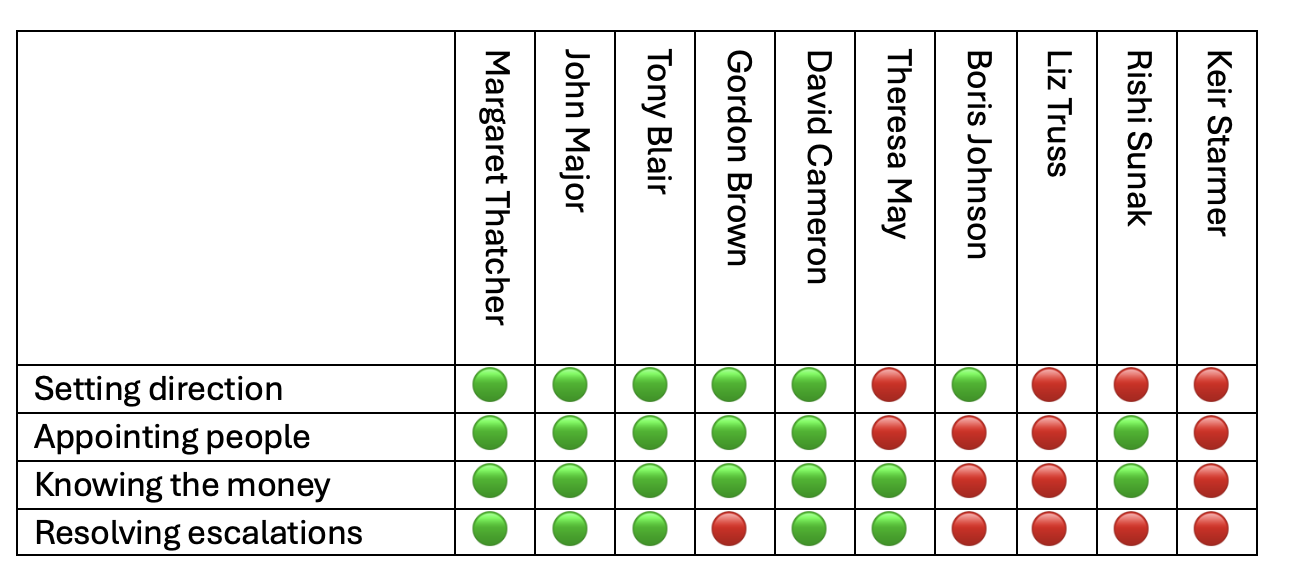
Just for fun, I’ve attempted to categorise all of the Prime Ministers of my lifetime against these four tasks, based on misremembered news reports and biographies. What do you think?
BTW - I’ve tried to focus on their capability at the task, not whether I agree with what they were trying to do - or whether the circumstances they were in made that task easier or hard.