Learning by doing not by modelling: Mini Switzerland
A Blog Post on a Real World Experiment
The week before last, I argued that transport integration creates network effects: meaning that connecting services together does not simply make a system slightly better, but disproportionately more useful.
It’s this insight that has made the Swiss system the world’s greatest public transport network, in which 23% of journeys in a rural country are made by public transport (in the East Midlands, where we’re hoping to demonstrate Mini Switzerland, it’s 6%).
One of the challenges we have is that we find it much easier to pilot technologies than systems. Government is (constantly!) providing funding for demand-responsive buses, but the assumption tends to be that networks are fixed and optimisation happens within them, rather than asking whether the structure of the network might itself be the problem.
As a result, debates about integration have persisted for decades without resolution.
Supporters argue that coordination increases usage and reduces subsidy dependency. Sceptics assume that integration simply adds cost. Both positions are largely theoretical because very few places have attempted to demonstrate what happens when services are deliberately redesigned to function as a single network under British operating conditions.
Rather than continuing that abstract debate, I wanted to see whether it could be tested in practice.
That’s where Mini Switzerland comes in.
Mini Switzerland
Instead of writing about this on a blog, I’d like to make change happen in the real world and demonstrate what this can look like.
Last year, I posted on LinkedIn calling for places interested in partnering to run a real-world experiment in integrated transport to get in touch.
Hope Valley Climate Action, a community group in the Peak District, did so. It was immediately clear that Hope Valley was an ideal location for a Mini Switzerland demonstrator project. It sits on the rail line linking Manchester and Sheffield, with five stations serving a series of villages spread across a National Park landscape less than an hour from one of the UK’s largest cities. It already has a regular, hourly train service - exactly as a Swiss rural railway would do.
We applied for a grant from the Foundation for Integrated Transport (FIT), and used this to put together a detailed plan for how integration could work in practice.
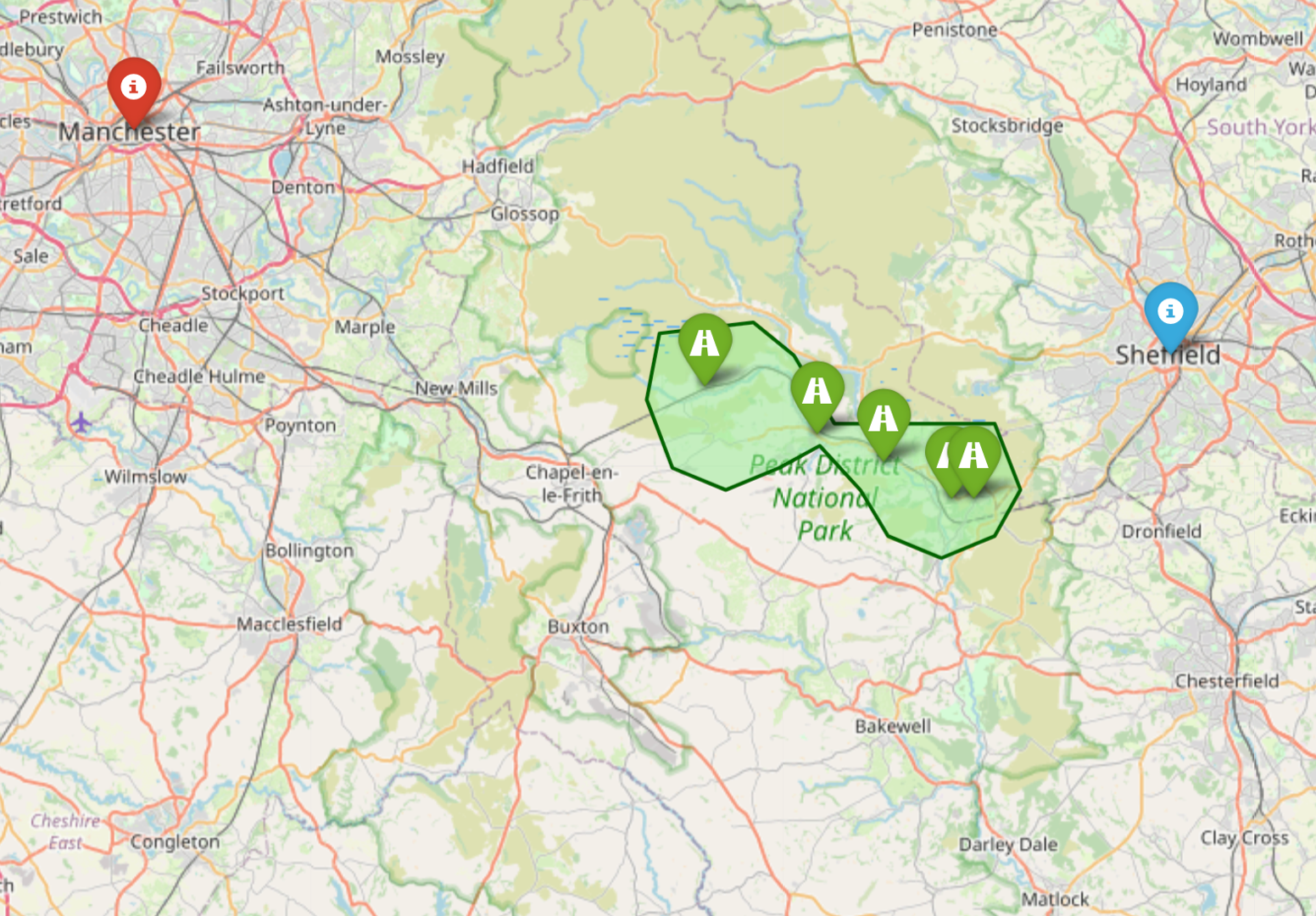
The location of Hope Valley’s five station on the rail line linking Manchester and Sheffield
In summary, the plan is to turn the villages in the Hope Valley from the first diagram in last week’s post into the second. In the process, we hope to demonstrate that more people will use the routes - and that it offers huge wider benefits.
To illustrate just one of those benefits: the Hope Valley is a stunningly beautiful National Park landscape, less than an hour from Manchester by train.
Around a third of households in Manchester do not have access to a car.
Yet, Mancunians do not get the train to Hope and then the local buses out into the hills.
Why not?
For all the usual British reasons: the buses don’t serve the station, don’t run at the right times, don’t have integrated fares and - in short - don’t feel a connected service.
Mini Switzerland aims to remove the barriers to people arriving by public transport so we can all observe what happens next.
Mini Switzerland will give everyone in Greater Manchester access to the beauty of the National Park, and everyone in Hope Valley access to the economic opportunity of Greater Manchester. This is the network effect in action - but in real life.
You can read more of our plans for Mini Switzerland here.
Crucially, most of the underlying costs already exist. Vehicles are already leased. Drivers are already employed. Track is already maintained. The experiment is therefore not primarily about spending more money, but about discovering whether coordination unlocks latent value already embedded in the network.
Why Demonstrators Matters
One of the persistent challenges in British transport policy is that arguments are often settled through modelling rather than observation. Forecasts attempt to predict behaviour decades in advance, while comparatively little effort is devoted to running controlled real-world demonstrations at a modest scale.
Mini Switzerland takes the opposite approach. Rather than attempting to prove integration through analysis alone, it seeks to create a functioning example and measure what changes. Transport Focus have offered to do the research.
If usage increases are materially greater than increases in cost, the business case for integration starts to write itself. If little changes, that is equally valuable learning.
Either way, the debate moves forward.
A Volunteer-Led Project
This is a volunteer-led project. I’m doing it entirely for free (I have taken no payment, including from the FIT grant that we won), which I am able to do thanks to clients elsewhere in the country who are keen to hire me to support transport change-making in other contexts.
The intention has never been to create a one-off curiosity in the Peak District. The ambition is to demonstrate a model that other places can adapt to their own geography and operating realities.
So could there be a Mini Switzerland near you?
Hope Valley is unlikely to be unique. Across Britain there are dozens of places with broadly similar characteristics: an existing rail spine, local bus services operating nearby, strong leisure or employment destinations, and communities who would benefit from better connectivity without large infrastructure investment.
Many of these places already incur the costs of running transport services that function only partially as networks. Changes to coordination, interchange design and timetable structure could plausibly unlock much greater usefulness from what already exists.
Mini Switzerland is therefore intended as the first demonstrator rather than the final destination.
If you represent a local authority, transport authority, community organisation or regional partnership interested in exploring whether integration could work in your area, I would be very interested in hearing from you. The aim is not to replicate Hope Valley mechanically, but to build a growing pipeline of real-world demonstrators from which the wider transport sector can learn.
Britain’s transport network is already one of the most extensive in the world. We may not need vast numbers of new lines; what we may need is to allow the existing ones to start behaving like a network.
If that sounds interesting - whether as a supporter, partner or potential future site - please do get in touch.
My day job is enabling transport change-makers. If this includes you, I’m happy to help. Drop me a line.