Why Integrated Transport Partly Pays for Itself
A blog post on why integration Benefits from Network Effects
Network effects
One of the reasons investors loved my startup Sn-ap is that it was a network effect business.
Network effect businesses are investors’ holy grail, because they tend to be successful and profitable.
A network effect business is one in which increasing the size of the network makes it disproportionately more useful to everyone.
A coffee shop is not a network effect business.
Assuming there are enough customers in your local coffee bar to pay its way, if more people start going there, it makes it worse for you, not better. Similarly, if the coffee bar becomes a chain, it makes very little difference to you in your local branch. The ideal coffee bar is one that not many people know about. Then you don’t have to queue.
Sn-ap, my startup, was a two-sided marketplace connecting customers and operators to run leisure travel trips. It was like Uber for intercity coaches.
It had multiple network effects. Because our timetable was built in response to demand, each user increased the number of places we could serve that day. And because our trips were run by independent operators providing their own vehicles, more users resulted in more operators - which resulted in more trips generating more users which… [you get the picture].
The other reason investors like network effect businesses is because they’re sticky. The pandemic killed Sn-ap while it was still young but, had it grown, it would have been hard to replace as the operators would want to be where the customers were and the customers would want to be where the operators were.
The same dynamic is why Twitter is still the most popular microblogging site, despite being owned by a neo-Nazi. People still donate free content to Elon Musk, many several times a day, because that’s where their followers are. (I wrote about the need to use regulation to address this flaw here).
Transport
Transport operates to a different series of network effects. They’re not consumer-led; they’re connectivity-led.
Connecting the network makes it possible to go to disproportionately more places.
At the most basic level, let’s imagine you had funding to build two 5km railway lines.
You look at a map and decide to connect A and B with one line and C and D with the other line.

Your mate looks over your shoulder and suggest that, instead, you connect A to B and B to C. It costs the same, but even though you’re serving fewer places, everyone has more places they can go:

By replacing two individual lines with a network of two connected lines, you’ve made the network more useful for everyone.
This is something that the UK, with a rail network built by competing Victorian operators, is still bad at.
The first Underground railway in the world, the Metropolitan line, passes directly in front of the first long-distance rail terminal in the world, Euston. But despite both having been on that site for 162 years, they are still not connected.
Across the country, rail services miss each other, and rail and bus services fail to connect.
This is important, as it means that one of the largest, densest rail passenger networks in the world isn’t actually a true network and misses out on the (largely free!) benefits of the network effect.
To illustrate my point, let’s look at how transport works in a typical British town:
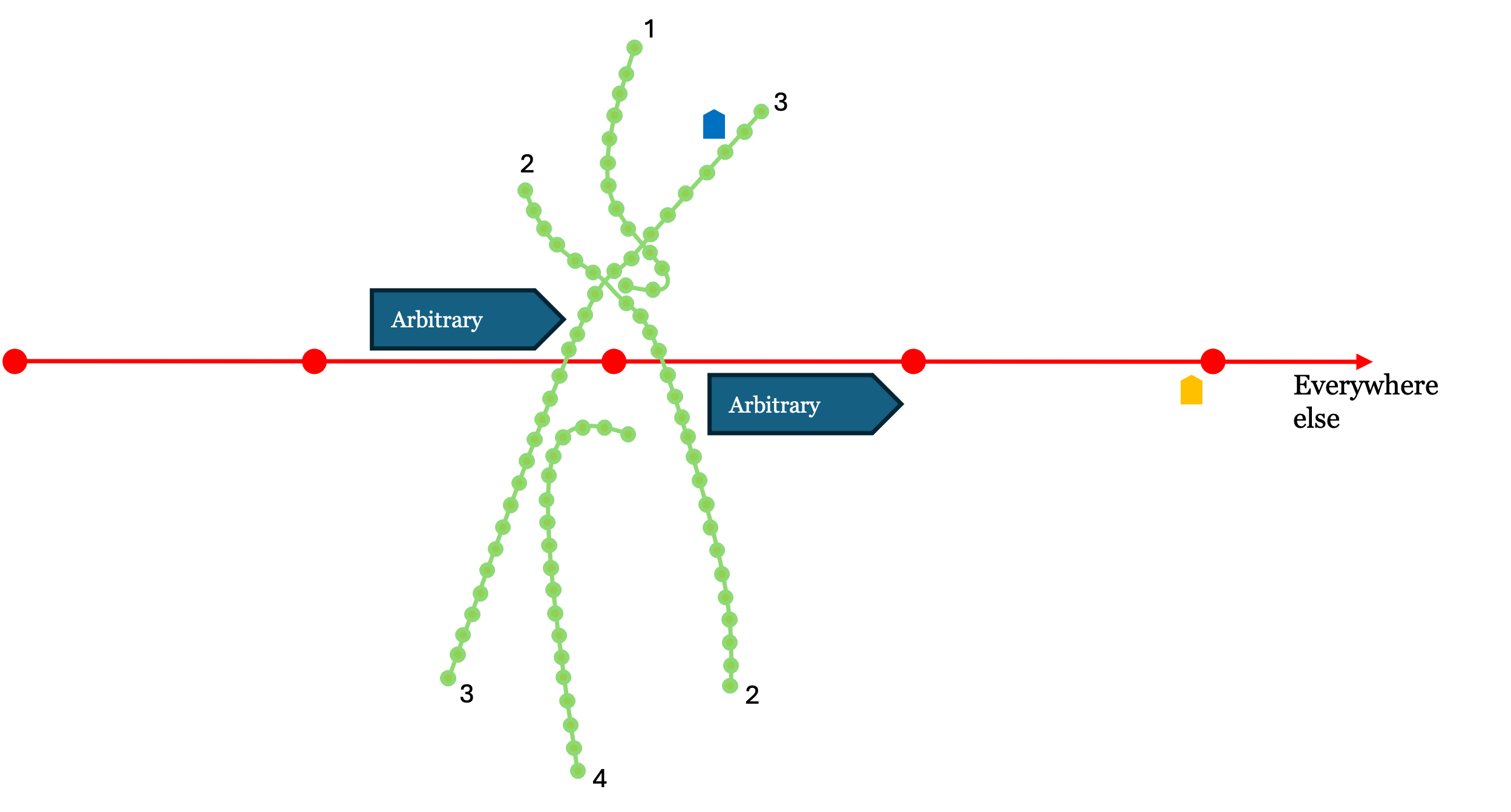
“Arbitrary” refers to the times of the buses and trains. When I looked back at this diagram, that wasn’t remotely clear but I couldn’t be bothered to change it.
As you can see, there’s a railway line through the middle of the town and various bus services into and out of it.
While the bus services all serve the centre of town, they aren’t designed to connect with the railway station.
A determined passenger (someone like me - I do this a lot) can force a connection out of them, by walking from the station to the bus stop - but most people won’t do that. People don’t like wandering around strange towns.
The blue arrows show the times the buses and trains arrive. As you can see, the timings are arbitrary - planned separately and without coordination on each route. This means for someone connecting, the timings are often inconvenient. It’s not uncommon to have to spend longer waiting for the bus than the time you spent on the train.
It’s also worth noting that the bus routes largely don’t connect with each other. Even if they are physically proximate, they’re not a network. Fares (such as the Government’s £3 price cap) are generally sold as single tickets and because of those arbitrary arrival and departure times, the timetables don’t connect up. Who’s going to spend £6 crossing town with a 45-minute wait in the middle?
In this imaginary town, I’m lucky: I live on bus route 3, which serves more destinations than any other. That’s my house: the blue one on the map. I can therefore get to 27 other places - all the other places on route 3. However, if I want to go anywhere else, I’ll drive.
If I get a job in the local city, I may prefer to commute by train. At that point, it makes sense to live close to the railway, so I might move to the orange house. But while I can now access the places that the train runs to, I cannot access all the places served by the bus.
I would like to emphasise that when I say “cannot access”, I realise that it’s possible. But normal human beings won’t actually do it because the barriers of disconnected fares, disconnected places and disconnected times are just too great. If you want to check what I’m saying, get off a train at any provincial town in the UK and walk to the bus station. You’ll leave the station with all the other people leaving the station but by the time you get to the bus station, no-one else from your train will be with you.
Now let’s see how this town would look in Switzerland:
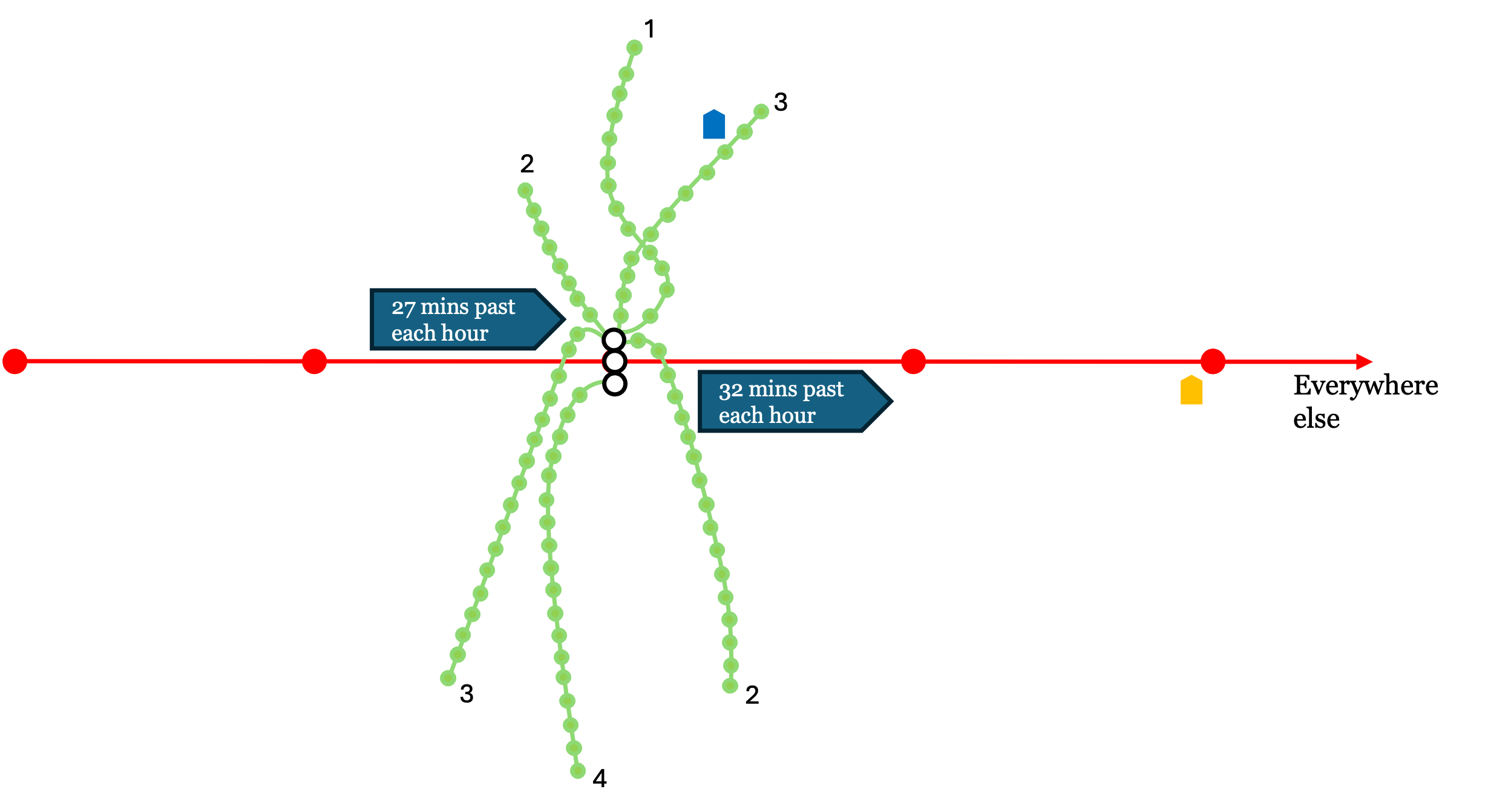
The first blue arrow shows the times all the buses and trains arrive. The second blue arrow shows the time the buses and trains all leave.
Here’s the map. The most important thing to note is that the actual bus routes are largely the same. All we’ve done is tweaked them to connect with the trains. That means serving the railway station directly and making them arrive and leave at the same time as the train.
Look at the blue arrow. This tells us that all the trains and buses arrive at 27 minutes past the hour and leave at 32 minutes past the hour. During that time, people can connect between services. They can connect from train to bus, bus to train or bus to bus.
Look what that’s done to my connectivity from my original home in the blue house. I can still get to the 27 other places on route 3, plus the 37 other places served by other bus routes and all the places served by the train. Suddenly, everyone is connected to everywhere else. (I also no longer need to move to the orange house to commute to the city by train - or to drive).
This is why I think people assume the Swiss network costs the taxpayer more than I suspect it does in reality.
In both the British and the Swiss town, all of the costs are being incurred. Buses are being leased and drivers employed to run four bus routes. Track is being maintained and train services run on the railway. Those costs are largely unchanged whether you’re British or Swiss. (That’s obviously untrue - Swiss wages are much higher, but we can ignore that, as won’t be employing Swiss people. We also won’t get such good cheese. Such are the pros and cons of not being Swiss).
Yes, there are some marginally higher costs on the Swiss network. The timetables can’t be made perfectly operationally efficient as they need to arrive and leave at pre-determined times. There needs to be a dedicated bus facility at the station, which will need building. But these are marginal compared to the benefits.
The integrated fares means a through fare is likely to be lower than two single fares, but this is irrelevant as no-one is buying two single fares as no-one is currently connecting.
However, set against these marginal increases in costs is the enormous increase in revenue from all the services, not becoming slightly more useful, but exponentially more useful. This is the bit about the Swiss network that people forget. People use it more. The buses are busy because they are feeders to the trains. The trains are busy because they’re carrying people to the buses. This is a network effect in action.
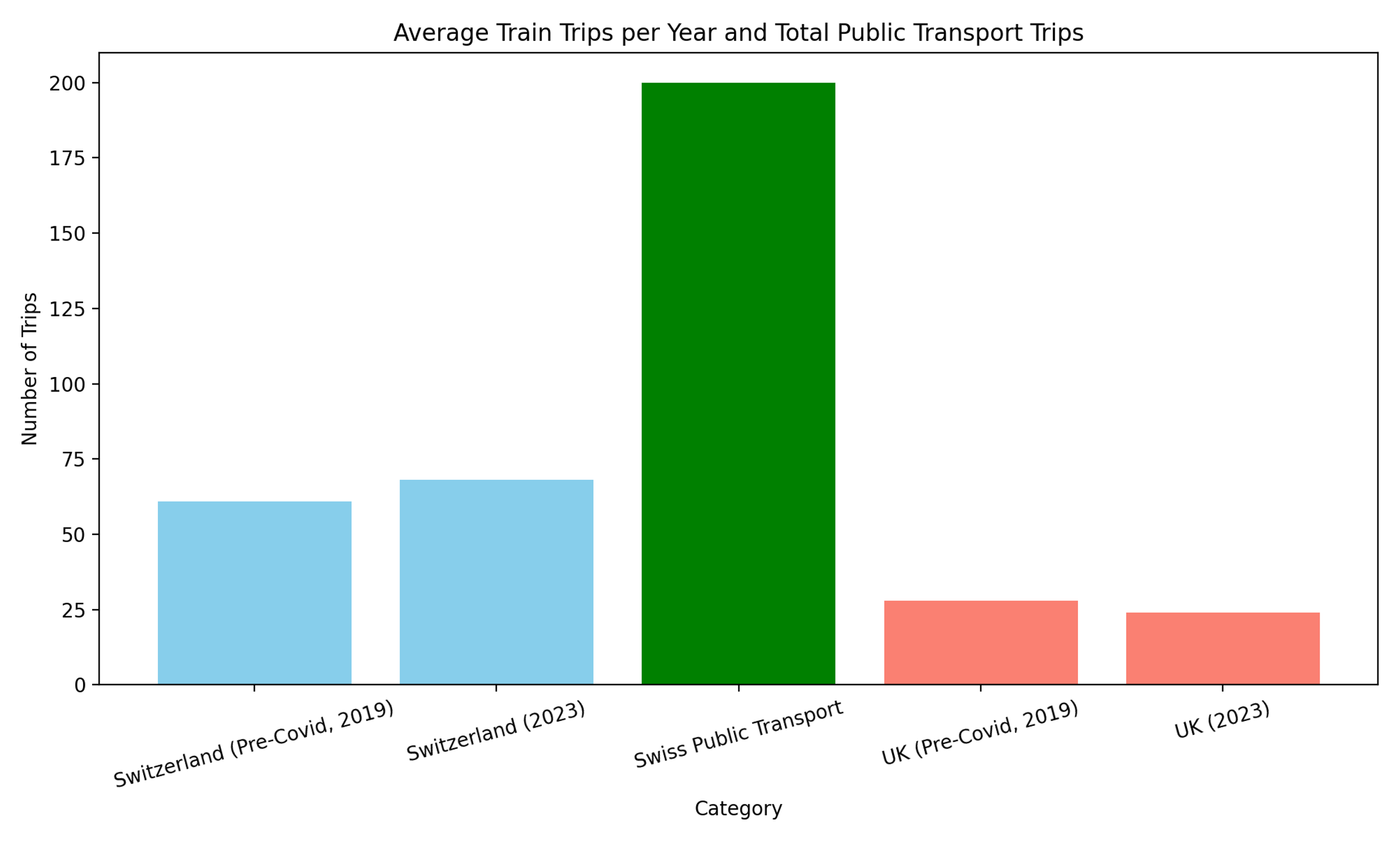
The graph shows the number of train trips made per person each year in Switzerland (blue) and the UK (red). The Swiss travel by train twice as much as we do. That’s despite Switzerland being a more rural country with no train-dependent cities like London.
Now look at the green bar. This shows the total public transport trips per year. It’s very high. It’s impossible to know what that figure is in the UK as we don’t measure it (as we don’t have an integrated network) but I’m going to strongly suggest to you that it won’t be anything like this number.
(It’s also worth noting that Swiss rail use has gone up since Covid. They didn’t cut back frequency like we did).
If you look down the list of the most valuable companies in the world, you’ll see it’s dominated by businesses with strong network effects. Amazon, Google, Meta, Tesla - all benefit from strong network effects. Network Effects are profitable.
The British transport system so nearly benefits from strong network effects. Everything is there in theory - it’s a state of mind to start the work to turn it into reality.
My day job is enabling transport change-makers. If this includes you, I’m happy to help. Drop me a line.
With colleagues at Beta Mobility, I have developed an Integrated Transport Programme. It's designed for city and regional leaders who are responsible for transport and need to design their organisational, governance and outcome structures to make it possible. If that's interesting, please get in touch.

I focus on supporting organisations get themselves in shape to make transport better. But what are the policies that work? I particularly recommend The Transport Leader Newsletter as a place that consolidates complex policy into simple solutions. I’m not being paid to say so - I just think it’s good!