What Next for the People People? Part 1
A post about improving HR
HR as an industry
Different industries have different norms.
The rail sector has developed a taste for excess syllables (“this service will be terminating at the next station stop”).
The supermarket sector convinced itself that people wanted more and more choice in bigger and bigger boxes until Aldi/Lidl came along and proved the opposite.
Apple became the most valuable company on earth by recognising that while the computer industry wanted to talk about customisable RAM, consumers just wanted a computer.
The HR industry is no different. Unfortunately, its norms affect every organisation of a certain size.
Some people have found a way around this. One of my first hires at my startup Sn-ap told me that, if we were successful, he wouldn’t be with us until the end as his key principle was “never to work for a company big enough to need HR”.
I get why he took this view. There’s definitely a touch of the Millwall about HR: “no-one likes us; we don’t care”. They see it as their role to tell difficult truths to both managers and employees.
But, as a result, they’ve tended to drift into their own space.
I should, by the way, make it absolutely clear that I’m talking about the norms of a sector, not individuals here.
In each of the organisations I’ve worked in that do have HR, that function has been led by one of my favourite people in the whole place (David Goldstraw at National Express, Rebecca Ward at Chiltern Railways, Paul Hymers at TfL).
But the norms and culture of the wider HR function tend to be somewhat different.
Obeying the rules
Partly this results from a tendency common to any function for whom interpreting the law is a big part of the job: the tendency to become the advocate for the rules, as opposed to the advocate for the company’s mission. (Procurement and legal have the same pathology).
Instead of explaining to managers how to achieve their goals in the context of rules by which we all must live, they can slip into simply stating what the rules don’t allow you to do – and then leaving the manager or employee with their problem unsolved.
The best HR people are the ones who start the conversation with lots of questions about what you’re trying to achieve and why. The more common ones are those that start (and end) the conversation by telling you what the law (and company policy) permits you to do.
In it for the organisation, or in it for HR?
I think there’s another reason HR has such a defined internal culture, though.
I lived my early career through the period in which HR was determinedly rebranding itself from “Personnel”. Fed by HR industry magazines, there was a determination that HR was going to be a leadership function (with an “HR Director”), whereas Personnel had been a support service.
Given humans are often the biggest cost for a company, the rebrand to Human Resources was about highlighting that managing this human “resource” is one of the most important things a company does. Thus HR should be one of the most important functions.
A tendency to be more interested in your own discipline than the company’s goals is not unique to HR, by the way. Software developers can, if not kept in check, prioritise developing tech that will look good on Github even if not strictly necessary to the product.
Unfortunately, no-one spotted that the language of Human Resources is somewhat dehumanising. Humans are resources, but they are not only resources. They are also people.
In recent years, this problem has also been recognised, and HR as a title itself is now being displaced with the less dehumanising “People”. LinkedIn data confirms that “Chief People Officer” is one of the fastest-growing jobs being advertised.
But, so far, the culture of new people teams tends to be the same culture as the old HR team: the dehumanising approach based on rules, policy and incentive frameworks with an added layer of wellbeing and “bringing your whole self to work”.
Luckily, this is an area where parts of the entrepreneurial sector has a lot of learning to offer.
A Worldwide Misunderstanding
To get started on how people teams need to change, it is well worth watching this TED talk.
(You may already have seen it. It is quite well-known. If not, take a few minutes out to watch it now)
The point Dan Pink is making is that not only the HR industry, but the entire business world has misunderstood how to get the best out of people. For decades.
Inspired by Henry Ford’s production line, we have created entire organisations run like the famous Michigan factory: tightly defined roles with very specific measures and monetary rewards for good performance.
The only problem: it doesn’t work.
As Dan Pink says, “These contingent motivators - if you do this, then you get that - either don’t work or, for a lot of circumstances, do harm. This is one of the most robust findings in social science and one of the most ignored.
If you look at the science, there’s a mismatch between what science knows and what business does.”
The thing is, it does work for a production line. But the type of role that this performance system was created for in the early 20th century was largely automated by the late 20th century.
A lot of 21st century work, full of uncertainty and complexity, needs to be managed and motivated in a totally different way.
Start-ups are really good at this.
Autonomy, mastery and purpose
In the TED talk, Dan Pink talks about the intrinsic motivations that drive good performance.
He identifies these as “autonomy, mastery and purpose.”
He hasn’t just made this up: it’s been pretty well researched.
The problem is that the infrastructure of HR teams tends to lead in the other direction. Tightly defined job descriptions, hierarchical organisations and performance management systems designed around objectives are not just unhelpful, they are damaging.
I have lost count of the number of times HR folk have said to me “it’s not about people” when designing a restructure. What they mean is that the idea is to design roles and structures first and then populate them with people (i.e. human resources) afterwards.
But, when you think about it, that is somewhat bonkers.
What frequently happens is that you design one role bundling activities A, B and C and another bundling role activities D, E and F. But when you come to fill these roles, you find that the best applicant is really good at A, B and F.
As “it’s not about people”, however, they don’t get to do F (which frustrates them as people like mastery) and the organisation gets F done by someone less good at doing F.
Moreover, the winning applicant may bring a skill that wasn’t in the JD.
It wasn’t in the original JD as it wasn’t deemed as valuable. But, crucially, with this person doing it, it would be valuable - because they like it and are good at it. Give them the autonomy to do it and they’ll probably add more value than unwillingly doing the thing you recruited for.
In a factory production line, this flexibility would be hopeless. In the modern economy it is essential.
But the JD’s been written and “it’s not about people”.
It doesn’t have to be like this
Startups tend to be inherently better at solving this problem because they’ve built themselves up organically. They couldn’t start with fixed JDs, so there’s a lot more fluidity.
With the right leadership, this fluidity can last.
Octopus Energy was a £billion company when its founder Greg Jackson recorded this podcast (scroll to episode 5) in 2021. It employed 1,200 people. Not big but certainly not small.
It’s worth quoting from in detail:
“First of all, we got a concept. We talked about the dry stone wall.
Now, I don't know whether you know about dry stone walls. But a dry stone wall is a way in which people build walls without using cement.
So with the walls most of you are familiar with, you have a brick, there's a perfect cuboid. And you cement it onto another perfect cuboid. And they all make a perfect straight wall.
Dry stone walls date back millennia. There's still dry stone walls around from Roman times here in the UK. And the way they work is the person building the wall looks at each stone, natural stone, and identifies how it will best fit with the others.
And they start stacking them and there's no cement. That's why it's called dry stone. And instead, it gets a strength from how well the natural shape of those stones fits together. And that strength means they can last millennia, whereas traditional cemented walls have real problems like water ingress, freezing, cracks in the cement and the wall starts to fall apart.
Now most companies recruit people, we’re all different shapes, then they try and turn them into bricks, they knock the edges off, and they try to make straight lines, because it's easier for them to construct the wall like that.
It's harder to do our way, which is really getting to know an individual and really getting to know where their strengths will fit against those of others.
But if we do that well, instead of chipping off some bits off someone that are incredibly valuable, and then trying to get them to do some stuff that's just not them, we're able to really try to enable people to contribute what they are naturally best at and then enjoy the most”
At TfL, I was responsible for Strategy. My JD included Estates Strategy. I know nothing about Estates.
(I told my daughter I had the job of writing a strategy for all TfL’s buildings. She said “Why do buildings need a strategy? Wouldn’t the strategy say ‘Let them all just sit there’?” I suspect my effort would have been along those lines)
Luckily, TfL’s director for Operational Planning had a real interest in this area, and was keen to take it on. So he and I agreed that he would. And he did. But it took 18 months to formalise this change as Strategy was my job.
I may be wrong, but I think making this change would have been easier in Octopus Energy.
And this is relevant, as Octopus survived the energy crisis when most of its peers didn’t, won best company to work for in 2022 and were voted one the 50 best places to work in 2022 on Glassdoor.
So this stuff works.
It’s not just startups
Let me take you to Northumberland Park Depot. I have a fondness for Northumberland Park Depot as it maintains the fleet of trains on the Victoria line that have taken me to school and work since I was eleven.
I visited Northumberland Park in March 2024 and what I found was a team of people that was positive, engaged, absolutely on-top of their performance targets and focused on what needed to be done.
Staff on the ground spontaneously told me of the culture of empowerment in the depot: the manager made sure everyone understood the outcomes that needed to be achieved, but teams were left to figure out how to get there themselves.
You cannot get a more hierarchical industry than rail, a more safety-critical environment than a rail depot and a more rules-based organisation than London Underground.
Yet Andy, the manager, was able to make this culture work. It obviously wasn’t Octopus Energy’s but it was the right one for this environment. And it was working: the staff engagement at Northumberland Park was more than 10% higher than the TfL average, despite being an operational environment with multiple shifts and most people working nights.
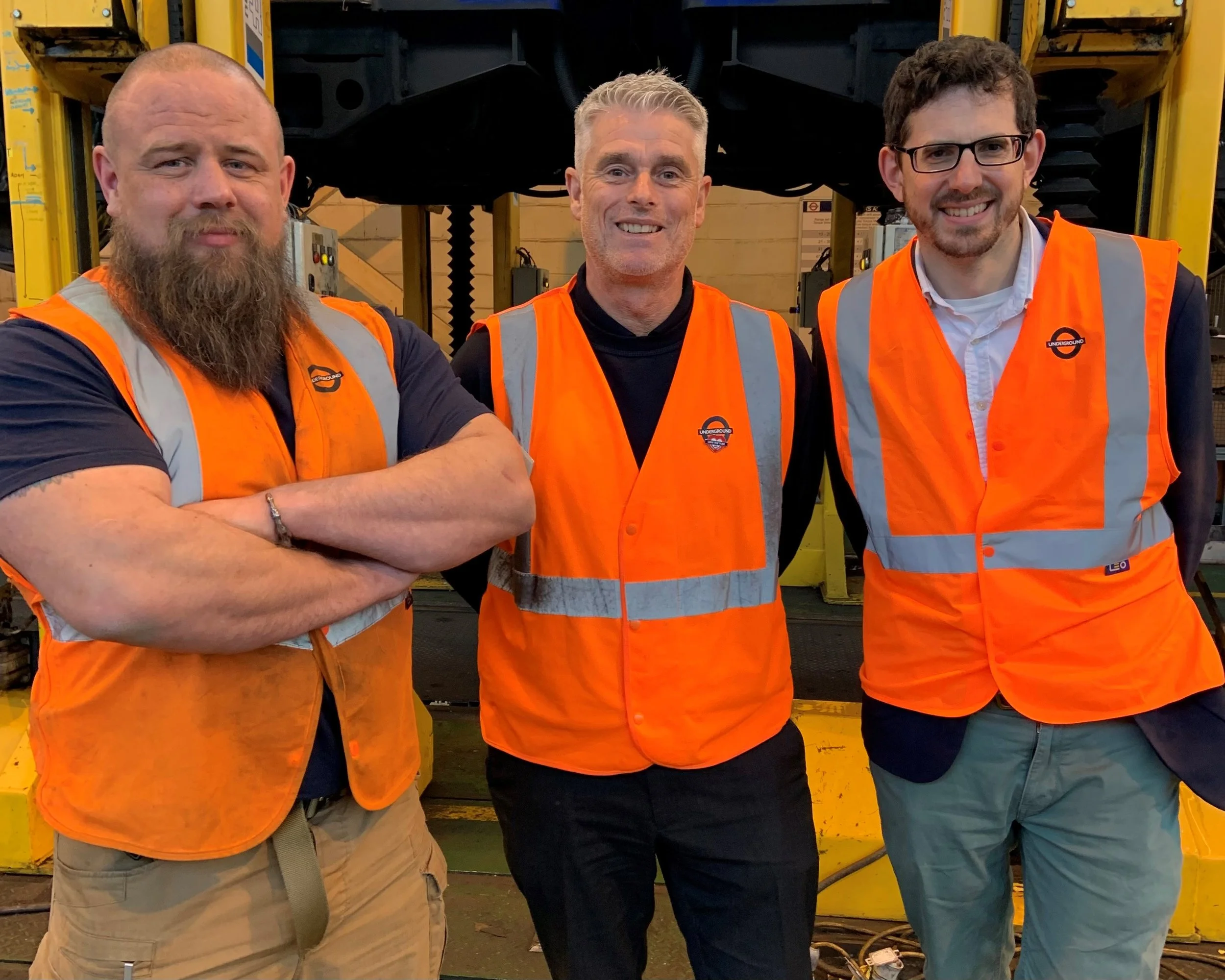
Depot Manager Andy, centre, with me and colleague Ali
Step forward the People People!
Greg, the founder of Octopus Energy, has concluded that HR would harm his company, so he hasn’t got it.
Andy has built an empowered team in an organisation with a huge HR function.
But my guess is that most of his interactions with HR won’t have been massively helpful in terms of building the empowerment culture that he’s succeeded in creating.
What, in future, should the role of the people people in organisations actually be?
That’s a question we’ll seek to answer next week.