“I was born in Liverpool, but I grew up in Hamburg”.
These words of John Lennon should also speak to any British transport planner who wants to know how to make our cities healthy, happy and prosperous.
It was in the 1960s that something truly radical emerged in Hamburg - that would go on to capture the attention of people all around the world.
Yup, if I’d been a young person then, I’d almost certainly have ignored the Beatles in favour of the concept of region-wide integrated transport.
Because shortly after the Fab Four took the US by storm, the Hamburgers were onto their next big idea: Der Hamburger Verkehrsverbund or HVV.
This week marks HVV’s 60th birthday, so let’s have a look round Hamburg together.
Integrated transport
There were already large integrated transport networks, but these tended to be huge organisations that operated everything themselves.
In 1933, London Transport came into existence as the operator of the bus, tram and tube networks in London.
But it wasn’t fully integrated transport: the rail network continued to operate with separate pricing and timetabling policies. To a significant degree, it still does.
In general, the customer experience represented operator boundaries. If you wanted to integrated (as in London), then you needed a bigger operator. There was very little attempt to integrate across transport modes unless the same firm happened to operate both modes.
This meant public transport often just wasn’t very convenient.
Even within the same city, a journey requiring a train, tram and bus would require planning, coordination and multiple separate ticket purchases.
And, as a result, public transport was failing in the face of the private car.
Hamburg decided to do something new.
Have a read of this article from the New York Timesin 1970. It describes how:
The city‐state of Hamburg — West Germany's largest metropolitan area stretching 40 miles from one side to the other — has become a mecca for public transport officials from all over the world. They come to this North Sea port to see the world's first integrated transport community.
Do read the article in full - it describes almost everything that every Combined Authority in Britain wants to make happen, including integrated ticketing, frictionless journeys, a single brand. It was all there, in Hamburg, in 1966.
It worked. In 1969, the third full year of the integrated service, 3 per cent more passengers used the HVV’s services than in 1968. By contrast, other West German cities lost 5 to 10 per cent.
And it’s continued to work.
Transport as the pathway to riches
Hamburg has always been prosperous but back in the 1960s, it was only a bit above the European average (as far as I can tell from the data I can find; I don’t speak German). Today, GDP per capita is 95% higher than the European average - higher than London, itself the richest part of the UK.
Now, you might say: of course Hamburg’s rich; it’s a major historic port.
Which is true.
But as Scousers will tell you, being a major historic port is no guarantee of long-term prosperity.
Hamburg did a better job of keeping the port jobs, but a modern integrated transport network has also done a great job of building a modern, integrated economy. Look up the major economic sectors of Hamburg and you’ll see a list of… major economic sectors; everything from media to life sciences, banking to plane-building.
This is a city doing what a city is meant to do: acting as a matching process between jobs and talent, and allowing as many people as possible to do the jobs in which they’ll be most productive. It only works with high-quality transport.
To show you what I mean, let me show you around.
A short city tour
First of all, let’s go first to HafenCity.
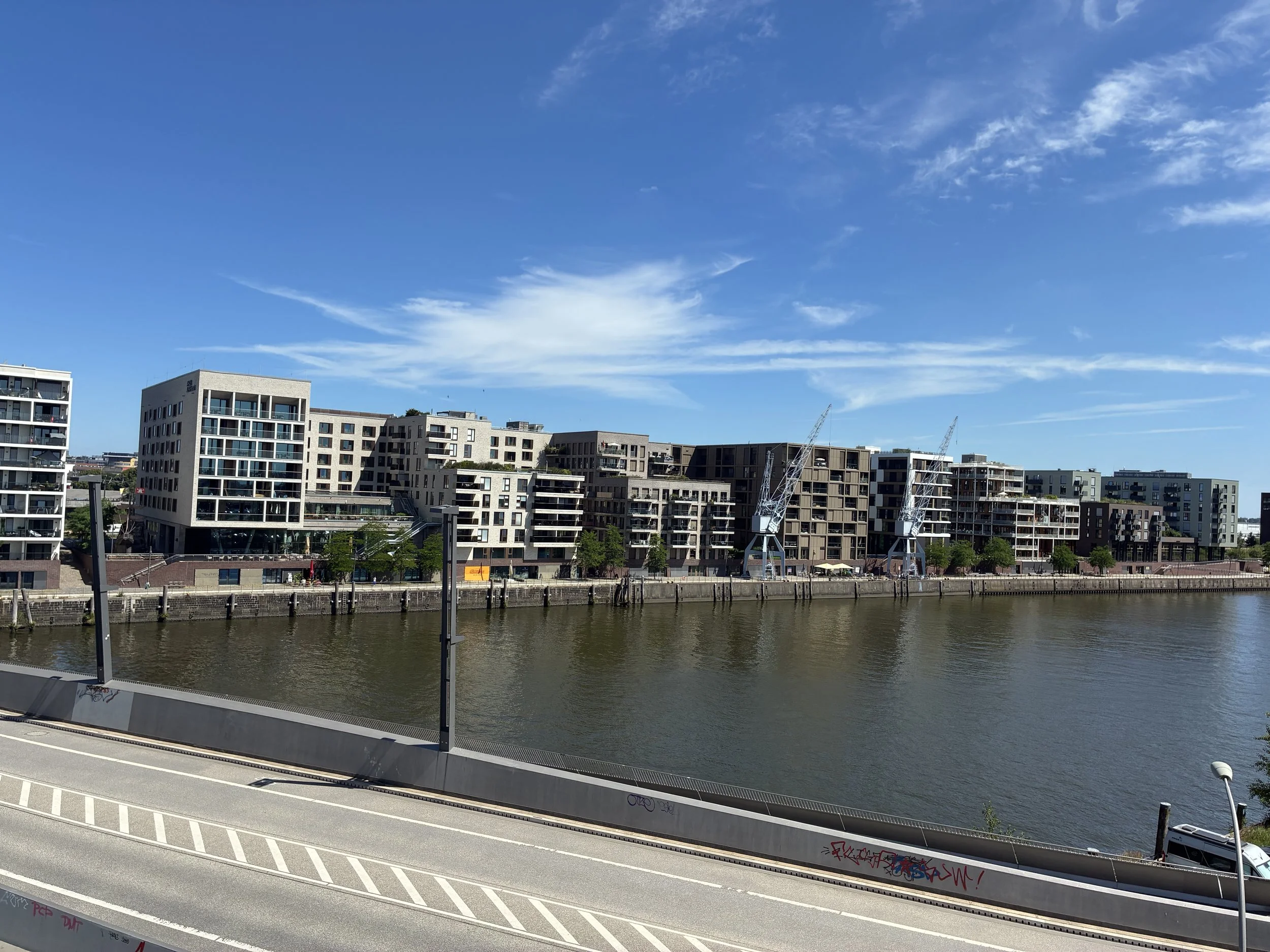
HafenCity, photographed from its observation deck. Yes, I know it looks just like every other Docklands regeneration in Europe…
HafenCity is 2.4 km² of docklands regeneration. You’ll know the kind of thing if you’ve been to London’s docklands. You won’t if you’ve been to Merseyside’s or the North East’s or Wigan’s or any of the former industrial land in Britain’s cities outside London.
Why did this scale of development prove possible in London and Hamburg, but nowhere in the North of England? It can’t be because Greater Manchester’s not big enough - its population is not dissimilar to Hamburg’s.
London’s development was made possible by the DLR, Jubilee line and Elizabeth line.
HafenCity is made possible by…. ah, this:
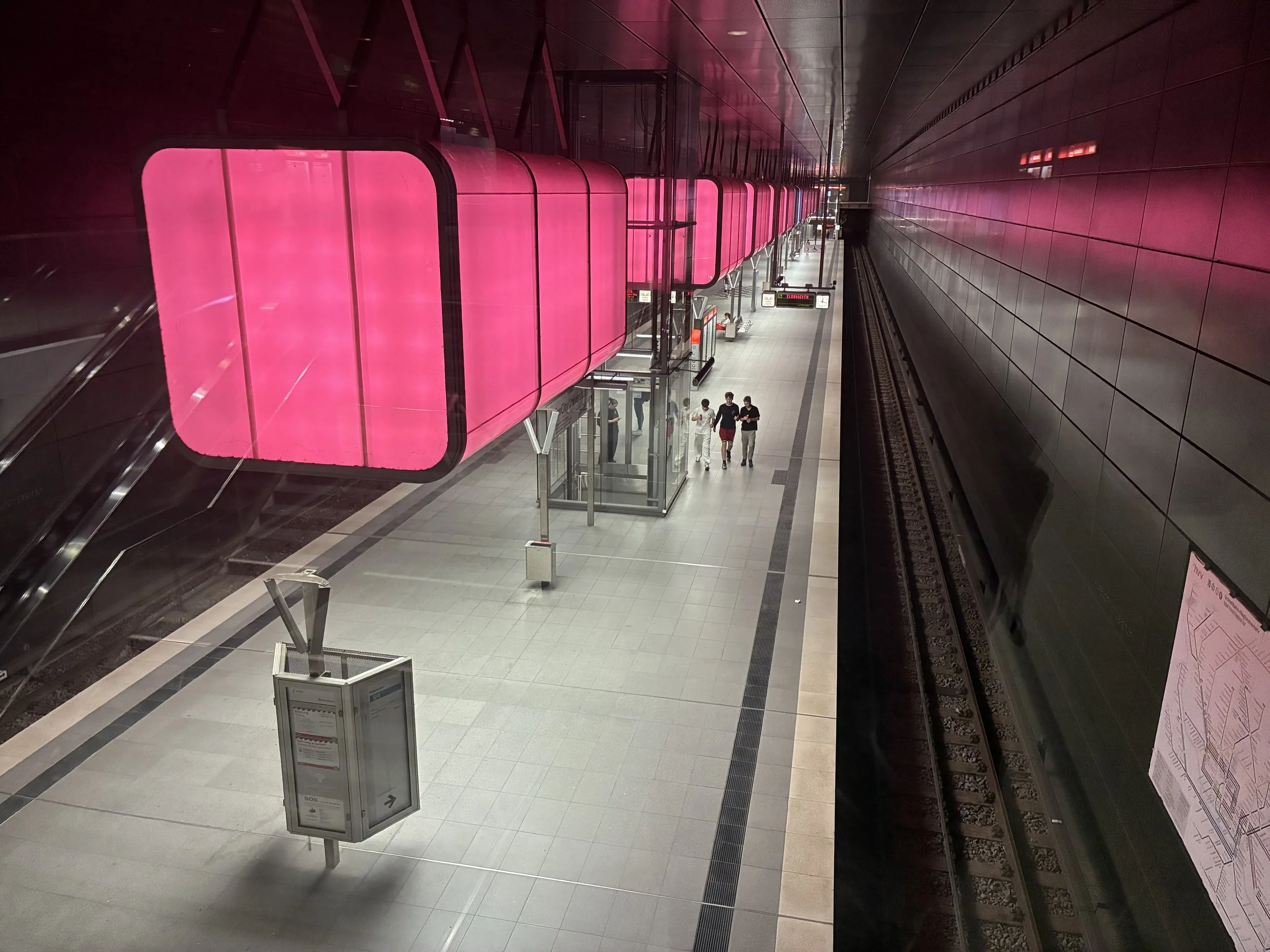
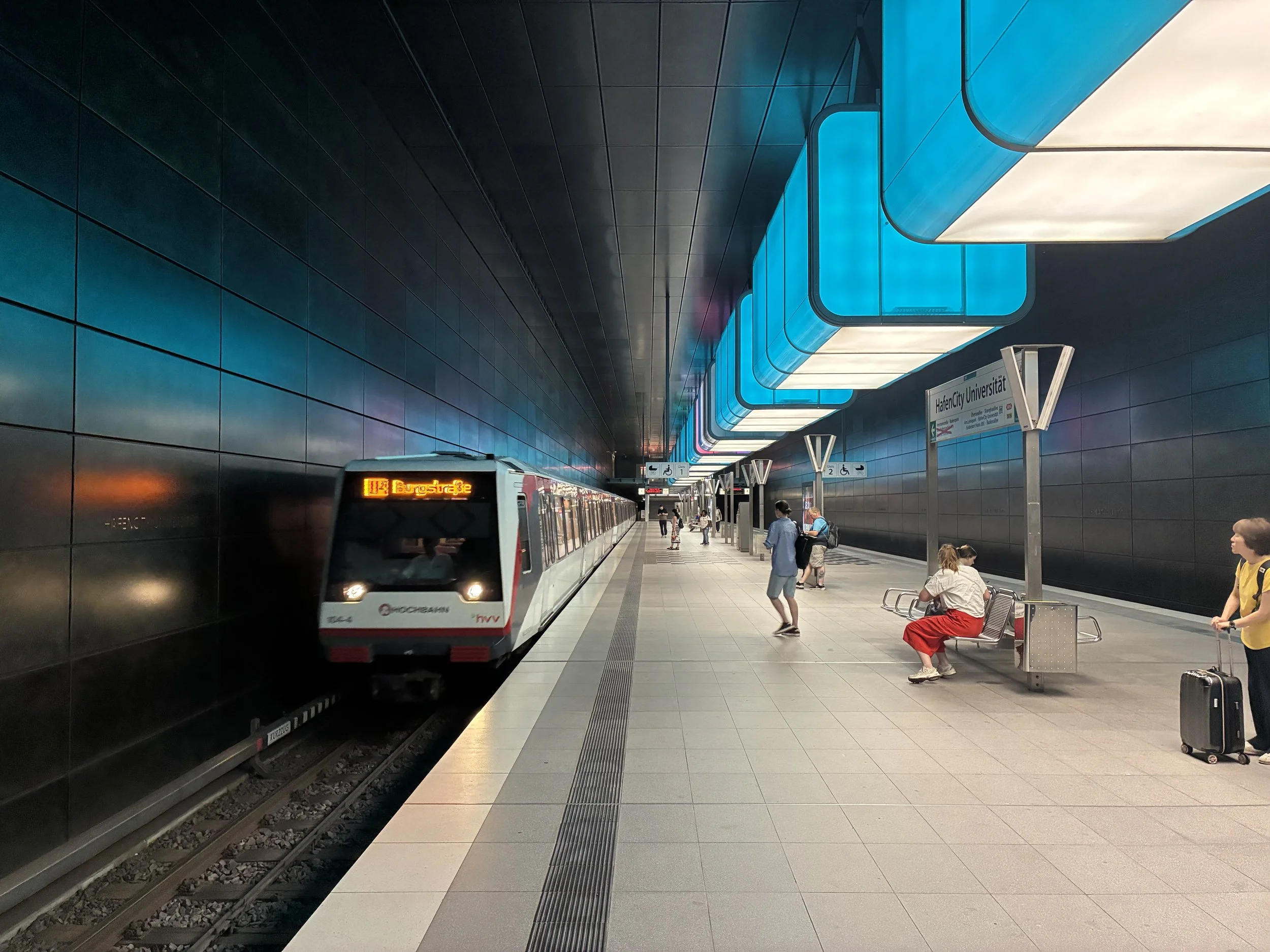
This is line U-Bahn extension of line U4, designed to enable HafenCity, which 45,000 people work.
The nearest (non-London) British equivalent to HafenCity is MediaCityUK in Manchester. Which is connected via a tram line and therefore totals 7,000 jobs.
Which is still better than nothing, which is what a lot of former industrial land has in terms of jobs.
A Metro unlocks a lot of jobs, a tram unlocks some jobs and nothing unlocks none.
You get what you build for. It’s actually very simple.
Travelling around Hamburg is a simple reminder that modern, integrated economies require modern, integrated transport.
Here’s Hamburg’s transport map:
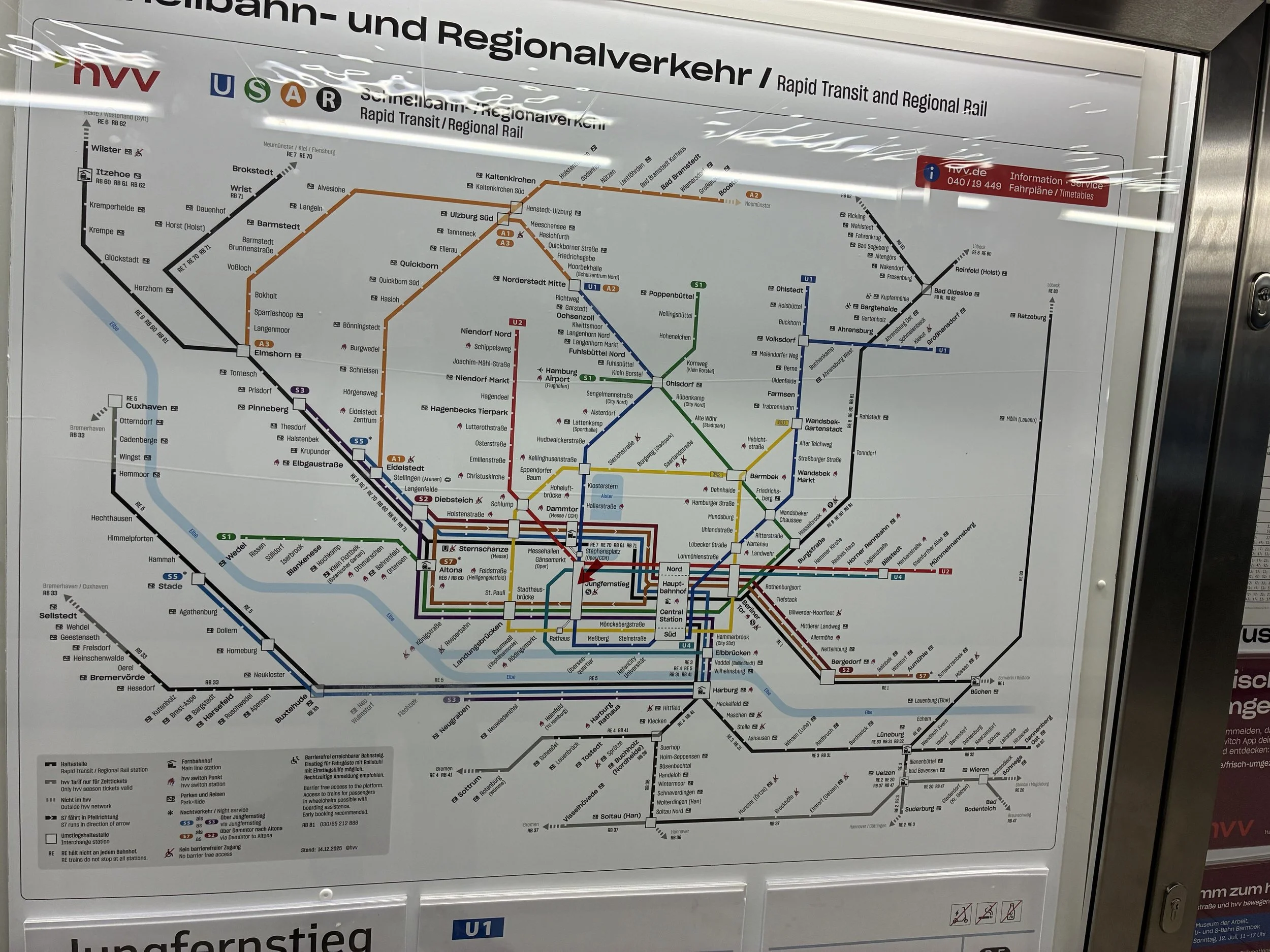
Even if we ignore high-frequency regional rail, and just focus on the U-Bahn and S-Bahn, we can see the difference between Hamburg and Manchester.
The U-Bahn and S-Bahn are both what we’d call Metro services: very high frequency and very high capacity. Here’s a photo of the S-Bahn to give you a sense:
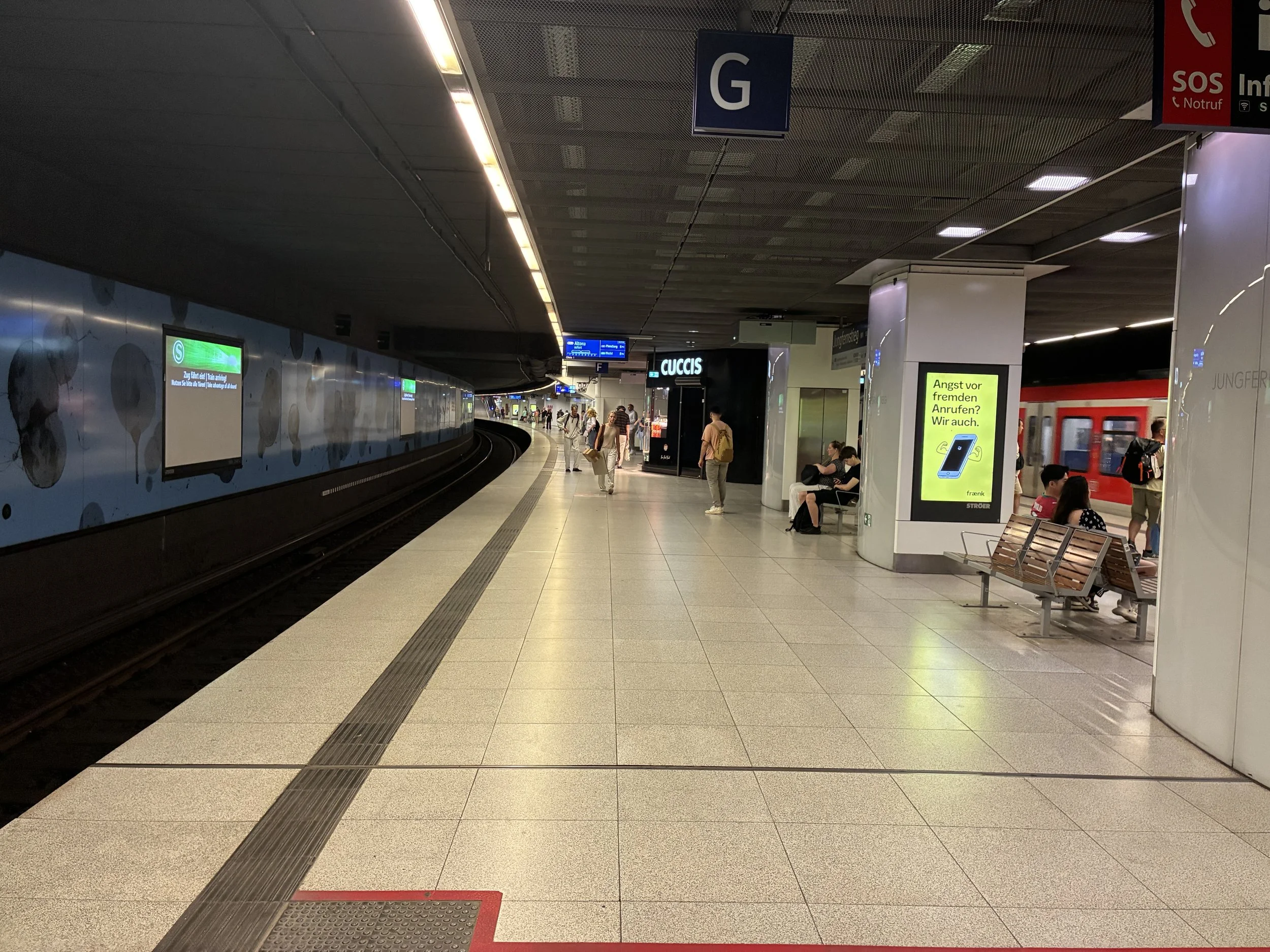
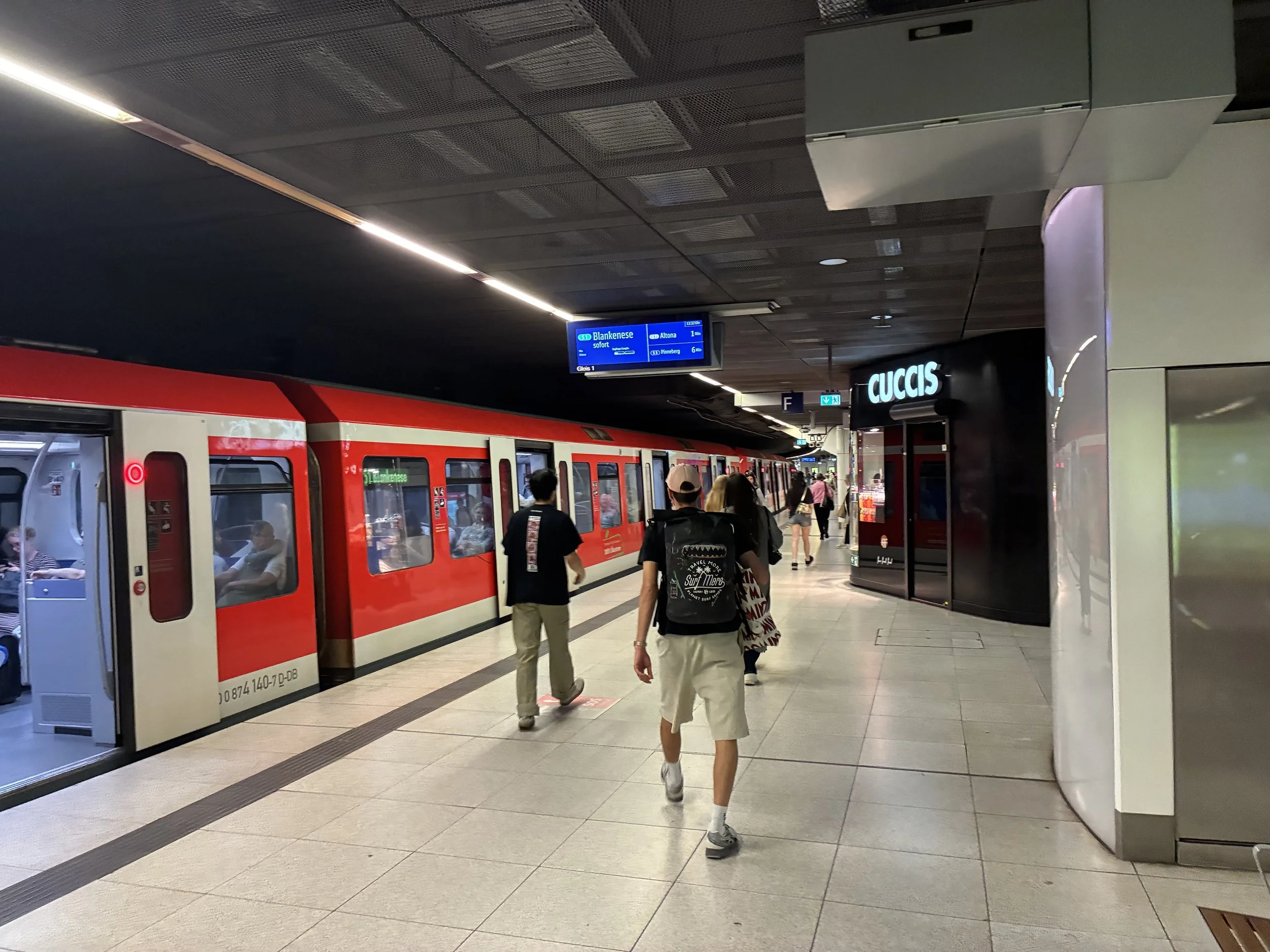
A full-length S-Bahn train has nine carriages and the combined U-Bahn and S-Bahn networks cover 157 miles. The S-Bahn carries 227 million passengers per year and the U-Bahn 244 million passengers per year.
By contrast, Manchester Metrolink is - by far - the most successful example of public transport development outside London. A full-length service has two tramcars and the 64 mile network carries 49 million passengers per year; just over 10% of the combined total of Hamburg’s networks (I realise there’ll be a bit of interchange duplication).
This comparison shows just how far Manchester is from what is needed. Our ambition is just on the wrong scale.
And Manchester’s where we’re doing this stuff best! Let’s not even try comparing Hamburg with Sheffield, Leeds, Bristol or Birmingham.
Lessons from Hamburg
There are many.
The first is that high-quality public transport is how European cities become rich.
The second is that this can be achieved even in cities with British population densities. The population density of Hamburg is almost identical to that of Greater Manchester (just over 6,000 per square mile).
The third is that we need to massively invest in urban rail for our second-tier cities. We’re decades behind where we need to be, and that’s why our second-tier cities are poor.
The fourth is that Hamburg was right to do integrated transport in 1966. Fifty years on, we’re just catching up. Let’s keep going and even try to overtake. It’s going to take my children’s lifetimes for us to catch up on infrastructure, but we could do integration even better than they do if we just tried.
So let’s start.