A Tale of two Commutes
Why does UK productivity outside London lag behind both London, and the European average?
For a Government focused on economic growth, it’s a crucial question.
Look at this graph: each place in the UK is represented by a blob, showing whether that place has above or below average productivity. As you can see, virtually everywhere in London and the South East is above average; virtually everywhere in the rest of the country is below average. (The outlier in the South West is Swindon - unambiguously part of the South East economic area).

What is going on?
Well, allow me to present to you two peak hour commutes of 8 miles from a suburb to a city centre.
Both were by me, last week.
One was last Wednesday when I was invited to speak at the Transport AI conference in Manchester and stayed the night before with my brother-in-law in Ellenbrook, Greater Manchester.
The other was the next day from my home in Walthamstow to the City of London.
Let’s see if this gives a clue as to the productivity gap.
ELLENBROOK TO MANCHESTER - Wednesday 5th February 2024:
Ellenbrook should be one of the best-connected places in Greater Manchester as it is on the £122 million Leigh - Salford - Manchester Guided Busway that opened in 2016.
I get to the stop on Wednesday at about 0745, and a bus comes immediately. Good start:

The busway looks good, doesn’t it!
Unfortunately, the busway stops in Ellenbrook, 8 miles from the centre of town.
So if you’re going into Manchester, the bus promptly joins the local road network.
Here’s what happens next:

Hmmm. Google maps is predicting the bus will take over an hour to do the 8-mile journey.
From my experience of this route at rush hour, that’s optimistic.
I’ve written about why that is previously.
So I decide to get the train.
Unfortunately, there isn’t a train from Ellenbrook.
Indeed, the guided busway took over the old railway line. So I decide to walk, appropriately enough, to Walkden.
It’s a 20-minute walk from Ellenbrook.
I walk to Walkden on the road but it’s easy to walk to Walkden because of all the closed railways in the area.
Like this one:

This connected Eccles to Bolton via Walkden but closed in 1969 under the Beeching axe.
It’s a shame really. More trains might mean that the road I’m walking on (from which this photo was taken) wouldn’t look like this:

Seems to be as much traffic here in Walkden as there was in Ellenbrook.
I feel sorry for all the drivers sitting in traffic.
And all the passengers on the bus.
But I’m off to the station.
And I make it with plenty of time to spare for my intended train, the 0813:

I’m only going to Manchester but the train is going to Leeds.
That’s great! Greater Manchester and Leeds should be one economic area.
Someone in Walkden is able to commute to work in Leeds on a direct train!
Economic integration in action!
Oh… wait… it takes two hours to get there…
Oh.
Ah, here comes the train.
But it’s only two cars long. I don’t think that’s gonna be big enough for everyone waiting:

I was right.
It wasn’t big enough for everyone.
These people didn’t get on:

Poor things: it’s 30 mins to the next train.
If you’re trying to get on the 0813 into Manchester, it’s because you need to be in work by 9. They’re going to be late for work.
I made it on. But it’s packed:

This is an unpleasant ride!
And we’re late.
The train was on time into Walkden, but we lose a few minutes at each station due to people trying to squeeze onto the train.
By the time we reach Manchester Victoria, we’re ten minutes late.
I’m on my way to a conference, so the fact we’ve arrived late isn’t an issue for me: the registration period is 0900 to 0930, so I’m on time.
But even some of the people who caught the train will be late for work.
The people still on the platform will be later still.
And the people on the bus will probably be late.
Of course, most people from Ellenbrook wouldn’t consider using public transport to reach Manchester; they’ll drive.
And here’s what Google Maps was showing them at the time I set off to walk to Walkden:

Let’s be honest: there are no winners here.
Everyone’s journey is slow and late.
And this is one of the few corridors in Greater Manchester to have received serious (£122 million) of public transport investment in the last decade
WALTHAMSTOW TO THE CITY OF LONDON - Thursday 6th February 2024:
I walk to Walthamstow Central station.
The train is on time. I might not get a seat but there’s no doubt I’ll get on; there are 8 carriages:
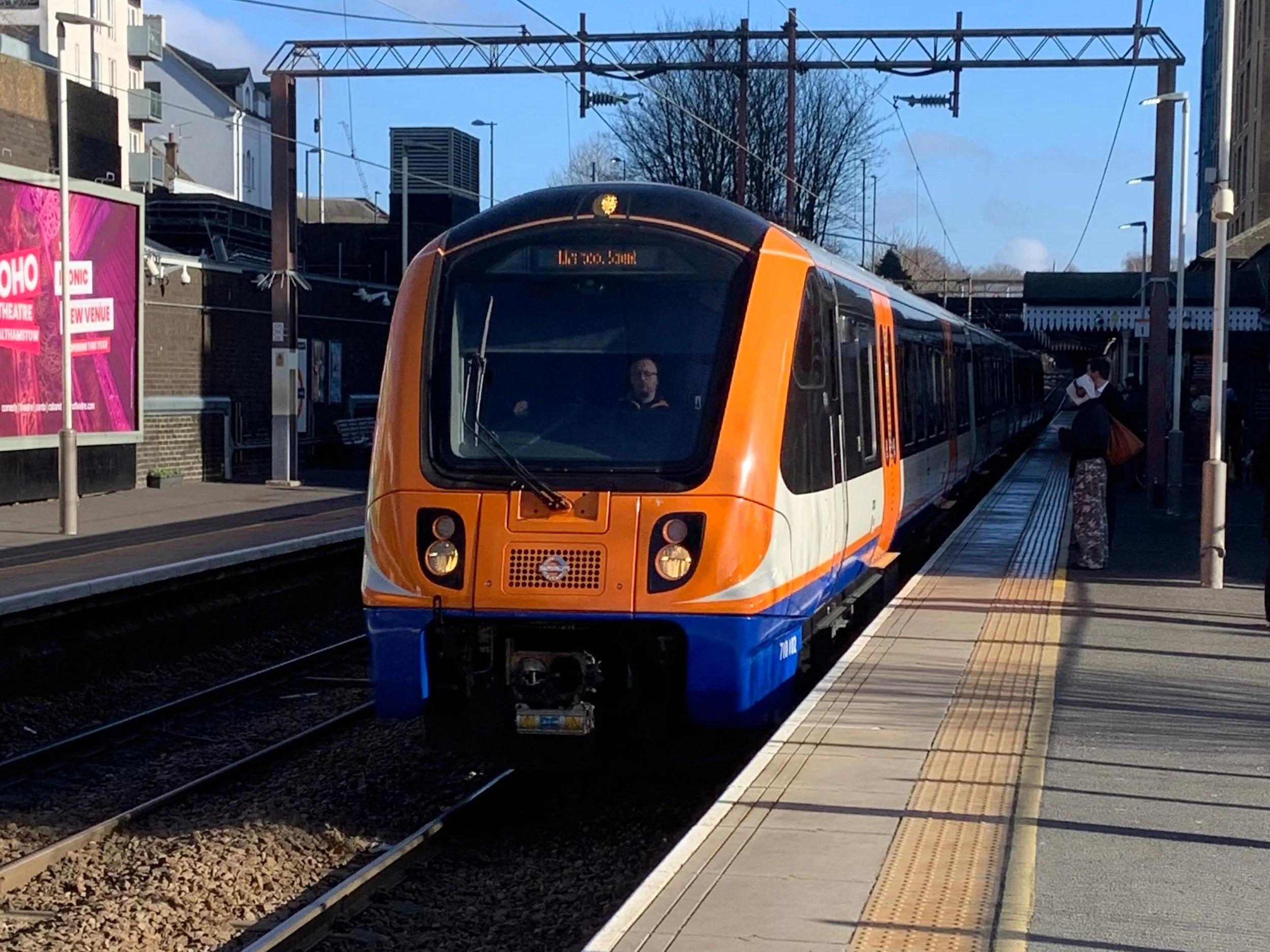
20 minutes later, I’m at Liverpool Street:

I got the Overground, which only runs every 15 minutes. But I could have got the Victoria line, which runs every 2 minutes.
What that means is that (assuming the other train from Walkden was a four-car), there were 426 rail seats in the hour from Walkden to Manchester, and 10,152 rail seats in the hour from Walthamstow to London. Even if both Walkden trains had been fully-formed, the difference would still be more than 1,000%.
The Productivity Gap
Why does this explain the productivity gap?
Well, at the most basic level, from my experience on Wednesday, there’s no good way to commute into Manchester. Trains are overcrowded, buses and cars are congested. So people’s time is wasted.
That creates a disincentive to commute: and it’s the high-productivity knowledge-based jobs that tend to congregate in city centres.
And if you do want to be a knowledge-based high-income worker, you probably don’t want to start and end every day with a miserable commute. So maybe you’ll move.
And if you’re an employer looking to set up a knowledge-based business, you won’t do it somewhere that people aren’t going to want to commute to.
Hence why both young people and young businesses end up moving to London.
The human impact of an unpleasant ride is hard to measure, but some of it is very measurable:
Here’s a TravelTime map showing where I can reach from my house in one hour:

I can commute to anywhere in London, more or less, giving me vast choice of potential jobs - and giving all those employers access to a vast range of skills.
Here’s where my brother-in-law can commute to by public transport from his house in Ellenbrook, to the same scale:

It’s a much smaller area, despite the wider North West being packed with places. He lives on the Liverpool side of Manchester but can’t get to Liverpool. He can’t even get to Warrington, just down the road. His skills can be deployed for fewer firms, and firms have access to fewer skills.
These are repeated across the country outside London.
Funding
None of this is any criticism of Northern Rail or Transport for Greater Manchester: this is a result of many decades of decision-making. (or, too often, no decision-making)
But it’s a golden opportunity for a Government that wants growth.
The announcement of the expansion of Heathrow has demonstrated that this Government is willing to commit to transport infrastructure projects that will not deliver results for decades as they are a signal to the market.
Why did they choose Heathrow? Well, probably because someone else will pay for it. The Government is terrified of increasing borrowing and this causing an interest rate spike.
But while it feels somewhat inappropriate for me (a transport innovation chap) to be offering views to HM Treasury on the bond markets, I think they’ve got this one wrong.
The Government seems to regard the bond markets as police officers who’s job it is to prevent the Government spending more than they earn.
That’s not what they are.
They are investors.
If they lend money, they want to be sure of getting it back. So if a Government seeks to borrow money to - for example - pay for a pension triple-lock or make unfunded tax cuts, then there’s no reason to think that this will expand the productive capacity of the economy. So what will the future Government use to pay back the debt? Hence why they want a higher rate of interest.
But if the Government borrows money to transform the productive potential of the North West by starting a multi-decade transport infrastructure programme, it’s apparent how this increases the productive capacity of the economy and where the tax revenues to pay back the investor will come from.
Investors want to invest. It’s literally their job. They just need a viable business plan that they can understand.
Last week I told you about the extraordinary expansion of the Paris Metro.
Borrow to invest
Ever since George Osborne attempted to claim that the collapse of Lehman Brothers in New York was caused by Gordon Brown’s borrowing, there’s been a sense that borrowing = bad.
And given that the effects of the financial crisis, Covid and Liz Truss have caused our national debt to skyrocket, that’s - in some ways - not a bad thing. Governments need to stop borrowing to pay ordinary bills.
But it’s very similar to a business.
A bank won’t lend you money to give your staff a payrise, but they will lend you money to build a new factory.
Last week, I told you about the staggering scale of transport investments being made in Paris.
Here’s how they’re being paid for:

Yup, they’re borrowing the money. Not all of it, but much of it.
Investors are willing to lend because they can see the economic potential of a greater Paris.
Borrowing is not a dirty word: it’s what every business does to make investments to increase earnings potential.
Ambition
There’s no good going to the bank and saying “I’d like to borrow money to repaint the factory”. They’ll assume you can do this from working capital and they won’t see why it helps.
Many of our small transport projects - on their own - don’t move the dial on the kinds of incentives I described above.
But layered up as part of an ambitious vision for transport in a city region, it’s possible to see how - in a couple of decades’ time - the productivity of a region could be transformed.
Our cities need to create the kinds of long-term ambitious plans that can convince a sceptical bond investor that - if delivered - their plans will generate transformational economic growth. And then the Government needs to be ready to back them.
We know this can be done. Crossrail cost nearly £20 billion. The money was available because TfL spend the early part of the 2000s putting together an economic case centred around growth.
The good news is that the Combined Authorities now have the political legitimacy and the energy to do the same.
I recently helped facilitate the Innovation Awayday of the Metro Mayors (Andy Burnham, Tracy Brabin, etc). I was really encouraged. They were positive, energetic, outcome-focused and impressively non-siloed in their thinking.
We’ve all got used to a certain fatalism: that nothing is possible. The existing Greater Manchester Transport Strategy is anchored around an assumption that HS2 and Northern Powerhouse Rail both are delivered in full - as was being explicitly promised by the Government just five years ago. It’s depressing.
But it doesn’t change the fact that the only way of delivering growth is to change that graph at the top; and that won’t be achieved unless our cities are backed to become places people can get around.
Don’t ask, don’t get…
I’m away for half term next week, but the week after, I’ll tell you what the French provincial cities are up to!

How Can I Help You?
👋 I'm 𝗧𝗵𝗼𝗺𝗮𝘀. I help organisations like yours drive 𝗶𝗻𝗻𝗼𝘃𝗮𝘁𝗶𝗼𝗻, deliver 𝗰𝗵𝗮𝗻𝗴𝗲, and achieve 𝗳𝗮𝘀𝘁𝗲𝗿 results, drawing on 20 years of leadership across public and private sectors.
🚀 I offer 𝘀𝗽𝗲𝗮𝗸𝗶𝗻𝗴, 𝗺𝗲𝗻𝘁𝗼𝗿𝗶𝗻𝗴, and 𝗰𝗼𝗻𝘀𝘂𝗹𝘁𝗶𝗻𝗴 that energise teams, shape strategies and remove barriers to change. Whether you aim to accelerate innovation, drive change, or inspire your people, I’m here to help. Let’s talk!