Why Was No MP Capable of Being Prime Minister?
A post about the flaws in how Members of Parliament are chosen
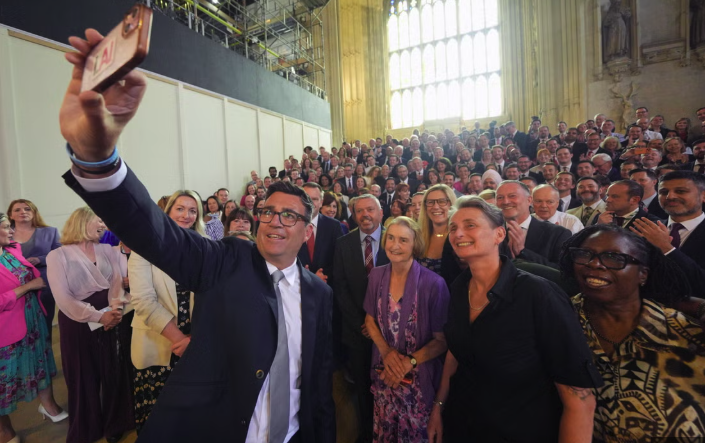
How can it be that, without Andy Burnham, Labour seemed doomed?
How can a party with 403 MPs not have had a single candidate able to beat Nigel Farage without bringing someone in through a by-election?
The answer is about how we choose the people to go to Parliament to make the laws by which we must all live.
What I’m able to tell you is a true story and one that reveals something very worrying about politics.
But that also means that fixing it is a huge opportunity.
Andy Burnham has already made a speech about his commitment to devolution. Earlier in the month, he promised to fundamentally change the whipping system and to reform Parliament.
The guy’s on a roll and there’s just one more bit he needs to add into the mix to solve the underlying pathologies of our politics.
It’s about how MPs are chosen.
Decision-making matters
One of the anchor principles of my work is that outcomes are driven by the way institutions make decisions. It’s why I spend so much time talking about decision-making with Exec teams. I’ve even created a card game about it.
What this story tells us is that the way political parties make decisions has been deeply, deeply flawed. I hope Andy Burnham could be the man to fix it.
This post is about the Labour Party, but it could just as easily be about the Tory Party. Reform has different flaws.
My Friend’s story
In the run-up to the 2024 election, a close friend of mine decided to stand for Parliament. I’m not naming her in this post, but this is a true story.
The reason she decided to run was that 2024 was the first time in her lifetime when her home counties seat would be competitive. It’s normally a safe Tory seat. She is a Labour Party member and wanted Labour to win.
So she decided to stand.
She was well aware that she was a long shot. She was not a political insider. She had joined the Labour Party decades ago, but did not go to its meetings. She spent her time doing her job and raising her family. Like most of us.
The front-runner to be the Labour candidate was a 23-year-old politics student. Unlike my friend, he was deeply embedded in the local constituency Labour Party, and well-liked by them. He was very well networked with the trade unions. She expected that, when the vote came, the local members would be likely to vote for him.
But she also felt it would be good for them to have a choice.
Who’d make a good MP?
Her CV was exemplary for a potential legislator. Again, I won’t link to her LinkedIn profile, but her 30-year career was a mix of economic regulation, healthcare regulation and private business. She had spent time working in law and has recently been working on the ethics of AI. She’s someone I’d like in Parliament.
I wrote her a website, which she published. It was not hard to demonstrate why she’d be a great local MP and a great legislator (even if she wasn’t currently well-connected in the political world).
She applied. She specifically chose only one seat to run in: the commuter town where she’s lived for 25 years, where her two kids are in school, where she’s a school governor and from which she commutes. She’d be a true local MP.
For those not close to the process, the way candidate selection works is that local party members vote on who they want as their local MP. (The reason Andy Burnham had to be approved by the National Executive Committee to run in Makerfield is because it was a by-election, and because he’s a sitting Mayor. Normally, the local party decides these things by a membership vote).
She started campaigning among the local party members and began to do quite well. Some of the frontrunner’s team even swapped sides to support her instead.
She still felt like she was a long shot when the selection vote came, but she also felt like she had momentum.
The next stage was the vote of the local party members.
But the one thing missing was a date for the actual selection vote to take place. By now, she would have expected to know the date of the hustings and resulting ballot.
But there was silence.
“Can you talk?”
Then, one Friday evening, as she was having a meal in Wahaca, she got a text message from someone in the regional Labour party. “Can you talk?”, it asked.
Not wanting to talk about this kind of thing in a restaurant with her kids, she replied asking for an email and said she’d call back.
The email didn’t come through until Saturday morning.
It didn’t say anything about the selection process for her constituency. It didn’t even mention it. It said that she had been selected for another constituency two and a half hours away by train.
This was very odd.
She had not applied to be a candidate there. She had no connections with it. She didn’t want to be MP for somewhere she didn’t know. Moreover, that place is an ultra-safe Lib Dem seat. She was being offered a seat that she didn’t want - and had zero chance of winning.
Remember, her expectation (as per the process) was that there would be a vote of the local members where she lived and instead she’d been gifted an unwinnable seat without a ballot.
The 23-year-old, meanwhile, had been gifted the seat that they’d both been contesting.
She arranged a call with the regional Labour person to try to understand what on earth had happened.
The answers she was given did not clarify matters.
She was told that the Regional Panel had made a decision to directly select for some constituencies without having selection votes.
She asked why they had made that decision. There was no clear answer. She asked when they had made the decision. There was no clear answer. She asked who was on the panel. She was told it was confidential. She asked what criteria they had used. She was told there weren’t any. She asked how it was decided that, for example, she got the safe Lib Dem seat and the other candidate got the seat they’d both applied for.
Again, no clear answer.
She asked how she could challenge the decision, given the complete absence of process, criteria or adherence to the rulebook. She was told that she could not as it was “too far gone”. (This on the Saturday morning after she received a text message on Friday night).
On Monday, it was announced to the media that her rival “had been selected”. There was no reference to the fact that no selection event had taken place. After months of delay, she didn’t have a single working day to review or challenge this entirely opaque decision.
According to the Labour party rule book, there’s no need for a vote if there is “no suitably qualified person” to contest it - but how could that be the case this time?
Firstly, my friend is an eminently qualified person (more so, I would argue, than the person who was gifted the seat - an argument that she was successfully making locally).
Secondly, if the view of the Labour party was that she was not a suitably qualified person to be put forward for a selection vote, how can she have been gifted another seat without any kind of selection at all?
I cannot know for certain what happened, but this looks - from the outside - like one Labour party insider organising a stitch-up for another Labour party insider.
Insiders’ clubs
This matters because being an MP should be a job accessible to all.
It certainly shouldn’t be the case that the system is so opaque that a highly qualified candidate can be prevented even from being considered.
With trust in politics as low as it is at the moment, it’s desperately harmful to our democracy for politics to be an insiders’ club in which those in the know rig the rules to suit themselves and their mates.
This is, I’m afraid to say, very much what this experience suggests is currently happening.
Now, I’d like to make it clear that this is not just a Labour Party problem.
Indeed, Rory Stewart - in his book Politics on the Edge describes near-identical situations in the Tory party.
This shows that both the two main parties have become insiders’ clubs in which people who are willing to devote their lives to the party (including as a teenager, as the 23-year-old had been when he got involved) will have the path cleared for them at the expense of people with experience of life outside politics. That makes for bad Government and, ultimately, will rebound on the parties.
In fact, I would argue that we’re currently living through the effects of that rebound taking place.
When you listen to the radio and hear endless ministers all sounding the same - well, maybe it’s because they are.
Why am I telling you all this?
We all need the Tories and Labour to succeed. Even if you support the Greens or Reform, it’s healthy for the parties with experience of Government to be credible.
For that to happen, they need to be capable of internal renewal.
I know that some of my readers are politically connected.
Please share this story with people you know with influence.
The two main parties have just suffered a near-death experience. Labour and Tory, between them, won just 34% of the vote in England (on a national basis) at the local elections. Wales and Scotland were far worse.
They urgently, urgently need renewal.
With a new leader of the Labour Party, now is the moment for him to instruct the insiders to take the tough decision to open up their club.
Genuinely, until this happened to one of my best friends, I had no idea the extent to which the parties rigged the system for their mates.
For the sake of all of us, they need to stop.
Andy, over to you.