Autonomous Vehicles Aren’t That Special
Back in June, I gave evidence to the Transport Committee of the London Assembly on Autonomous vehicles on Tuesday and to the Transport Select Committee of the House of Commons on integrated transport on Wednesday.
The coincidence of days was pure fluke.
The topics, however, are interesting as, at first glance, they look to be entirely separate - but I’m going to argue in this blog post that they’re not. In fact, they’re all one big debate.
The purpose of transport
At its heart, transport has a simple purpose: how do we connect as many people as possible to as much opportunity as possible, while doing the least possible harm along the way?
After all, connecting people to opportunity is why we’re all here.
Even if our own company’s incentive structure is profit or politics; the connection to opportunity is our purpose.
But what about the harms?
Well, transport generates a lot of them.
It costs money, generates carbon emissions, poisons the air, consumes a vast amount of space and pollutes tranquil spaces with noise.
Transport policy is about how we get the most connection to opportunity with the least harm.
That is the basic equation of all our work, whether or not you’re talking about autonomous vehicles or integrated transport.
Answering the wrong questions
The trouble with the autonomous vehicle conversation is that it often stops at the question of whether they are safe, and somehow never arrives at the question of whether they are useful.
You wouldn’t do that with any other piece of technology.
If you walked into Currys and simply chose an appliance based on whether it was safe (without considering whether it did the job you wanted), you’d end up trying to do your printing on an air fryer.
Safety is a crucial question for autonomous vehicles but it’s not the only question.
Safety is also a crucial question for trains, buses, cars and all other transport modes. But we don’t stop at safety - we also develop wider policy based on the outcomes we want.
That’s also what we need to do for autonomous vehicles.
"Autonomous vehicle" doesn’t mean "robotaxi"
Too often, when we say "autonomous vehicle", we picture a robotaxi - probably operated by Waymo or Uber. Without making a proactive decision to do so, we’ve let a handful of tech firms’ models become our mental model for an entire technology.
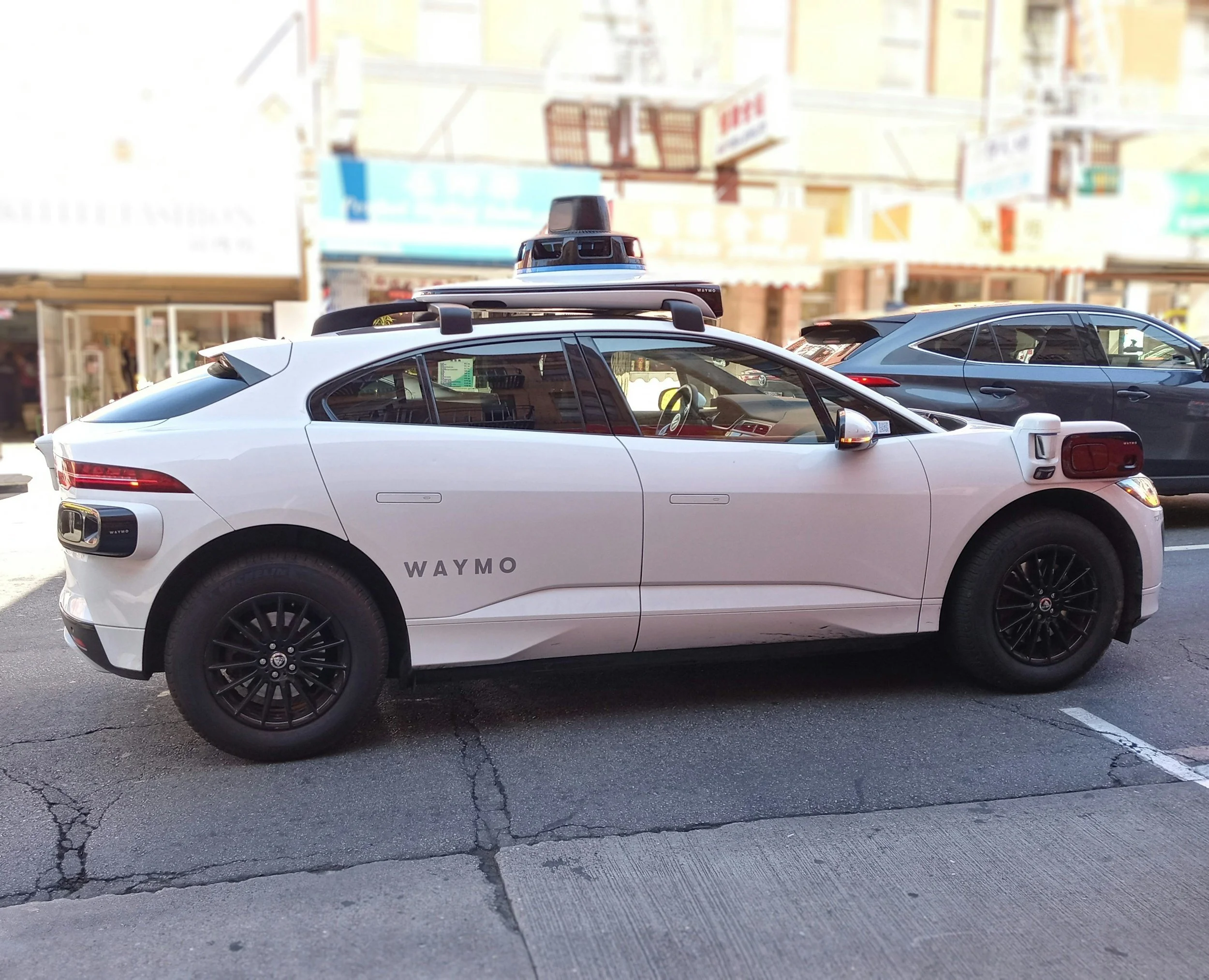
Instead, we need to think about Autonomous Vehicles as being a category a bit like “Petrol vehicles” - a much wider technological category.
We wouldn’t treat all petrol vehicles with the same rules.
A petrol bus in central London is subject to a totally different set of rules and policy frameworks to a petrol car in Herefordshire, because it does a different job.
Nobody in their right mind would take just one model of “petrol vehicle” and assume it needs just one regulatory model, yet that seems to be the standard tone of the debate on AVs.
This is important because policy choices can result in very different outcomes for a vehicle category.
In central London, more people use petrol buses than petrol cars. By using very large vehicles that carry dozens of people, London’s been able to maintain a productive, commuter-based economy without changing its pre-petrol vehicle street layout.
By contrast, Abu Dhabi focused on petrol cars not buses, built ten-lane motorways and almost no public transport at all. That has resulted in a much more dispersed urban layout.
A “Petrol vehicle” can do different things and drive very different city outcomes. The same will be true with autonomous vehicles.
It’s about transport policy
A robotaxi in Soho is, on the whole, a bad idea. It is yet another vehicle, carrying one or two people and quite often nobody, added to some of the narrowest, most congested streets in Britain. At its best, it is Uber all over again, without the thing that constrained Uber: the supply of human drivers.
A driverless shuttle carrying people from a thinly populated suburb to their nearest station is, on the whole, a rather good idea, and it is more or less what Oslo is doing. Ruter, the city's transport authority, runs the largest experiment of its kind in Europe, running small autonomous vehicles through the low-density edges of the city and into the rail network. They carry Ruter's livery, you summon them through a Ruter app, and they are part of the public transport system.
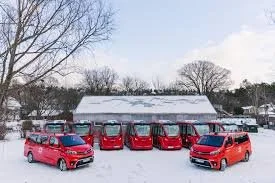
Ruter’s autonomous vehicles in Oslo
I have ridden in one, and I can report, as the very highest praise, that it was boring.
Now look again at those two examples and notice what is most important. It’s not actually about the lack of a driver.
A private car in Soho, with a flesh-and-blood human at the wheel, is a bad idea, for all the same reasons. A bus in Trafalgar Square, with a flesh-and-blood human at the wheel, is a good thing. So is a bus winding through a village in the Derbyshire hills, which is the whole point of Mini Switzerland, the demonstrator of rural transport integration in the Hope Valley. If you live on a farm, then a private car is essential.
Autonomous vehicles are just another type of vehicle, which can be helpful in some places and deeply harmful in others. They slot into the same question of maximum connectivity for minimum harm.
Unfortunately, DfT appears to be have been dazzled by a made-up number. When they launched a partnership with Wayve for a robotaxi trial, they announced that it would be worth £42 billion to the economy. That figure was picked up by the BBC.
£42 billion?! Seriously?!
AV expert Tym Syrytczyk kindly responded to my bafflement and went and found where that figure had come from. It turns out to be a pre-pandemic estimate for a British AV car-manufacturing industry, dusted off and stapled to something it has nothing to do with. One of the politicians at the Assembly quoted an even bigger number: £66 billion and 342,000 jobs. Making the numbers bigger doesn’t make them more real.
The only question that matters
London is the only corner of the United Kingdom that matches the productivity of a comparable European city, and it is, by no coincidence at all, the only corner with a properly integrated public transport network.
London’s transport network succeeds in connecting people to opportunity in a way that Sheffield’s does not (yet! - the team at South Yorkshire CA are determined to change that).
The way that AVs will contribute to the economy is if they improve access to opportunity; for example, by connecting low-density suburbs to the mass transit network.
Conversely, they could be actively harmful to the economy if, for example, they increase traffic congestion, which is perfectly possible.
If we have a handful of Uber-style vehicles at Uber's prices, their contribution will be, give or take, nothing.
It’s Just Another Mode
AVs need a new safety rulebook but they don’t need a new policy approach: we know how to deal with transport modes.
We are perfectly good at treating different vehicles differently when they fulfil the mission in different ways; hence why the regulatory regime for buses, trains and taxis is different today.
The crucial thing we need to do is focus on where AVs help us achieve our goals and where they don’t - and then regulate accordingly.
What will maximise access to opportunity with the least harm? That’s the question, as it always is.